
California Real Estate Case Studies
Court decisions explained by a Glendale real estate law firm
Each case study explains a published California or federal court decision, statute or resolved dispute: what happened, what the court decided, and what it means for property owners, buyers, sellers, landlords, tenants and businesses in Glendale and across Los Angeles County.
Latest case studies
Cases 1 to 9 of 23, newest first
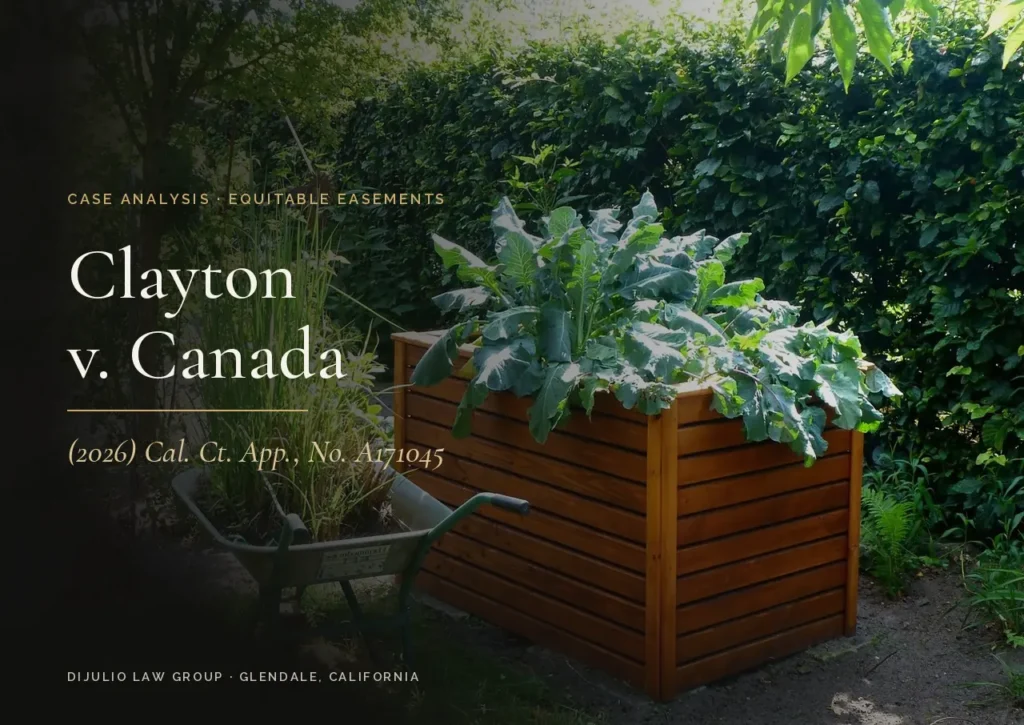
Clayton v. Canada (2026)
Buyers kept an exclusive equitable easement over a walled garden inside a neighbor's deed, based on an unrecorded 1955 agreement between the prior owners.
Easements and boundariesCal. Court of Appeal (unpublished)
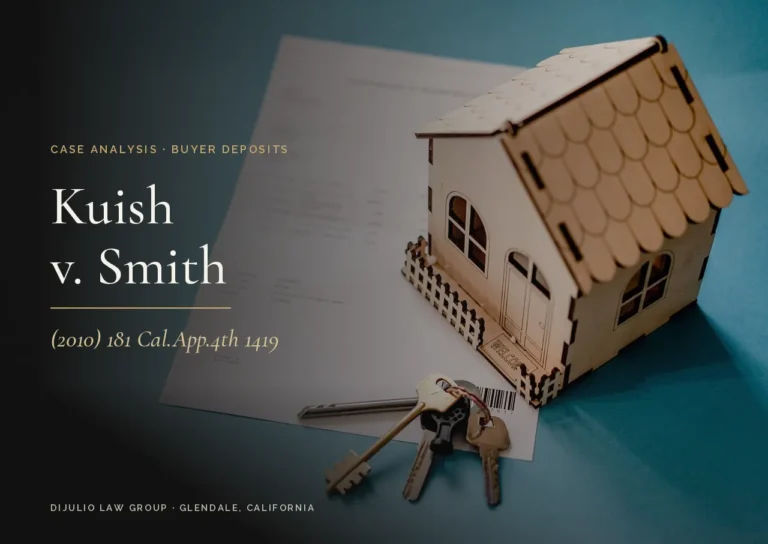
Kuish v. Smith (2010)
A seller who resold for $1 million more could not keep a $600,000 "non-refundable" deposit, because keeping money beyond actual damages is an invalid forfeiture.
Purchase, title and foreclosureCal. Court of Appeal
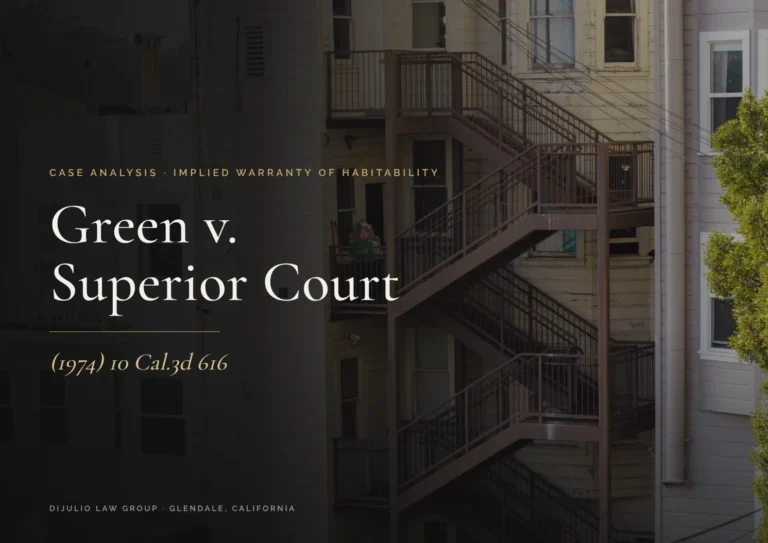
Green v. Superior Court (1974)
Every residential lease carries an implied warranty of habitability, and a breach can be raised as a defense when a landlord sues to evict for unpaid rent.
Disclosure, mold and habitabilityCal. Supreme Court
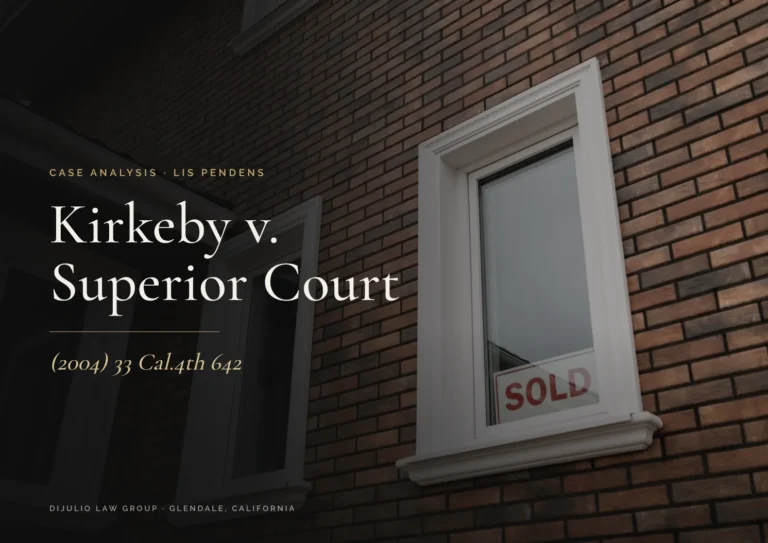
Kirkeby v. Superior Court (2004)
A claim to set aside a transfer of real property supports a lis pendens, even when most of the lawsuit seeks money.
Purchase, title and foreclosureCal. Supreme Court
Montecito Country Club v. Root (2026)
Owners who moved a hedge to the property line and improved the strip behind it were ordered to remove the work, and the court addressed the burden of proof for prescriptive easements.
Easements and boundariesCal. Court of Appeal
Yvanova v. New Century Mortgage (2016)
A homeowner may challenge a void assignment of the deed of trust in a wrongful foreclosure suit after a trustee's sale.
Purchase, title and foreclosureCal. Supreme Court
Holguin Family Ventures v. County of Ventura (2024)
A grandfathered use may continue, but it cannot be expanded or converted to a new principal use without the permit the current code requires.
Zoning and land useCal. Court of Appeal
Nellie Gail Ranch Owners Assn. v. McMullin (2016)
Owners who built a wall and yard on association land lost their adverse possession claim on the property tax element and were ordered to restore the slope.
Adverse possessionCal. Court of Appeal
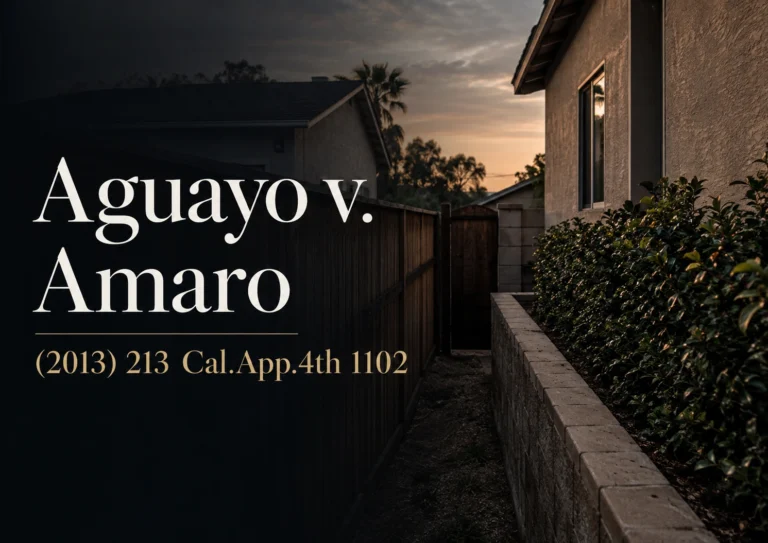
Aguayo v. Amaro (2013)
A claimant who met every element of adverse possession still lost the house because the unclean hands defense barred the claim.
Adverse possessionCal. Court of Appeal
California easement and boundary cases
3 cases
California recognizes easements created by written grant, by implication from a prior use, and by prescription after five years of open, continuous and adverse use. Recent decisions address exclusive implied easements and the proof needed to establish a prescriptive easement.
- Clayton v. Canada (2026)Cal. Court of Appeal (unpublished)Buyers kept an exclusive equitable easement over a walled garden inside a neighbor's deed, based on an unrecorded 1955 agreement between the prior owners.
- Montecito Country Club v. Root (2026)Cal. Court of AppealOwners who moved a hedge to the property line and improved the strip behind it were ordered to remove the work, and the court addressed the burden of proof for prescriptive easements.
- Romero v. Shih (2024)Cal. Supreme CourtAn implied easement can be recognized even when it leaves the owner with little practical use of the strip of land it covers.
Related practiceEasement disputesBoundary disputes
Adverse possession cases in California
2 cases
Adverse possession in California requires five years of actual, open, hostile, continuous and exclusive possession, plus payment of all property taxes assessed on the land during that time (Code of Civil Procedure section 325). Most claims fail on the tax requirement or on equitable defenses.
- Nellie Gail Ranch Owners Assn. v. McMullin (2016)Cal. Court of AppealOwners who built a wall and yard on association land lost their adverse possession claim on the property tax element and were ordered to restore the slope.
- Aguayo v. Amaro (2013)Cal. Court of AppealA claimant who met every element of adverse possession still lost the house because the unclean hands defense barred the claim.
Related practiceAdverse possessionBoundary disputes
Disclosure, mold and habitability cases
3 cases
California sellers must disclose known material defects on the Transfer Disclosure Statement (Civil Code section 1102 and following), and an "as is" clause does not excuse concealment. Residential landlords owe an implied warranty of habitability recognized in Green v. Superior Court.
- Green v. Superior Court (1974)Cal. Supreme CourtEvery residential lease carries an implied warranty of habitability, and a breach can be raised as a defense when a landlord sues to evict for unpaid rent.
- California mold disclosure lawStatute and case lawThe 2001 mold disclosure statute never took effect, so seller liability for mold runs through the Transfer Disclosure Statement and fraud law.
- Hidden mold and a failed disclosureSettled disputeA repaired leak left off the Transfer Disclosure Statement became a concealed-mold claim after closing, and the dispute settled for $450,000.
Related practiceFailure to disclose defectsMold claims
Purchase, title and foreclosure cases
5 cases
California presumes money damages cannot replace a specific parcel of real property (Civil Code section 3387), which supports specific performance against a seller who refuses to close. Title disputes also turn on when a lis pendens may be recorded, who has standing to partition, and when an assignment is void.
- Kuish v. Smith (2010)Cal. Court of AppealA seller who resold for $1 million more could not keep a $600,000 "non-refundable" deposit, because keeping money beyond actual damages is an invalid forfeiture.
- Kirkeby v. Superior Court (2004)Cal. Supreme CourtA claim to set aside a transfer of real property supports a lis pendens, even when most of the lawsuit seeks money.
- Yvanova v. New Century Mortgage (2016)Cal. Supreme CourtA homeowner may challenge a void assignment of the deed of trust in a wrongful foreclosure suit after a trustee's sale.
- Amundson v. Catello (2025)Cal. Court of AppealHeirs could not force a partition sale while probate had not confirmed their title, and the partition judgment was reversed.
- Seller refuses to close: specific performanceCivil Code § 3387California presumes money cannot replace a specific property, so a buyer can sue to force a seller who backs out after accepting an offer to close.
Related practiceTransactional real estateStop foreclosure
Landlord, tenant and rent control cases
3 cases
Local rent ordinances in Los Angeles County operate within state limits such as the Costa-Hawkins Rental Housing Act. Courts have struck down local provisions that conflict with state law while upholding others, and commercial tenants generally remained liable for rent during pandemic closure orders.
- Apartment Assn. of Greater Los Angeles v. City of Los Angeles (2026)Cal. Court of AppealCosta-Hawkins preempts Los Angeles's relocation assistance mandate for exempt units, while the city's eviction threshold rule was upheld.
- SVAP III Poway Crossings v. Fitness International (2023)Cal. Court of AppealPandemic closure orders did not excuse a commercial tenant's rent, and the court rejected all five of the tenant's defenses.
- California Apartment Assn. v. City of Pasadena (2025)Cal. Court of AppealTwo provisions of Pasadena's Measure H were struck down, while its rent caps and just-cause eviction protections remain in effect.
Related practiceCommercial and residential leasesReal estate mediation
Zoning and land use cases
1 case
A legal nonconforming use may continue after a zoning change, but it generally cannot be expanded or converted to a different principal use without the permit the current code requires.
Related practiceZoning and land use
Construction defect cases
2 cases
For new residential construction, the Right to Repair Act (Civil Code section 895 and following) sets building standards and a mandatory prelitigation process. Courts will not enforce CC&R provisions a developer drafts to block a homeowners association from pursuing its defect claims.
- McMillin Albany v. Superior Court (2018)Cal. Supreme CourtThe Right to Repair Act's prelitigation process applies to new-home defect claims even when homeowners plead only common law causes of action.
- Aldea Dos Vientos v. CalAtlantic Group (2020)Cal. Court of AppealA CC&R clause the developer wrote to block the HOA's $5.6 million defect claim was held unconscionable and void.
Related practiceConstruction defectsConstruction law
Business, mediation and privacy decisions
4 cases
Decisions outside real estate that shape how California businesses contract, mediate disputes and handle consumer data.
- California v. General Motors and OnStar (2026)SettlementA $12.75 million CCPA settlement over driving data that GM sold to insurance data brokers without consumer consent.
- Department of State v. Muñoz (2024)U.S. Supreme CourtA U.S. citizen has no constitutionally protected interest in a spouse's visa, which left the consular denial in place.
- Cassel v. Superior Court (2011)Cal. Supreme CourtMediation confidentiality bars evidence of what was said in mediation, even in a malpractice claim against the client's own lawyers.
- Ixchel Pharma v. Biogen (2020)Cal. Supreme CourtInterfering with an at-will contract is actionable only when the interfering conduct is independently wrongful.
Related practiceBusiness and corporate lawMediation
How these case studies are prepared
Primary sources
Each analysis works from the published opinion, statute or official record, identified by court and date, with links to the full text on official court, legislative or Justia pages where it is publicly available.
Attorney review
The library is maintained by the real estate practice of DiJulio Law Group in Glendale, led by R. David DiJulio, a member of the California Bar since 1983. Most analyses cover decisions in which the firm was not counsel.
Dated, and limited
Every case study shows when it was published. Later appellate decisions or new legislation can change how a rule applies, and outcomes depend on the facts of each matter, so an analysis is a starting point, not legal advice.
Questions about the case studies
What are DiJulio Law Group's case studies?
They are plain-English analyses of California and federal court decisions, statutes and resolved disputes that affect real property. Each one explains the facts, what the court decided, and what the ruling means for owners, buyers, sellers, landlords, tenants and businesses in Los Angeles County.
Did DiJulio Law Group handle these cases?
Most case studies analyze published decisions in which DiJulio Law Group was not counsel. They are written to explain how California law applies to common property disputes, not to describe the firm's own results.
Can I rely on a case study for my own property dispute?
No single case decides your situation. Courts apply these rules to specific facts, and deadlines such as statutes of limitations can cut off a claim. Use a case study to understand the issue, then speak with a California real estate attorney about your documents and timeline.
How current are these analyses?
Each case study shows its publication date. Check that date and any status notes in the analysis, because later appellate decisions or new legislation can change how a rule applies, particularly in rent control cases that are still on appeal.
How do I talk to a real estate attorney in Glendale about a similar issue?
Call DiJulio Law Group at (818) 502-1700 or request a consultation online. The office is at 330 North Brand Boulevard, Suite 1280, Glendale, and the firm works with clients throughout Los Angeles County.

Facing a property dispute like one of these cases?
DiJulio Law Group represents owners, buyers, sellers, landlords and businesses in real estate disputes and transactions from its office on North Brand Boulevard in Glendale. Bring the documents you have, and we will tell you where your matter stands under California law.
These case studies are general information about published decisions, statutes and resolved disputes. They are not legal advice for any specific matter, and reading them does not create an attorney-client relationship. Outcomes depend on the facts of each case.