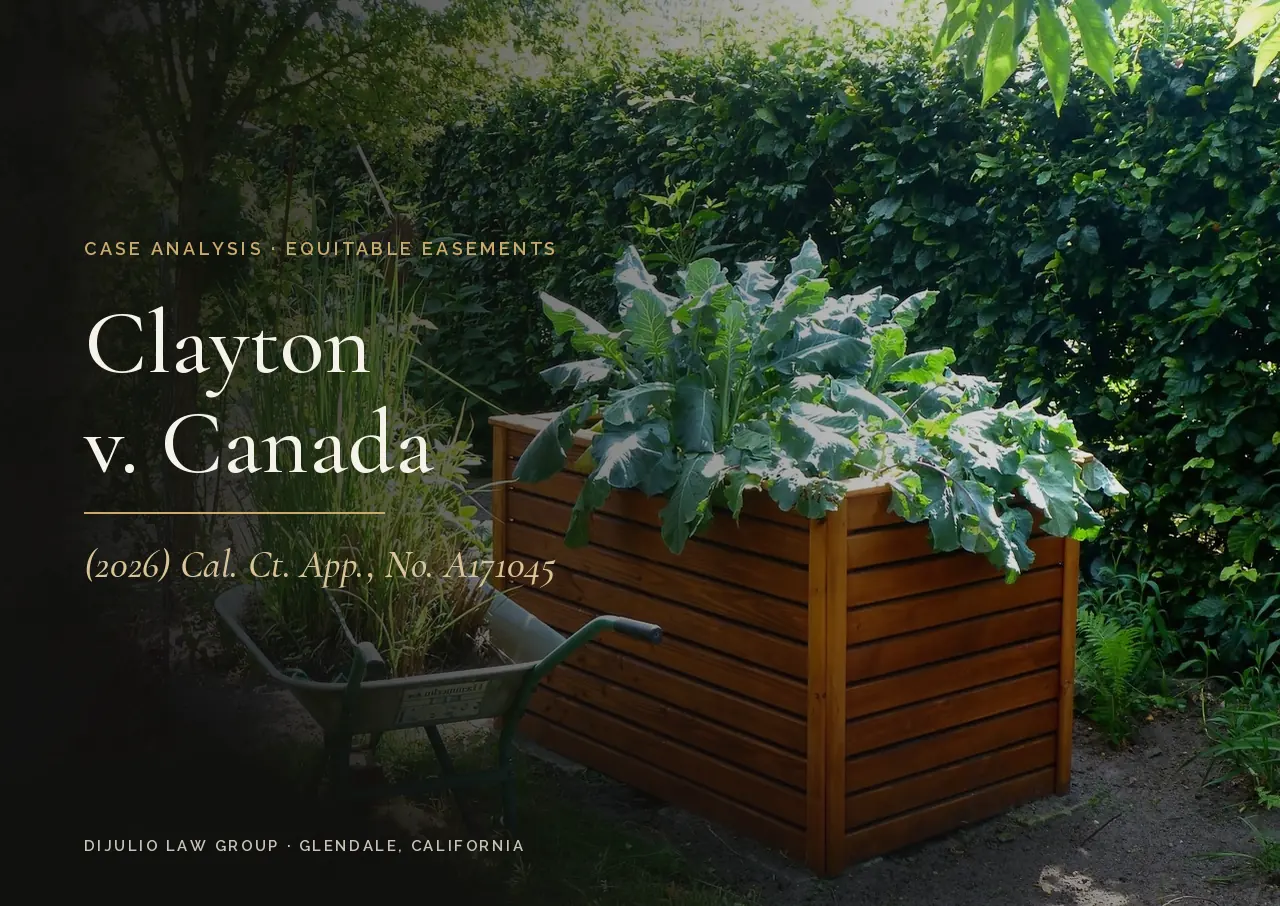
Full citation and procedural posture
Clayton v. Canada
(Oct. 26, 2026, A171045) [nonpub. opn.]
- Court
- Court of Appeal, First Appellate District, Division Five
- Docket
- No. A171045 (Alameda County Super. Ct. No. 21CV003448)
- Decided
- October 26, 2026 · Not certified for publication
- Disposition
- Judgment for the garden owners affirmed
- Doctrines
- Equitable easement · Balancing of hardships · Boundary hearsay (Evid. Code § 1323)
- Property
- A 20-by-20-foot garden between two homes on Olive Avenue, Oakland and Piedmont
Facts below are drawn from the opinion. The opinion is unpublished, so under California Rules of Court, rule 8.1115, it cannot be cited or relied on as precedent in other California cases. It is discussed here because it shows how trial courts apply published equitable easement law to an ordinary backyard dispute.
A couple bought an Oakland home in 2019 with a fenced vegetable garden they believed came with the house. A neighbor's survey showed the 20-by-20-foot plot sat inside the neighbor's deed. No recorded deed ever moved the line, yet the court let the buyers keep gardening there, because a 1955 deal between the prior owners, paid for with $250, babysitting, and the release of an alley easement, made it unjust to take the garden away.
What did the court decide in Clayton v. Canada?
The Court of Appeal affirmed an exclusive equitable easement for gardening over land the neighbors still own. The trial court acted within its discretion because the garden owners were innocent, the neighbors had no real use for the walled-off strip, and losing the garden would be a hardship greatly out of proportion to the neighbors' loss.
The court also held that statements by the deceased prior owners about the 1955 deal were admissible under the boundary hearsay exception in Evidence Code section 1323, and that a court weighing hardships may consider the history of the land and how each side behaved, not only the cost of moving out.
A Garden on the Wrong Side of the Deed Line
Two homes sit side by side on Olive Avenue, where Oakland meets Piedmont. The home at 300 Olive is in Oakland; the home at 304 Olive is in Piedmont. Between them is an L-shaped plot of about 20 by 20 feet that lies within the legal description of 304 Olive but has been enclosed on the 300 Olive side for decades.
A retaining wall about four feet high, topped by a four-foot fence, separates the plot from 304 Olive. The ground drops roughly four feet from 304 Olive down to the garden. From the 304 Olive side, the area was cut off by the fence and thick vegetation. From the 300 Olive side, it looked like part of the backyard: flat, weeded, and planted.
Herbert Canada and Bernadette Rodriguez bought 304 Olive in 2017. Rupert Clayton and Miriam Pinchuk bought 300 Olive in 2019. Their disclosures described a "jog" in the property line caused by a 1955 transaction, and they testified that the garden was critical to their decision to buy.
In 2020 the neighbors discussed replacing the fence between their yards. Canada sent a survey he had recorded in 2019 that put the garden inside 304 Olive. In December 2021, after the new owners had spent about two years building the garden, Canada called the police to report a trespass. Clayton and Pinchuk sued, and they stopped using the plot while the case was pending.
The 1955 Deal: $250, Babysitting, and an Alley Easement
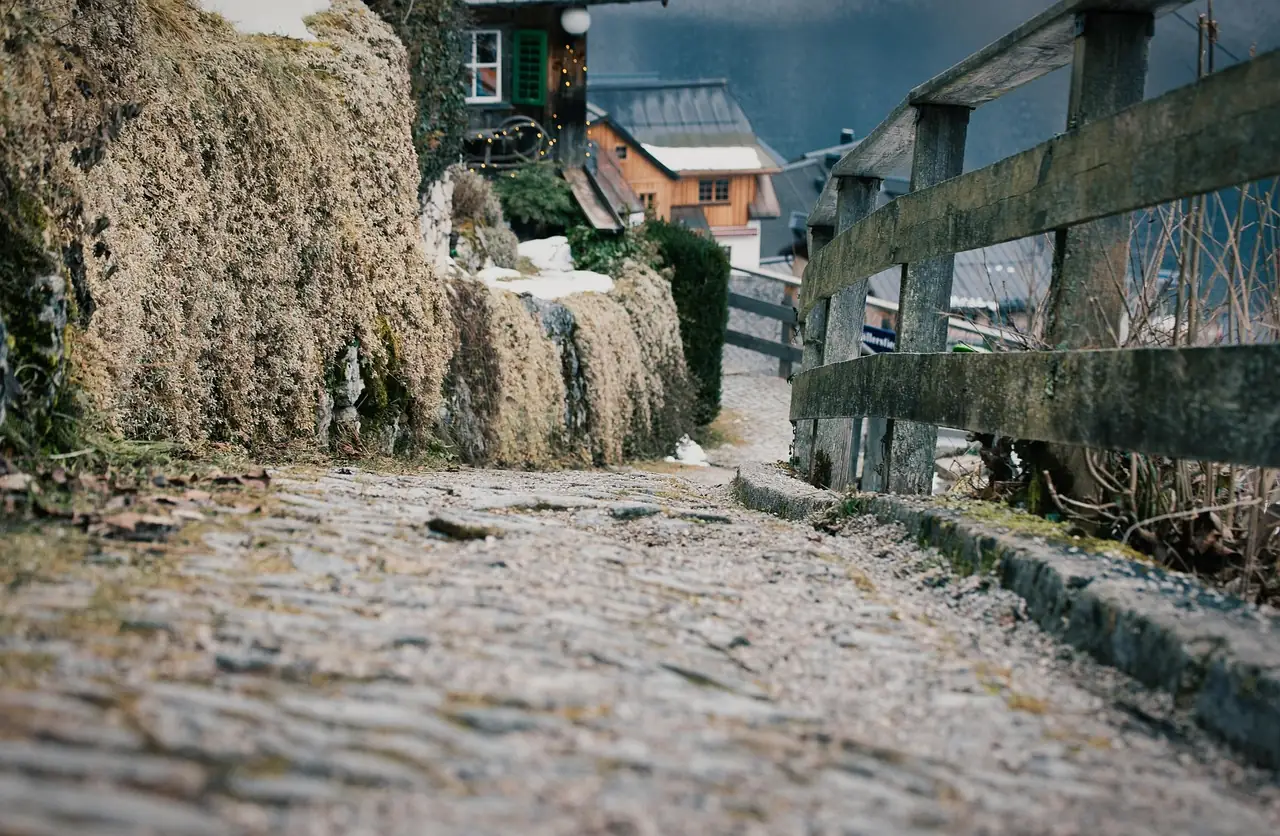
In 1955 the Kroeger family owned 304 Olive and the Reom family owned 300 Olive. The Kroegers wanted to build a garage that would block the Reoms' access to their property from an alleyway. The families agreed that the Kroegers would transfer the garden plot to the Reoms in exchange for three things: the Reoms gave up their access easement across 304 Olive, they paid $250, and Carol Reom babysat the Kroegers' young daughter.
The Kroegers then tore down their old garage, built a new one, and built the retaining wall and fence that enclosed the plot as part of 300 Olive. The Reoms gardened there for more than 50 years. In a 2006 letter, Harry Reom wrote that he had acquired the land from his neighbor in 1955 in exchange for losing his alley access, that he had been planting vegetables on it for about 50 years, and that he did not think the land had ever been recorded properly.
He was right. By trial, no one could produce a recorded deed. Larry Reom, the son, testified that he had seen a document on legal letterhead among his parents' papers with a legal description and signatures, but he could not find it. The family's files did contain fragments of 1955 letters describing the "20 by 20 piece of backyard we are selling them" and a sketch sent to the Kroegers' lawyer so a title company could write the legal description.
In 2018, while Canada was remodeling 304 Olive, he asked the Reom family for a storm drainage easement he described as critically important. Before the family granted it, Larry Reom told Canada about the 1955 deal and gave him the documents. The trial court found that Canada knew of the agreement, promised to record it, and then reneged. The Reoms granted the drainage easement for nothing, and Larry testified he would not have done so had he known Canada would claim the garden.
"The Disputed Area has been walled off and fenced off from 304 Olive for 70 years."
Court of Appeal, Clayton v. Canada (2026)
Why the Buyers Lost on Title but Kept the Garden
The buyers first pleaded the usual theories for a neighbor dispute over land: adverse possession, prescriptive easement, implied easement, quiet title, reformation of the deed, and declaratory relief. Two of them were gone before trial. In January 2024 the trial court granted summary adjudication to the neighbors on adverse possession and prescriptive easement. The opinion does not explain that ruling, but both claims are hard to win in a case like this one.
- Adverse possessionCalifornia requires five years of possession plus payment of all property taxes assessed on the land during that time (Code Civ. Proc. § 325). Owners of a garden strip almost never pay the tax on a neighbor's parcel. The firm's analysis of Nellie Gail Ranch v. McMullin shows how the tax element defeats these claims.
- Prescriptive easementA prescriptive easement is a right to use land, and California courts generally refuse to grant one so exclusive that it amounts to ownership. A fenced garden only one household can use looks like ownership. See the firm's analysis of Montecito Country Club v. Root on how prescriptive rights are proven.
- Quiet title and reformationAfter a six-day bench trial, the court found the evidence did not show that the 1955 deal was put into a deed, and denied both claims. Ownership of the plot stayed with 304 Olive.
What remained were the two easement theories. The trial court found that the 1955 deal reflected an agreement between neighbors to transfer the plot, or at least to confirm the right to its exclusive use, and it granted an implied easement and an equitable easement. The Court of Appeal affirmed on the equitable easement and did not reach the implied easement. For the implied easement standard, see the firm's analysis of Romero v. Shih, the 2024 California Supreme Court decision on exclusive implied easements.
What Is an Equitable Easement in California?
Short answerAn equitable easement is a right to keep using a neighbor's land that a court creates using its equity power, even when no deed, implication, or prescription supports it. California courts grant one only if the user's encroachment was innocent, the owner will not suffer irreparable harm, and denying the easement would cause a hardship greatly disproportionate to granting it.
The three-part test comes from published decisions, chiefly Tashakori v. Lakis (2011) 196 Cal.App.4th 1003 and Hirshfield v. Schwartz (2001) 91 Cal.App.4th 749. The court may also order the easement holder to pay the owner for the land's use. Here, the trial court chose not to award compensation, because the buyers had paid for a home they believed included the garden, and the neighbors' side had already received the benefit of the 1955 deal.
1. The use must be innocent
The encroachment cannot be willful or negligent. The neighbors argued the buyers acted willfully by gardening on land after learning of the dispute. The trial court rejected that. The question is who created the encroachment, and here the prior owners of 304 Olive built the wall and fence themselves. The buyers had nothing to do with it.
2. The owner must not suffer irreparable harm
The neighbors pointed to a city storm drain pipe that runs through the plot and to a possible future accessory dwelling unit. The trial court found the drainage need was already met by the easement the Reoms had granted for free, uphill from the garden, and that the neighbors' own geotechnical report did not plan to connect in the plot. The ADU plan was called speculative.
3. The hardships must tip greatly toward the user
This is where most equitable easement claims fail, and where this case is most useful. The neighbors relied on Shoen v. Zacarias (2015) 237 Cal.App.4th 16, which reversed an equitable easement because moving some patio furniture, at a cost under $300, was not a hardship greatly out of proportion to the owner's loss of her own land. They argued the buyers had to prove actual dollar costs of leaving the garden, and had not.
The Court of Appeal disagreed. Shoen does not limit the hardship analysis to the cost of removing things. The court can weigh the conveniences and hardships of both sides. Here those included the flat, fertile ground that made the plot the best garden space on the lot, the buyers' testimony that they would not have bought the house without it, and two years of work building the garden.
The court also held it was proper to consider history and conduct: the 1955 agreement, the benefit 304 Olive received when the alley easement was released, the 70 years the plot sat walled off, and Canada's promise to record the deal. Those facts, the court said, go to how much the neighbors actually lose if the easement is granted. The court noted it might reach a different result if the only evidence were that the plot was first used as a garden in 2019.
From a 1955 handshake to a 2026 appeal
Neighbors make a deal
The owners of 304 Olive agree to transfer the plot for $250, babysitting, and release of an alley easement, then build the wall and fence.
Decades of gardening
The Reom family gardens the plot for more than 50 years. No deed is recorded.
Neighbors buy 304 Olive
Canada and Rodriguez purchase from the Kroeger family trust.
Drainage easement granted
The Reom family gives Canada a free storm drain easement after showing him the 1955 documents.
Buyers purchase 300 Olive
Clayton and Pinchuk buy, with disclosures describing a jog in the line from a 1955 transaction.
Survey, then police
A recorded survey puts the garden inside 304 Olive. In December 2021 Canada reports a trespass, and the buyers sue.
Six-day trial
Adverse possession and prescriptive easement are lost on summary adjudication. After trial, the court grants an exclusive easement for gardening.
Affirmed
On October 26, 2026, the Court of Appeal affirms in an unpublished opinion.
Can Old Letters and a Lost Deed Be Used as Evidence?
Everyone who made the 1955 deal was dead or unavailable by trial, so the buyers had to prove it through family testimony and old papers. The neighbors objected that this was hearsay. The trial court admitted the evidence on several grounds, and the appeal focused on one of them.
- Statements about a boundaryEvidence Code section 1323 admits a statement about the boundary of land if the person who made it is unavailable and had sufficient knowledge, unless the circumstances show it is untrustworthy. The neighbors argued the case was about ownership and use, not a boundary. The Court of Appeal disagreed: the dispute was over the boundaries of adjoining lots, and the Reoms' statements and Harry Reom's 2006 letter came in.
- Ancient documentsThe 1955 letter fragments were admitted under Evidence Code section 1331, which covers statements in writings more than 30 years old that people with an interest have since acted on as true.
- A lost writingLarry Reom's description of the missing 1955 document was admitted under Evidence Code sections 1521 and 1523, which allow oral testimony about the contents of a writing that has been lost without fraud.
The practical lesson is that the family files matter. Letters, sketches, attorney correspondence, and a parent's notes can carry a case when the deed is gone, but only if someone keeps them and can explain them.
Equitable Easement, Prescriptive Easement, or Adverse Possession?
Neighbors arguing over a strip of yard often reach for the wrong theory first. The table compares the main options in California.
| Doctrine | What it gives | What must be shown | Can it be exclusive? | Key authority |
|---|---|---|---|---|
| Adverse possession | Ownership | Five years of open, hostile, continuous possession plus payment of all property taxes | Yes, it is title | Code Civ. Proc. § 325 |
| Prescriptive easement | A right to keep using the land as it was used | Five years of open, continuous, adverse use | Generally no | Civ. Code § 1007 |
| Implied easement | A use that continued when land was divided or transferred | An obvious, permanent use at the time of the transfer | Sometimes, per Romero v. Shih | Civ. Code § 1104 |
| Equitable easement | A court-created right to keep an innocent encroachment | Innocence, no irreparable harm, and greatly disproportionate hardship | Yes, as in this case | Tashakori v. Lakis (2011); Shoen v. Zacarias (2015) |
| Quiet title | A judgment declaring who owns the land or interest | Proof of the claimed title or interest against adverse claims | Yes | Code Civ. Proc. § 760.020 |
What This Means for Glendale and Los Angeles County Owners
The facts in this case are common on the hillside lots of Glendale, La Cañada Flintridge, Eagle Rock, and the Verdugo foothills: a retaining wall built decades ago where it was easiest to build, a fence on top of it, and a deed line somewhere else. Many of these arrangements began as neighbor agreements that were never recorded.
- Assessor maps are not surveysThe parcel maps published by the Los Angeles County Assessor are drawn for property tax purposes. Only a licensed surveyor working from the recorded legal descriptions can locate a deed line.
- Agreements should be recordedA boundary line agreement or easement that is signed but never recorded with the Los Angeles County Registrar-Recorder/County Clerk can be lost, disputed, or missed by the next buyer. The 1955 deal in this case was enforced only as an easement, after a trial and an appeal.
- Read the disclosures and the title reportThe buyers here were told about a "jog" in the line. A title report and a survey before closing would have shown whether the garden came with the house.
- Cases are heard locallyEasement and quiet title cases involving property in this area are filed in the Los Angeles County Superior Court, and equitable claims like this one are decided by a judge, not a jury.
If a Survey Shows Your Yard Is on the Neighbor's Land
Get the records before you argue
Pull your grant deed, the neighbor's deed, any recorded surveys or maps, and the title report from your purchase. Disclosures often mention line adjustments.
Hire your own licensed surveyor
A neighbor's survey is a starting point, not the final word. Ask your surveyor to show the deed line, the fence and wall, and any easements of record.
Find the history
Ask prior owners, their families, and long-time neighbors who built the wall, when, and why. Collect old letters, permits, photos, and aerial images that show how the area was used.
Keep using the area openly, but carefully
Do not build anything new in the disputed area while the issue is open. New work can turn an innocent encroachment into a willful one.
Consider a recorded agreement first
A boundary line agreement, a lot line adjustment, or a recorded easement can settle the issue at a fraction of the cost of a trial. Real estate mediation often gets neighbors there.
Know your claims and their limits
Before filing, match the facts to the right doctrine. Adverse possession requires taxes. A prescriptive easement is rarely exclusive. An equitable easement depends on proving a disproportionate hardship.
How DiJulio Law Group Approaches Boundary and Easement Disputes
Cases like this one are won on records and history: deeds, surveys, title reports, and the papers in someone's attic. The firm starts by building that record, then decides whether a recorded agreement, mediation, or a quiet title action gives the client the clearest path to a durable result.
The firm represents owners on both sides of boundary disputes and easement disputes in Glendale, Los Angeles, and throughout Southern California through its California real estate law practice. Valeria Granata handles trial and appellate work in real estate matters.
Questions About Equitable Easements and Garden Boundary Disputes
Can a neighbor take part of my yard if they have used it for years?
Not easily. To get ownership by adverse possession in California, the neighbor must show five years of open, hostile, continuous possession and that they paid the property taxes on the strip. Most claims fail on taxes. A neighbor may instead seek an easement, which allows use but leaves ownership with you.
What is the difference between an equitable easement and a prescriptive easement?
A prescriptive easement arises from five years of open, adverse use and is generally nonexclusive. An equitable easement is created by a court in its discretion to protect an innocent encroachment when removing it would cause a hardship greatly out of proportion to the owner's loss. An equitable easement can be exclusive, as in this case.
Does a fence or retaining wall decide where my property line is?
No. The recorded legal descriptions decide where the deed line is. A fence or wall can matter to easement and agreed boundary claims, and long-standing walls built by a prior owner, like the one here, can weigh heavily in the equities. Only a licensed survey can show where the deed line runs.
Can an unrecorded agreement between prior owners still be enforced?
Sometimes. In this case, the 1955 agreement was never recorded as a deed, so the buyers could not quiet title. But the court relied on the agreement, the decades of use, and the deed owner's promise to record it to grant an equitable easement. Recording an agreement avoids that uncertainty.
Will I have to pay my neighbor for an equitable easement?
The court can require payment for the value of the easement. In this case, the trial court decided no payment was owed because the buyers had paid for a home they believed included the garden and the deed owner's property had already benefited from the 1955 deal. Compensation depends on the facts.
Can other courts rely on Clayton v. Canada?
No. The opinion was not certified for publication, so California Rules of Court, rule 8.1115, bars courts and parties from citing it as precedent. The published decisions it applies, including Tashakori v. Lakis and Shoen v. Zacarias, remain the controlling authority on equitable easements.
Do I need a real estate attorney in Glendale for a boundary or easement dispute?
If a neighbor has recorded a survey, claimed part of your yard, or reported you for trespass, an early review of your deed, title report, and the area's history can show which claims you have and which you do not. You can contact DiJulio Law Group or call (818) 502-1700.
Neighbor dispute over a garden, wall, or fence line?
Bring your deed, title report, any survey, and photos of the area. The first conversation is about what the records show and what you can safely do next.
330 North Brand Boulevard, Suite 1280, Glendale, CA 91203
This case analysis discusses an unpublished California appellate opinion for general information. Unpublished opinions cannot be cited or relied on as precedent under California Rules of Court, rule 8.1115. This analysis is not legal advice, does not create an attorney-client relationship, and does not predict the outcome of any matter. DiJulio Law Group was not counsel in Clayton v. Canada. Facts are drawn from the opinion. Consult a licensed California attorney about your situation.
Primary sources
- Clayton v. Canada (Oct. 26, 2026, A171045) [nonpub. opn.], Court of Appeal, First Appellate District, Division Five. courts.ca.gov (PDF)
- Opinion record and other formats, Judicial Branch of California. courts.ca.gov
- Shoen v. Zacarias (2015) 237 Cal.App.4th 16. caselaw.findlaw.com
- Tashakori v. Lakis (2011) 196 Cal.App.4th 1003; Hirshfield v. Schwartz (2001) 91 Cal.App.4th 749; Linthicum v. Butterfield (2009) 175 Cal.App.4th 259, as cited in the opinion.
- Evidence Code §§ 1323, 1331, 1521, 1523. leginfo.legislature.ca.gov
- Civil Code §§ 803, 1007, 1104; Code of Civil Procedure §§ 325, 760.020. leginfo.legislature.ca.gov
- California Rules of Court, rule 8.1115 (citation of opinions). courts.ca.gov
0 Comments