
Full Citation & Procedural Posture
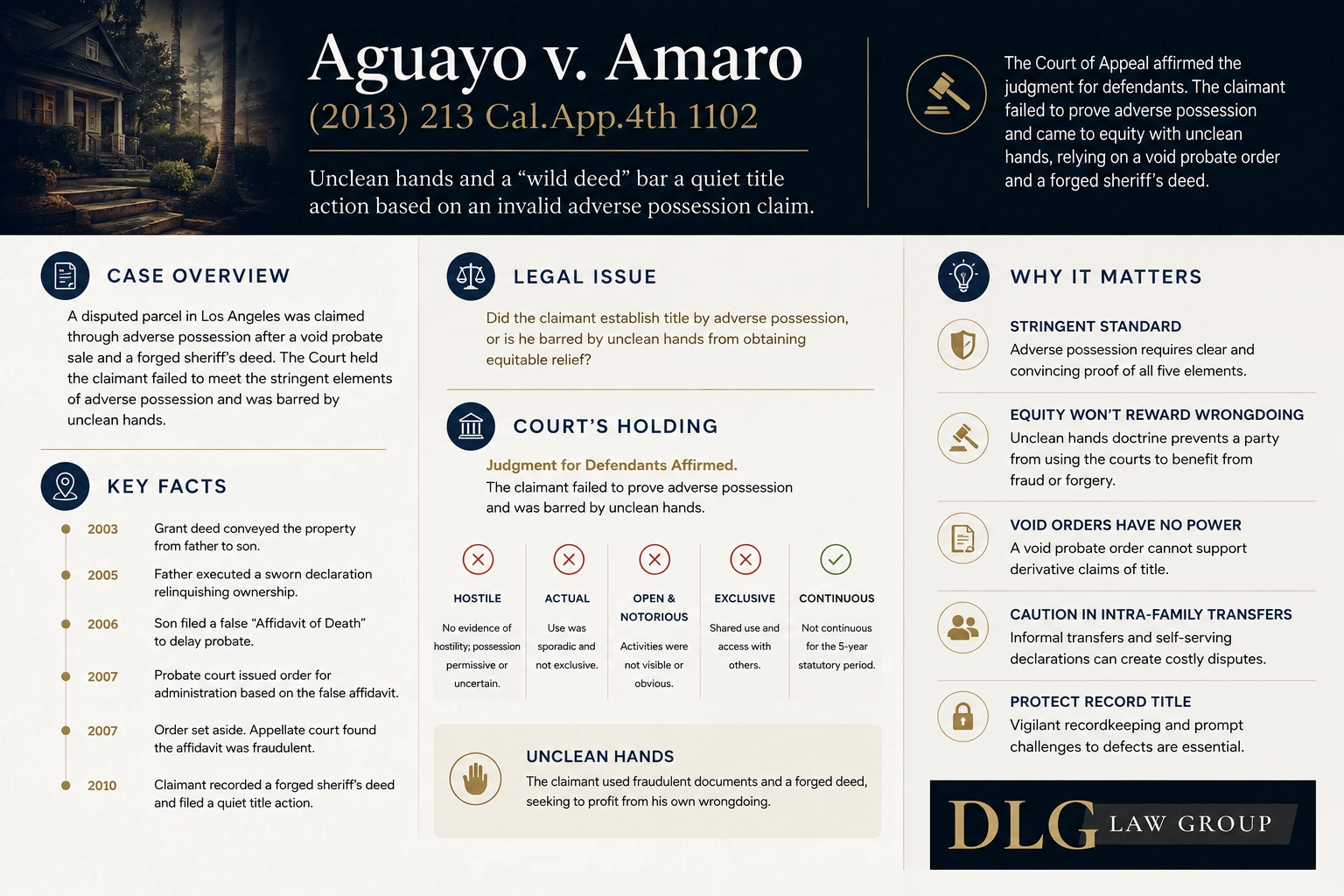
Sofia Aguayo v. Michelle Amaro, as Special Administrator
(2013) 213 Cal.App.4th 1102
- Court
- Court of Appeal, Second District, Division 3
- Docket
- No. B231194
- Decided
- January 31, 2013 · Published
- Disposition
- Judgment affirmed
- Doctrines
- Adverse possession by claim of right · Unclean hands · Quiet title
- Property
- 3665 Gillig Avenue, Los Angeles
Sofia Aguayo did everything California adverse possession law requires. She occupied the house, fenced it, changed the locks, posted her name as owner, held it for more than five years, and paid every property tax bill from 1993 through 2006. The trial court found she met every technical element. She lost anyway, and the Court of Appeal affirmed. The reason is the most useful thing any California property owner can learn about this doctrine: she satisfied the tax element by making sure the real owners never received a bill.
Adverse possession by claim of right has no good-faith requirement. A trespasser who knows the land is not theirs can still acquire title. That is the historical bargain, and California courts have said so for decades. So a property owner cannot defeat the claim just by arguing the claimant was a trespasser, because every claim-of-right case involves a trespasser.
Equity is a different question. Quiet title is an equitable action, and Aguayo holds that a trial court may apply the unclean hands defense where the claimant engaged in deceitful interference with the true owner's ability to defeat the claim. Recording a forged deed whose only real function was to redirect the county's tax bills away from the owners is exactly that kind of interference. The misconduct does not have to be a crime, and it does not have to be an actionable tort. It only has to relate directly to the claim.
The practical rule: meeting the five elements gets you to the courthouse. It does not get you the house.
1946
Year the Infante family bought the house
11 yrs
Between the owner's death and probate
~10
Quiet title actions the claimant's husband said he had filed
5 of 5
Elements the trial court found satisfied
The House on Gillig Avenue
Herman and Isabel Infante took title to 3665 Gillig Avenue in Los Angeles by grant deed in 1946. It was the family home. They raised two sons there, Alfred and Richard. Richard's daughter Michelle grew up in the house until she was nine, when she was adopted by another family because, as she later testified, her father could not care for her.
Herman died in 1969. Isabel died intestate in 1993. Alfred and Richard kept living in the house. Nobody opened a probate.
That last sentence is the entire vulnerability. An intestate estate with no administrator is a property that legally belongs to a set of heirs who have not been identified, holding title nobody is actively managing, generating tax bills that arrive at a house where the person named on them has died. It is the single most exposed condition in California residential real estate, and it can persist for years without anyone noticing.
In 1995, a letter arrived at the house. It was addressed to Isabel Infante and asked whether the property might be for sale. Isabel had been dead for two years.
Adverse Possession as a Line of Business
The letter came from Sofia Aguayo. Her husband, Jesus Duran Aguayo, testified that he was in the business of acquiring properties through adverse possession. He said he had filed roughly ten quiet title actions. The opinion records that he had developed an expertise in the practice, and that Sofia worked with him in the same occupation.
That admission matters more than anything else in the record, because it establishes what the Aguayos knew. Everything that follows was done by people who understood the five elements precisely.
What followed reads like a checklist. Sofia contended Alfred agreed orally to sell his contingent interest for $25,000, and that Jesus gave him $2,000 in cash in 1995 in exchange for a promise to open probate. Alfred never opened it. He died intestate in 2001. On January 2, 1999, Jesus posted a sign on the property reading No Trespassing and naming Sofia as the owner. They changed the locks on the front door, put a fence around the property, and did electrical, plumbing, and drywall work. In April 1999, Jesus said he lent Richard $2,000 in cash. On January 1, 2000, Jesus drafted a document titled Part Sale & Rental Agreement under which Richard would rent the property from Jesus for $400 a month, and would transfer his rights in exchange for the $2,000 and 54 months of rent credit, totaling $23,600.
From 1999 through 2004, Richard lived in the house, apart from several stays in county jail. The No Trespassing sign stayed up. Jesus visited weekly.
Actual occupation. Hostile to the owner's title. A claim of the property as their own. Continuous for more than five years. That is four of the five elements, assembled deliberately over a period of years.
The fifth element required paying the taxes. And that is where the case turns from an aggressive property claim into something a court of equity would not tolerate.
The Wild Deed
On April 27, 2000, the Aguayos recorded a quitclaim deed. It purported to transfer the property from a person named Jesus Duran to Jesus Aguayo and Sofia Aguayo. Jesus conceded at trial that his legal name was not Jesus Duran.
The document was a wild deed, meaning it was recorded outside the chain of title. It came from a grantor who had never held title, so it conveyed nothing. On its own terms it was legally inert.
It did one thing. The deed instructed that tax statements be mailed to Sofia Aguayo at a post office box in Downey. After it was recorded, the Los Angeles County Registrar-Recorder sent every tax bill for the property to that box. The Infante family had no access to it. Sofia then paid all the bills that came due from 2000 through 2006, and the back taxes owed from 1993 through 1999 as well.
What the wild deed actually did
- Statutory notice path
- Severed by the recording
- Diverted path
Why the Tax Element Exists
Most people read Code of Civil Procedure section 325 as a fee: pay five years of taxes and the land can become yours. That reading misses what the requirement is for.
The annual tax bill is a notification device. It arrives every year and tells the owner of record that they own something and that something is owed on it. If an owner ignores that reminder for five consecutive years while a stranger occupies the land and pays the bill, the law treats the combination as meaningful evidence of abandonment. The payment is not the point. The owner's opportunity to notice, and their failure to act on it, is the point.
Sofia understood this well enough to attack it directly. She did not need a deed to satisfy any element of adverse possession, and the trial court found she knew that. What the deed did was guarantee that the one built-in warning the statute gives a distracted owner would never reach the house.
She did not satisfy the tax element. She disabled it, and then satisfied what was left. The mechanism at the center of Aguayo
Every Element Met, and the Claim Still Failed
Actual occupation giving reasonable notice Met
A fence, changed locks, a posted sign naming Sofia as owner, and electrical, plumbing, and drywall work on the house.
Hostile to the owner's title Met
No permission from the estate, which had no administrator to give any. Hostility does not require ill will. It requires the absence of consent.
Claim of right or color of title Met
The trial court found both, which the Court of Appeal noted was internally inconsistent, since color of title requires good faith. Under claim of right there is no good-faith requirement at all.
Continuous and uninterrupted for five years Met
Possession dating to at least January 1999, with suit filed in August 2004. The sign stayed up, and Jesus visited weekly.
All taxes levied and assessed, five years Met
Every bill from 2000 through 2006, plus back taxes from 1993 through 1999. The element that defeats almost every California claimant was the one she satisfied most completely.
Clean hands Fatal
Not an element of adverse possession. It is a defense to the equitable remedy she needed in order to convert possession into title. Quiet title is an equitable action, and a plaintiff in equity must act fairly in the matter for which relief is sought.
Claim of Right and Color of Title Are Not the Same Thing
California recognizes two routes to adverse possession, and confusing them is one of the most common mistakes in this area. They are codified in different statutes and carry different requirements. The distinction did real work in Aguayo, and it will do real work in any claim you are evaluating.
The Two Routes Under California Law
Claim of Right
Code Civ. Proc. §§ 324, 325
- Foundation
- No written instrument. Possession rests on the claimant's own assertion of ownership.
- Good faith
- Not required. A deliberate trespasser can prevail. So can someone acting on an honest mistake about the line.
- How land counts
- Only land protected by a substantial enclosure or usually cultivated or improved, and no more than that.
- Typical use
- Fence-line and enclosure disputes, occupied vacant property, and neighbor encroachments.
Color of Title
Code Civ. Proc. §§ 322, 323
- Foundation
- A written instrument, judgment, or decree that appears to convey the property but is defective in some way.
- Good faith
- Required, and it is crucial. The occupant must have genuinely relied on the flawed document without knowing it was flawed.
- How land counts
- All land described in the instrument can qualify, not merely the portion physically enclosed or improved.
- Typical use
- Defective deeds, botched conveyances, errors in a legal description, and title flowing from a flawed decree.
Why it mattered here. The trial court found Sofia took possession under both theories and also found her conduct went beyond bad faith. Those findings cannot both stand, because good faith is required for color of title. The Court of Appeal declined to untangle it: a judgment is presumed correct and is affirmed if any legal theory supports it, and at most the contradiction meant the trial court had misunderstood color of title in Sofia's favor.
Why Trespass Alone Is Never Unclean Hands
Sofia's central argument on appeal had real force. Adverse possession by claim of right necessarily involves wrongful occupation of someone else's land. If a court can call that wrongful occupation unclean hands, then the doctrine cannot exist at all, because every claimant would be barred by definition.
The Court of Appeal agreed with the premise. California law settled it back in 1962: a claimant under mere claim of right is an intruder without any bona fide belief in title, and holding that such a person is barred by unclean hands would eliminate adverse possession for everyone except those claiming under color of title. The court there traced the doctrine to its origins, describing the claimant who takes by bow and spear and defends against all comers until the statutory period runs.
So the trespass could not support the defense. Something else had to. The court found it in a principle already well established: misconduct is only unclean hands if it relates directly to the claim for which relief is sought. And the conduct need not be criminal or even tortious. Anything that violates conscience, good faith, or equitable standards of conduct will do.
Which means the line the court drew is narrow and specific. Occupying land you know is not yours does not disqualify you. Manipulating the owner's ability to discover and stop you does. Sofia's wild deed did not help her possess the property. It stopped the estate from learning that anyone was paying its taxes.
Two older cases the court distinguished make the boundary clearer. In one, the claim of unclean hands failed because there was no evidence the plaintiffs had acted inequitably toward the defendants at all. In another, a property owner's earlier fraudulent transactions could not be used against a later adverse possession claimant, because the fraud did not relate directly to that claimant's possession. Both illustrate the same requirement from the other side: the misconduct has to be aimed at the very claim in front of the court.
What It Cost, and What Came After
In August 2004, Sofia filed her verified quiet title complaint. Michelle Amaro, the granddaughter who had grown up in the house, took an assignment of Richard's interest that November and was appointed special administrator of Isabel's estate the following day, eleven years after Isabel died.
The trial in August 2006 was a bench trial on competing quiet title claims. Two witnesses testified: Jesus and Amaro. In November the court issued its statement of decision, finding the technical requirements met and the claim barred by unclean hands.
Six days before that decision issued, a grand jury indicted Jesus and Sofia on 22 counts arising from their adverse possession business, involving multiple alleged victims. In 2008 a jury convicted them of vandalizing this property, entering it without authorization, and conspiracy. Those convictions were affirmed. They were acquitted on certain forgery counts, and the count concerning the quitclaim deed was dismissed before trial. Sofia argued on appeal that the acquittal undercut the trial court's finding.
The Court of Appeal set that aside in a sentence that is worth remembering. An acquittal carries no res judicata effect in a civil case because the standards of proof differ, and it did not matter here in any event: unclean hands does not require a crime. Whether Sofia violated a penal statute was simply not part of the analysis.
Judgment was finally entered in December 2010. The record does not explain the four-year gap. The property belonged to the Estate of Isabel Infante. The appeal was decided in January 2013, sixty-seven years after Herman and Isabel bought the house.
Sixty-Seven Years on Gillig Avenue
1946
The family buys the house
Herman and Isabel Infante take title by grant deed. Two sons, Alfred and Richard, are raised there, and later Richard's daughter Michelle.
1993
Isabel dies intestate, and nothing is opened
Herman had died in 1969. Alfred and Richard keep living in the house. Probate does not commence for eleven years. The vulnerability begins here.
1995
A letter arrives for a dead woman
Sofia writes to Isabel Infante asking about buying the property. Jesus later says he paid Alfred $2,000 for a promise to open probate. Alfred never does, and dies intestate in 2001.
Jan 1999
Possession, established on the record
A No Trespassing sign naming Sofia as owner goes up. New locks, a fence, and electrical, plumbing, and drywall work follow. The five-year clock starts running.
Apr 2000
The wild deed is recorded
A quitclaim deed from Jesus Duran, a name Jesus conceded was not his own, conveying nothing. Its operative effect: every county tax bill now goes to a post office box in Downey.
Aug 2004
Suit filed, and the family responds
Sofia files a verified quiet title complaint. In November, Richard assigns his interest to Michelle Amaro, who is appointed special administrator of Isabel's estate the next day.
Nov 2006
Every element met, claim barred anyway
After a two-witness bench trial, the court finds the technical requirements satisfied but holds the claim fails for unclean hands, resting squarely on the recording of the wild deed.
2006–2008
The criminal case runs alongside
A 22-count indictment arising from the adverse possession business. A jury later convicts on vandalism, unauthorized entry, and conspiracy as to this property. Those convictions are affirmed.
2010–2013
The house goes back to the estate
Judgment enters in December 2010, four years after the statement of decision, for reasons the record does not explain. The Second District affirms in January 2013 and publishes the opinion.
Does This Describe Property You Own or Expect to Inherit?
Aguayo is not a story about a rare kind of criminal. It is a story about a house that was left unattended in an unopened estate for eleven years, which is an ordinary situation. If any of the following is true, the conditions that made this case possible are present right now.
Six Conditions That Create This Exposure
A family member died and probate was never opened. This is the condition that started everything here. An unadministered estate has no one authorized to notice a problem, respond to a letter, or file suit. See our case study on partition standing among heirs.
You stopped receiving property tax bills and did not think much of it. The absence of an expected bill is a signal, not a convenience. Check the assessor's record of where your bills are being mailed.
A property sits vacant, is rented informally, or is occupied by a relative with no written arrangement. Occupation without documented permission is the raw material of a hostility argument.
Someone has approached you or a deceased relative about buying a property and the inquiry felt oddly informed. A letter addressed to a person who has died is not a coincidence.
You have not pulled a title report on a family property in years. A recorded document you never authorized will show up there. That is how a wild deed is found, and finding it early is what makes it cheap to remove.
You are the one holding land you believe you have earned through long use. Everything you do from here is evidence. See adverse possession and quiet title for how the elements are actually proved.
Two documents answer most of this in an afternoon. A current title report shows every instrument recorded against the property, including anything filed without your knowledge. A tax record from the county shows where the bills are going and who has been paying them. Together they tell you whether a five-year clock is running, and how far along it is.
Before the clock finishes running
Is someone claiming property that belongs to your family?
A free consultation with DiJulio Law Group covers what the title and tax records show, whether a claim is viable, and what has to happen first. No obligation, and nothing is filed on your behalf without your direction.
How an Owner Defeats a Claim Like This
The Infante estate won, but it won late and expensively, after a bench trial and an appeal spanning nearly a decade. Every one of the steps below would have ended the claim earlier, and most cost very little.
Five Ways to End an Adverse Possession Claim Early
Open the probate
The root fix · Do this first
An estate with an appointed administrator has someone with legal authority to receive notice, inspect the property, evict an occupant, and sue. Eleven years without one is what made this case possible. If a family property is sitting in an unopened estate, that is the single highest-priority item, ahead of any dispute strategy.
Pay the taxes, or verify who is
Defeats element five outright
A claimant must show they paid all taxes for five years, proven by certified county tax collector records. An owner who simply keeps paying makes the element unsatisfiable. Confirm the mailing address of record with the county, since that is the exact point the Aguayos attacked.
Grant permission in writing
Destroys hostility
Possession with the owner's consent is never hostile, and hostility is an element. A signed license, a short written agreement, or a documented rental converts an adverse possessor into a permissive occupant. This is the cheapest tool available and the most frequently overlooked.
Interrupt the five years
Resets the clock
Continuity is an element. An eviction, an unlawful detainer, a suit to quiet title, or documented re-entry breaks it. Because the period runs from when occupation begins, an owner who acts in year three faces a very different case than one who acts in year six.
Remove the cloud on title
Where a wild deed exists
A recorded instrument outside the chain of title conveys nothing, but it sits on the record, redirects mail, and blocks a sale or refinance until it is cleared. A quiet title action removes it. See transactional real estate and title and disclosure issues.
Read With Nellie Gail: Two Ways to Lose the Same Claim
These two published decisions are the clearest pair in California adverse possession law, and they fail in opposite directions.
In Nellie Gail Ranch Owners Assn. v. McMullin (2016), homeowners enclosed more than 6,100 square feet of association common area and lost because they could not satisfy the tax element. Association common area is assessed to every member's individual lot, so no single member can produce a certified record showing they paid its taxes. The claim was structurally impossible.
In Aguayo, the claimant satisfied the tax element completely and lost anyway, because of how she satisfied it. Which means the two cases together mark the outer edges of the doctrine: the tax requirement is nearly impossible to meet honestly, and meeting it dishonestly forfeits the equitable remedy you need to convert possession into title. That is the practical reason successful California adverse possession claims are so rare, and why the ones that succeed usually involve unusual tax circumstances rather than unusually long occupation.
For a claimant, the useful takeaway is that the alternatives are often stronger than the claim itself. Prescriptive easements carry no tax requirement. Boundary line agreements, lot line adjustments, and negotiated purchases produce recordable title without litigation. Those routes are laid out in the Nellie Gail case study, and they apply here with equal force.
How These Cases Present Across Los Angeles County
Aguayo was a Los Angeles property, decided by the Second District, which is the appellate court covering Los Angeles County. The pattern it describes recurs across the region wherever older housing stock meets long family ownership and delayed estate administration.
Where These Claims Come From
Multigenerational homes
Glendale · East LA · San Gabriel Valley
Houses held by one family since the 1940s and 1950s, passed informally between generations without recorded transfers or probate. Long ownership and thin paperwork is the exact combination that produces these claims, and it is common throughout Los Angeles County.
Unopened estates
Intestate succession
When an owner dies without a will and no one petitions, the property has heirs but no administrator. Nobody has authority to evict, sue, or even reliably receive notice. Delay is the vulnerability, and it compounds with every year.
Vacant and underused lots
Infill · hillside · landlocked
Parcels nobody visits generate no complaints when someone fences them. Combined with rising land values across Los Angeles and Glendale, a quiet parcel is a target rather than a non-issue.
Owners at a distance
Out-of-state · overseas
An owner who inherited a Southern California property and lives elsewhere may go years without seeing it. The tax bill is often their only annual contact with the asset, which is precisely why interfering with that bill is treated as interference with the claim itself.
Boundary strips
Fences · driveways · walls
The far more common version of this doctrine involves a few feet rather than a whole house, and it usually fails on the tax element for the reasons set out in Nellie Gail. See also boundary and encroachment disputes and easement rights.
Sale-triggered discovery
Escrow · title · refinance
Most wild deeds surface when a family finally tries to sell or refinance and title comes back clouded. At that point the problem is on a closing timeline, which is the most expensive moment to address it.
DiJulio Law Group advises property owners, heirs, buyers, and businesses on these matters as part of its California real estate law practice, including adverse possession and quiet title, boundary and encroachment disputes, easements and access, and transactional real estate. The real estate practice center explains what to gather before a first consultation, and the real estate resource library covers common property-rights questions. Additional decisions are collected in our California case study library.
Why This Matters
Six Things Aguayo v. Amaro Settles About California Adverse Possession
This is the case that separates the checklist from the outcome. Everything below follows from a single fact: the claimant met every requirement and still walked away with nothing.
Meeting the Elements Is Not Winning
Quiet title is an equitable action. A claimant who satisfies all five statutory elements still needs a court of equity to grant relief, and equity can refuse.
Bad Faith Alone Is Not a Defense
Claim of right has no good-faith requirement. Knowing the land is not yours does not disqualify you, and an owner who argues only that the occupant is a trespasser will lose that argument.
The Tax Bill Is Notice, Not a Fee
The requirement exists so the record owner gets an annual reminder. Interfering with that reminder attacks the statute's purpose, which is why it supported the defense here.
The Misconduct Must Be Aimed at the Claim
Unrelated wrongdoing will not do. The conduct has to interfere with the owner's ability to defeat this claim. It need not be a crime or an actionable tort.
An Acquittal Proves Nothing Here
Criminal and civil cases use different standards of proof, so an acquittal has no res judicata effect. And since unclean hands does not require a crime, the question was beside the point.
Delayed Probate Is the Real Risk
The house was exposed for eleven years because no one opened an estate. Opening probate is a property-protection step, not just an inheritance step.
Frequently Asked Questions
What did Aguayo v. Amaro decide?
The Court of Appeal held that a trial court has discretion to apply the equitable defense of unclean hands to bar an adverse possession claim, where the claimant engaged in deceitful interference with the true owner's ability to defeat that claim. The claimant in that case recorded a forged quitclaim deed whose practical effect was to redirect the county's property tax bills away from the owners of record, allowing her to satisfy the tax-payment element while the owners remained unaware. The trial court found she met every technical requirement of adverse possession and barred the claim anyway. The judgment was affirmed.
Can unclean hands defeat an adverse possession claim in California?
Yes, in the right circumstances. A quiet title action is equitable, and a plaintiff in equity must act fairly in the matter for which relief is sought. But the misconduct must relate directly to the claim. Mere trespass will never qualify, because adverse possession by claim of right necessarily involves wrongful occupation, and allowing trespass to serve as unclean hands would eliminate the doctrine entirely. What qualifies is conduct aimed at the owner's ability to discover or stop the claim. The misconduct need not be a crime or an actionable tort; anything violating conscience, good faith, or equitable standards of conduct can be enough.
What is the difference between claim of right and color of title?
Claim of right, under Code of Civil Procedure sections 324 and 325, requires no written instrument. The claimant simply asserts ownership, and there is no good-faith requirement, so a deliberate trespasser can qualify. Only land protected by a substantial enclosure or usually cultivated or improved counts. Color of title, under sections 322 and 323, rests on a written instrument, judgment, or decree that appears to convey the property but is defective. Good faith is a crucial element there, since the occupant must have genuinely relied on the flawed document. Color of title can reach all land described in the instrument, not just the portion physically occupied.
Does adverse possession require good faith in California?
It depends which route the claimant uses. Adverse possession under claim of right has no good-faith requirement, and California courts have described such a claimant as an intruder without any bona fide belief in title. Adverse possession under color of title does require good faith, because the claimant must have relied on the defective instrument without knowing it was defective. This distinction is why a property owner cannot defeat a claim-of-right case simply by proving the occupant knew the land was not theirs.
What is a wild deed?
A wild deed is an instrument recorded outside the chain of title, typically because the person named as grantor never held title to the property. It conveys nothing. But it sits in the public record, and it can have real practical effects: redirecting where the county mails tax statements, clouding title, and blocking a sale or refinance until it is removed. In Aguayo, the recorded quitclaim deed named a grantor whose name the claimant's husband conceded was not his own. A quiet title action is the usual remedy for clearing one.
Why does California adverse possession require paying property taxes?
Code of Civil Procedure section 325 requires the claimant to have timely paid all state, county, and municipal taxes levied and assessed on the land for the full five years, proven by certified records of the county tax collector. The requirement functions as a notice mechanism as much as a payment obligation. An annual tax bill tells the record owner that they own the property and that something is due on it. An owner who ignores that reminder for five straight years while someone else occupies and pays is treated as having effectively abandoned the property. That is why interfering with the delivery of tax bills was treated as interfering with the claim itself.
Can someone take a house that is stuck in probate?
An unadministered estate is unusually exposed. Until an executor or administrator is appointed, no one has clear legal authority to inspect the property, evict an occupant, respond to correspondence, or file suit, and the heirs may not have been identified. In Aguayo, the owner died intestate in 1993 and probate did not commence for eleven years, which is the condition that made the claim possible at all. Opening probate promptly is a property-protection measure, not merely an inheritance formality. Related reading: our case study on partition standing among heirs.
How do I stop someone from claiming adverse possession of my property?
Several steps defeat a claim outright, and most are inexpensive. Keep paying the property taxes, and confirm with the county where the bills are being mailed, since a claimant must show that they paid them. Grant written permission if you are willing to allow the use, because possession with consent is not hostile and hostility is an element. Interrupt the five-year period through an eviction, an unlawful detainer, a quiet title action, or documented re-entry. If a family property sits in an unopened estate, open probate so someone has authority to act. And pull a current title report to find anything recorded against the property without your knowledge.
Does an acquittal in a criminal case help in a related civil property case?
Generally not. Criminal and civil proceedings apply different standards of proof, so an acquittal carries no res judicata effect in a later or parallel civil case. In Aguayo, the claimant argued that her acquittal on a related charge undermined the trial court's finding that she had acted deceitfully. The Court of Appeal held the question was irrelevant to the analysis, because unclean hands does not require a crime or even an actionable tort.
What happens if a trial court makes contradictory findings?
The judgment usually survives. A judgment is presumed correct, all presumptions are indulged in its favor on matters where the record is silent, and an appellate court reviews the correctness of the judgment rather than the trial court's reasoning. That means the judgment is affirmed if any legal theory supports it, even where the trial court misapplied or misunderstood the law. In Aguayo, the trial court found both color of title, which requires good faith, and conduct beyond bad faith. The Court of Appeal treated the inconsistency as, at most, a misunderstanding resolved in the claimant's favor, and affirmed.
How do I find out if a fraudulent deed has been recorded against my property?
Order a current title report or a property profile, which lists every instrument recorded against the parcel, including anything filed without your authorization. Separately, check with the county tax collector to confirm the mailing address of record for tax statements, since a recorded document can change where those bills are sent. Many California counties also offer recorded-document notification services that alert an owner when something new is filed. Finding a wild deed early matters, because clearing it before a sale or refinance is far less disruptive than discovering it in escrow.
Are successful adverse possession claims common in California?
No, and these two decisions explain why from opposite directions. In Nellie Gail Ranch Owners Assn. v. McMullin, the claim failed because the tax element could not be satisfied at all, since association common area is assessed to every member's individual lot. In Aguayo, the claimant satisfied the tax element completely and lost because of how she did it. The requirement is very hard to meet honestly in the ordinary boundary-strip case, and meeting it through deceit forfeits the equitable remedy needed to convert possession into title.
Do I need a quiet title attorney in Los Angeles or Glendale?
These matters are decided by records rather than arguments: the title report, the recorded instruments, the county tax history, the probate file, and the dates that start and stop the five-year period. Reading them early usually determines whether a claim or a defense is viable before anything is filed. DiJulio Law Group advises owners, heirs, buyers, and associations on adverse possession and quiet title, boundary and encroachment disputes, and easement matters in Glendale, Los Angeles, and throughout Southern California. You can contact the firm or call 818-502-1700. Where the parties still have room to deal, real estate mediation often resolves these disputes for a fraction of what litigation costs.
How DiJulio Law Group Approaches Quiet Title and Possession Disputes
These matters usually arrive through a document. A family tries to sell an inherited house and title comes back clouded by an instrument nobody recognizes. An owner living out of state realizes the tax bills stopped years ago. A relative who has occupied a property for a decade asks whether it is now theirs. The doctrine is settled. What varies is what the records show, and how much time is left.
The first work is diagnostic and largely factual: pulling a current title report and every recorded instrument in the chain, obtaining the county tax payment and mailing history, locating the probate file or confirming none was ever opened, establishing when occupation began and whether anything interrupted it, and identifying which limitations periods are running. That analysis typically settles the strength of a claim or a defense before a complaint is drafted.
DiJulio Law Group has represented property owners, heirs, buyers, sellers, and businesses in Glendale, Los Angeles, and throughout Southern California for more than 35 years in real estate, business, construction, environmental, and mediation matters. Founding partner R. David DiJulio brings a background in environmental science alongside his legal practice. Senior litigator Valeria Granata handles trial and appellate work in California real estate and business matters.
Facing a Claim to Property Your Family Owns?
Bring what you have: the title report if you have one, any deed or probate paperwork, and the county tax records. The first conversation is about what those documents show and which deadlines are running, not about filing anything.
- Free initial consultation
- 35+ years in California real estate matters
- You speak with an attorney, not an intake screener
- Serving Glendale, Los Angeles, and Southern California
This case study discusses a published California appellate decision and related statutes for general informational purposes. It is not legal advice, does not create an attorney-client relationship, and does not describe, promise, or predict the outcome of any particular matter. DiJulio Law Group was not counsel in Aguayo v. Amaro. All facts stated here are drawn from the published opinion and the findings recited in it. Every property dispute depends on its own records, facts, and procedural posture, and the law changes. Consult a licensed California attorney about your situation.
Primary Sources
- Aguayo v. Amaro (2013) 213 Cal.App.4th 1102, No. B231194 (Cal. Ct. App., 2d Dist., Div. 3, Jan. 31, 2013). Full opinion text. caselaw.findlaw.com
- California Code of Civil Procedure § 325 (adverse possession by claim of title; five-year occupation and payment of taxes established by certified records of the county tax collector). leginfo.legislature.ca.gov
- California Code of Civil Procedure § 324 (actual continued occupation under a claim of title not founded upon a written instrument). leginfo.legislature.ca.gov
- California Code of Civil Procedure § 322 (adverse possession founded upon a written instrument, judgment, or decree — color of title). leginfo.legislature.ca.gov
- California Code of Civil Procedure § 323 (what constitutes adverse possession under color of title). leginfo.legislature.ca.gov
- California Code of Civil Procedure § 760.010 et seq. (quiet title actions). leginfo.legislature.ca.gov
- California Penal Code § 115.5 (filing a false or forged document with the county recorder affecting title to a single-family residence). leginfo.legislature.ca.gov
- California Courts, official published opinions of the California Supreme Court and Courts of Appeal. courts.ca.gov
Authorities Cited in the Opinion
- Cal. Code Civ. Proc. §§ 322, 323, 324, 325.
- Cal. Pen. Code §§ 115, 115.5.
- Dimmick v. Dimmick (1962) 58 Cal.2d 417, 421 (the five elements of adverse possession).
- Sorensen v. Costa (1948) 32 Cal.2d 453, 458.
- Safwenberg v. Marquez (1975) 50 Cal.App.3d 301, 309–310 (claim of right; no good-faith requirement).
- Buic v. Buic (1992) 5 Cal.App.4th 1600, 1604.
- Estate of Williams (1977) 73 Cal.App.3d 141, 147 (good faith is crucial to color of title).
- Brown v. Berman (1962) 203 Cal.App.2d 327, 329–330 (trespass cannot itself be unclean hands).
- Kendall-Jackson Winery, Ltd. v. Superior Court (1999) 76 Cal.App.4th 970, 978–979 (clean hands; direct relationship required).
- Farahani v. San Diego Community College Dist. (2009) 175 Cal.App.4th 1486, 1495 (abuse of discretion review).
- Estates of Collins & Flowers (2012) 205 Cal.App.4th 1238, 1242, 1247–1248.
- Dickson, Carlson & Campillo v. Pole (2000) 83 Cal.App.4th 436, 447.
- Le Fevre v. Borwick (1953) 116 Cal.App.2d 786, 789–790 (distinguished).
- Treager v. Friedman (1947) 79 Cal.App.2d 151, 173 (distinguished).
- Far West Savings & Loan Assn. v. McLaughlin (1988) 201 Cal.App.3d 67, 73 (wild deed).
- DeRosa v. Transamerica Title Ins. Co. (1989) 213 Cal.App.3d 1390, 1396–1397.
- Potter v. Boisvert (1953) 117 Cal.App.2d 688, 690.
- In re Coughlin (1976) 16 Cal.3d 52, 58 (acquittal has no res judicata effect in a civil case).
- Hoover v. American Income Life Ins. Co. (2012) 206 Cal.App.4th 1193, 1201 (affirm on any supporting theory).
- Estate of Phelps (1990) 223 Cal.App.3d 332, 340 (quiet title as an equitable action).
- Fladeboe v. American Isuzu Motors, Inc. (2007) 150 Cal.App.4th 42, 56.
0 Comments