Full citation and procedural posture
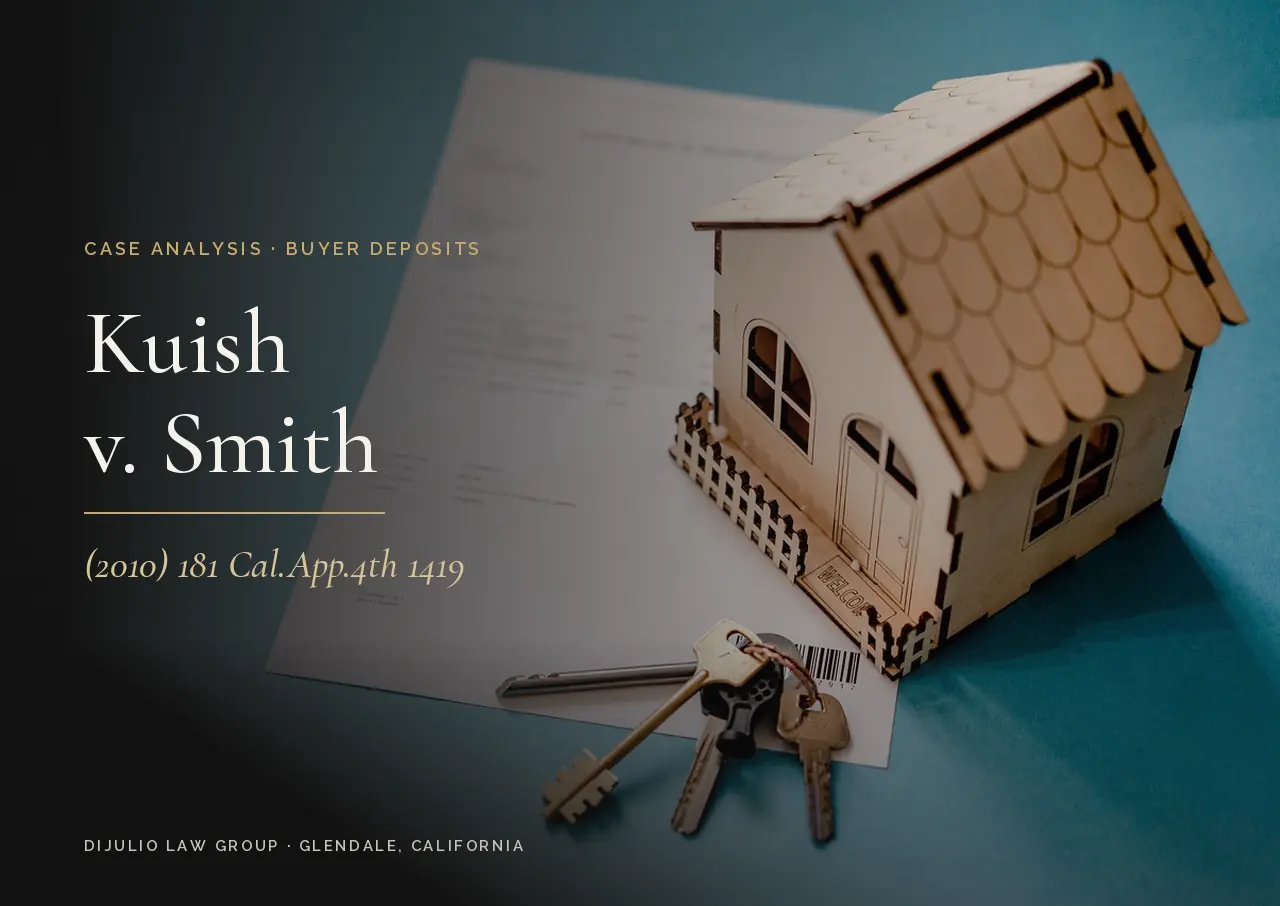
Kuish v. Smith
(2010) 181 Cal.App.4th 1419
- Court
- Court of Appeal, Fourth Appellate District, Division Three
- Docket
- No. G040743 (Orange County Superior Court)
- Decided
- February 2010 · Published
- Disposition
- Judgment for the sellers reversed and remanded
- Doctrines
- Forfeiture · Liquidated damages · Seller's damages (Civ. Code § 3307)
- Property
- Beachfront single-family home in Laguna Beach, Orange County
Facts below are drawn from the published opinion and the stipulated facts it recites. The parties agreed the contract had no liquidated damages clause and was not an option contract.
A buyer agreed to pay $14 million for a Laguna Beach house and put down $620,000 in deposits the contract called "non-refundable." He cancelled escrow. The sellers sold to a backup buyer for $15 million and kept the deposits anyway. The Court of Appeal held that keeping $600,000 when the sellers had lost nothing was an invalid forfeiture, whatever the contract called it.
Can a seller keep a nonrefundable deposit in California?
Not automatically. In Kuish v. Smith, the court held that a seller who resells for more than the contract price, and has no real damages, cannot keep a deposit labeled "non-refundable" unless it qualifies as valid liquidated damages. Without a valid, separately initialed liquidated damages clause, a seller may keep only an amount matching its actual losses.
The court also rejected the argument that the deposit was separate payment for extending escrow. The "non-refundable" term was in the original contract, so it could not serve as new consideration for later extensions.
A Nine-Month Escrow on the Sand
In December 2005, Bradford Kuish offered to buy William and Rhonda Smith's single-family home in Laguna Beach. After an offer and nine counteroffers, the parties signed a purchase agreement on January 7, 2006, at a price of $14 million.
The agreement required two "non-refundable" deposits of $400,000 each. The first was to be released to the sellers once contingencies were approved. Escrow was set to close by July 28. Through later escrow instructions, the parties changed the deposit schedule twice and moved the closing date twice, ending with a total deposit of $620,000 and a September 15, 2006 closing. Of that amount, $400,000 was released to the sellers and $220,000 stayed in escrow.
On September 18, the buyer's lawyer asked the escrow company to cancel. The parties signed cancellation instructions on October 17. The sellers turned to a backup offer and closed a sale to that buyer for $15 million on November 16. The parties stipulated that the home was worth $15 million when the buyer cancelled.
The sellers refused to return any of the money and would not let escrow release the $220,000 it still held. The only damage they identified was $9,483.15 for harm to the roof during the buyer's staking of the property.

The Trial Court: Sophisticated Parties, Separate Consideration
After a bench trial, the Orange County Superior Court ruled for the sellers. It found that $20,000 of the deposit was refundable but offset it entirely with the roof damage and interest. It held that keeping the remaining $600,000 was not a forfeiture because both sides were sophisticated businesspeople who freely negotiated the deposit terms, and it called the deposit separate consideration for the sellers' agreement to keep escrow open for nine months.
The trial court also emphasized that this was not an ordinary house purchase. The buyer planned major renovations requiring approvals from several agencies, which naturally took time.
"Any provision by which money or property would be forfeited without regard to the actual damage suffered would be an unenforceable penalty."
Freedman v. The Rector (1951), quoted in Kuish v. Smith (2010)
Why the Court of Appeal Reversed
In a rising market, the seller's damages were close to zero
California measures a seller's damages when a buyer breaches a purchase contract under Civil Code section 3307: the amount by which the contract price exceeds the property's value, plus consequential damages and interest. The Smiths resold for $1 million more than Kuish had agreed to pay. Apart from the roof, they did not claim any actual damages.
Freedman v. The Rector controls deposits kept as a penalty
The court relied on the California Supreme Court's decision in Freedman v. The Rector (1951) 37 Cal.2d 16. There, a buyer who repudiated a land purchase was held entitled to recover his down payment, less what the seller actually lost, because the seller resold for $2,000 more. The Supreme Court held that even a buyer whose breach is willful can recover the part of the payment that exceeds the seller's actual damage. Letting the seller keep more would be a penalty, and California law disfavors penalties and forfeitures in contract cases.
Calling a deposit "non-refundable" does not make it liquidated damages
The court reasoned that reading "non-refundable" to let the sellers keep the whole deposit regardless of actual damages would, in effect, create a liquidated damages clause. The parties had stipulated their contract had none. And even if the term were treated as one, it would fail Civil Code section 1677, which makes a seller's liquidated damages provision invalid unless each party separately signs or initials it, and, in a printed contract, it appears in at least 10-point bold type or 8-point bold red type.
The court noted the deposit would have been nonrefundable in a falling market to the extent the sellers could prove damages under section 3307. The deposit works as a fund the seller can draw on for real losses, and it puts the burden on the buyer to show that keeping it would be unjust enrichment.
The deposit was not payment for extending escrow
The sellers relied on Horowitz v. Noble (1978) 79 Cal.App.3d 120, where sophisticated developers agreed in a later, separate agreement that $20,000 would be "irrevocably disbursed" in exchange for extending the closing date. The Kuish court distinguished it. Here, none of the amended escrow instructions that extended closing said the deposit was nonrefundable or irrevocably released. The "non-refundable" language was in the original contract, so it could not be new consideration for later changes. Accepting the sellers' argument, the court said, would create an exception that swallows the Freedman rule.
From offer to reversal
Offer made
The buyer offers to purchase the Laguna Beach home.
Contract signed at $14 million
Two "non-refundable" $400,000 deposits are required, and escrow is set to close July 28.
Terms amended
Total deposits are reset to $620,000 and closing moves to September 15. $400,000 is released to the sellers.
Buyer cancels
The buyer's lawyer asks escrow to cancel. Cancellation instructions are signed October 17.
Resale closes at $15 million
The sellers sell to their backup buyer for $1 million more.
Sellers win
The trial court lets the sellers keep the deposits as separate consideration between sophisticated parties.
Reversed
The Court of Appeal holds that keeping $600,000 was an invalid forfeiture and remands for a new judgment.
When Can a Seller Keep the Buyer's Deposit in California?
Short answerA California seller can keep a buyer's deposit after the buyer defaults if the contract has a valid liquidated damages clause, separately initialed by both parties. For an owner-occupied home of one to four units, an amount up to 3 percent of the price is presumed valid. Without a valid clause, the seller may keep only what it can prove it actually lost.
| Situation | Who usually gets the deposit | Why | Authority |
|---|---|---|---|
| Buyer cancels within a contingency period | Buyer, under the contract terms | Cancelling under a contingency is not a default | The purchase agreement |
| Buyer defaults; valid clause; owner-occupied home; 3% or less | Seller, up to the amount actually paid | Presumed valid unless the buyer proves it unreasonable | Civ. Code § 1675(c) |
| Same, but more than 3% | Buyer, unless the seller proves reasonableness | The clause is invalid unless shown reasonable | Civ. Code § 1675(d) |
| Clause not separately initialed | Seller keeps only proven damages | The liquidated damages provision is invalid | Civ. Code § 1677 |
| No clause; deposit labeled "non-refundable"; rising market | Buyer, less the seller's actual losses | Keeping more is an unenforceable forfeiture | Kuish (2010); Freedman (1951) |
| No clause; falling market | Seller, up to proven loss of bargain and costs | The deposit is a fund for actual damages | Civ. Code § 3307 |
| Seller refuses to close | Buyer, and the buyer may seek to force the sale | The breaching seller has no claim to it | Specific performance analysis |
How California's 3 Percent Rule Works
For most home purchases, the deposit fight turns on Civil Code section 1675. It applies to "residential property": a dwelling of no more than four units that the buyer intends, when the contract is made, to occupy as a residence.
- Only money actually paid countsThe clause is valid only to the extent payment in cash or by check, including a postdated check, was actually made.
- 3 percent or less is presumed validThe buyer must prove the amount is unreasonable as liquidated damages to get it back.
- More than 3 percent is presumed invalidThe seller must prove the amount is reasonable to keep it.
- Later resales matterReasonableness is judged by the circumstances when the contract was made and by the terms of any resale made within six months of the buyer's default. A resale at a higher price, as in Kuish, cuts against the seller.
- Each payment needs its own initialsIf more than one payment is to count as liquidated damages, Civil Code section 1678 requires a separate initialed clause for each later payment.
Commercial property, investment property, and homes the buyer does not intend to live in fall outside section 1675. For those, liquidated damages clauses are tested under the general rule in Civil Code section 1671, but section 1677's initialing and type-size requirements still apply to any real property purchase contract.
Getting a Deposit Released From Escrow
Escrow companies will not release a disputed deposit without matching instructions from both sides. For owner-occupied homes of one to four units, Civil Code section 1057.3 adds a penalty for refusing to sign without a good reason.
- 30 days after a written demandA buyer or seller who does not sign the release documents within 30 days after a written demand can be liable for the deposit, plus treble damages of at least $100 and at most $1,000, plus reasonable attorney's fees.
- Good faith disputes are excusedNo penalty applies if the funds are held to resolve a good faith dispute, meaning the withholding party reasonably believed it was entitled to the money.
- Signing a release does not end the contractUnless cancellation is stated, signing escrow release paperwork does not by itself cancel the purchase contract or waive a breach of contract claim.
Deposit disputes in Glendale and Los Angeles transactions that cannot be resolved by agreement are filed in the Los Angeles County Superior Court. Many standard California purchase agreements include a mediation clause, so real estate mediation is often the first formal step.
What Buyers and Sellers Should Do
Read the deposit and liquidated damages terms before signing
Check whether a liquidated damages clause exists, whether both parties initialed it, and how much of the deposit it covers. A "non-refundable" label is not the same thing.
Track every contingency deadline
Most deposit disputes start with a missed deadline. A cancellation inside a contingency period usually protects the buyer; a cancellation after removal usually does not.
Be careful with early release of deposit funds
Money released to the seller during escrow, as $400,000 was in Kuish, can be harder to recover even if the law is on the buyer's side.
If you are the seller, document your losses
Without a valid clause, a seller keeps only proven damages. Keep records of carrying costs, a lower resale price, and other consequential costs.
Send a written demand
A written demand for release of escrow funds starts the 30-day period under Civil Code section 1057.3 and creates a clear record.
Get advice before the deal collapses
A short review of the contract and the facts can show whether to cancel, extend, renegotiate, or insist on closing. The firm's real estate transaction practice handles these reviews.
How DiJulio Law Group Approaches Deposit and Escrow Disputes
Deposit cases are decided on the contract language, the escrow instructions, the timeline, and the numbers: the contract price, the resale price, and the costs each side can prove. The firm starts by putting those in order, then decides whether a demand letter, mediation, or litigation is the right next step. When the seller is the one walking away, the analysis turns to specific performance and, where appropriate, recording a lis pendens, discussed in the firm's analysis of Kirkeby v. Superior Court.
The firm represents buyers and sellers in Glendale, Los Angeles, and throughout Southern California through its California real estate law practice, with trial and appellate work handled by Valeria Granata.
Questions About Nonrefundable Deposits in California
Are nonrefundable deposits legal in California?
A deposit can be described as nonrefundable, but the label alone does not let a seller keep it. Under Kuish v. Smith, if the seller suffers little or no actual loss and the contract has no valid liquidated damages clause, keeping the deposit is an unenforceable forfeiture. The seller may keep only the amount of its proven damages.
Can a seller keep my earnest money if I back out of escrow?
It depends on why and when you backed out. If you cancel under a contingency, the deposit is usually returned under the contract. If you default after removing contingencies, the seller may keep it under a valid, separately initialed liquidated damages clause, presumptively up to 3 percent of the price for an owner-occupied home.
What is the 3 percent rule for deposits in California?
Civil Code section 1675 applies to homes of one to four units the buyer intends to occupy. If the seller keeps 3 percent of the price or less under a valid liquidated damages clause, the amount is presumed valid. If it keeps more, the clause is invalid unless the seller proves the amount was reasonable.
What happens if the seller resells the home for more than my contract price?
The seller's loss-of-bargain damages usually disappear. In Kuish, the sellers resold for $1 million more and could not keep a $600,000 deposit. Under Civil Code section 1675, a resale within six months of the default is also considered when deciding whether a liquidated damages amount is reasonable.
How do I get my deposit back from escrow in California?
Escrow needs signed release instructions from both buyer and seller. For owner-occupied homes of one to four units, a party who fails to sign within 30 days of a written demand, without a good faith dispute, can owe the deposit, treble damages between $100 and $1,000, and attorney's fees under Civil Code section 1057.3.
Does the same rule apply to commercial property?
The 3 percent presumption in Civil Code section 1675 applies only to owner-occupied residential property of up to four units. Commercial and investment purchases are tested under the general liquidated damages rule in Civil Code section 1671. The Freedman and Kuish forfeiture rule, and section 1677's initialing requirement, apply to real property sales generally.
Do I need a real estate attorney for a deposit dispute in Glendale or Los Angeles?
Large deposits, released funds, and disputed contingency deadlines are worth a review before you sign anything that cancels the deal. You can contact DiJulio Law Group or call (818) 502-1700 to discuss the contract and timeline.
Deposit stuck in escrow, or a buyer or seller walking away?
Bring the purchase agreement, every counteroffer and addendum, the escrow instructions, and the cancellation paperwork. The first conversation is about what the contract and the law allow.
330 North Brand Boulevard, Suite 1280, Glendale, CA 91203
This case analysis discusses a published California appellate decision for general information. It is not legal advice, does not create an attorney-client relationship, and does not predict the outcome of any matter. DiJulio Law Group was not counsel in Kuish v. Smith. Facts are drawn from the opinion. Consult a licensed California attorney about your situation.
Primary sources
- Kuish v. Smith (2010) 181 Cal.App.4th 1419, No. G040743 (Cal. Ct. App., 4th Dist., Div. 3). caselaw.findlaw.com
- Freedman v. The Rector (1951) 37 Cal.2d 16. law.justia.com
- Horowitz v. Noble (1978) 79 Cal.App.3d 120, as discussed in the opinion.
- Civil Code §§ 1671, 1675, 1677, 1678 (liquidated damages on default under a real property purchase contract). leginfo.legislature.ca.gov
- Civil Code § 3307 (seller's damages for buyer's breach). leginfo.legislature.ca.gov
- Civil Code § 1057.3 (release of escrow deposits). leginfo.legislature.ca.gov
- Civil Code § 3275 (relief from forfeiture). leginfo.legislature.ca.gov
0 Comments