
California's Mold Disclosure Statute Never Took Effect What actually creates seller and landlord liability for mold in Los Angeles County
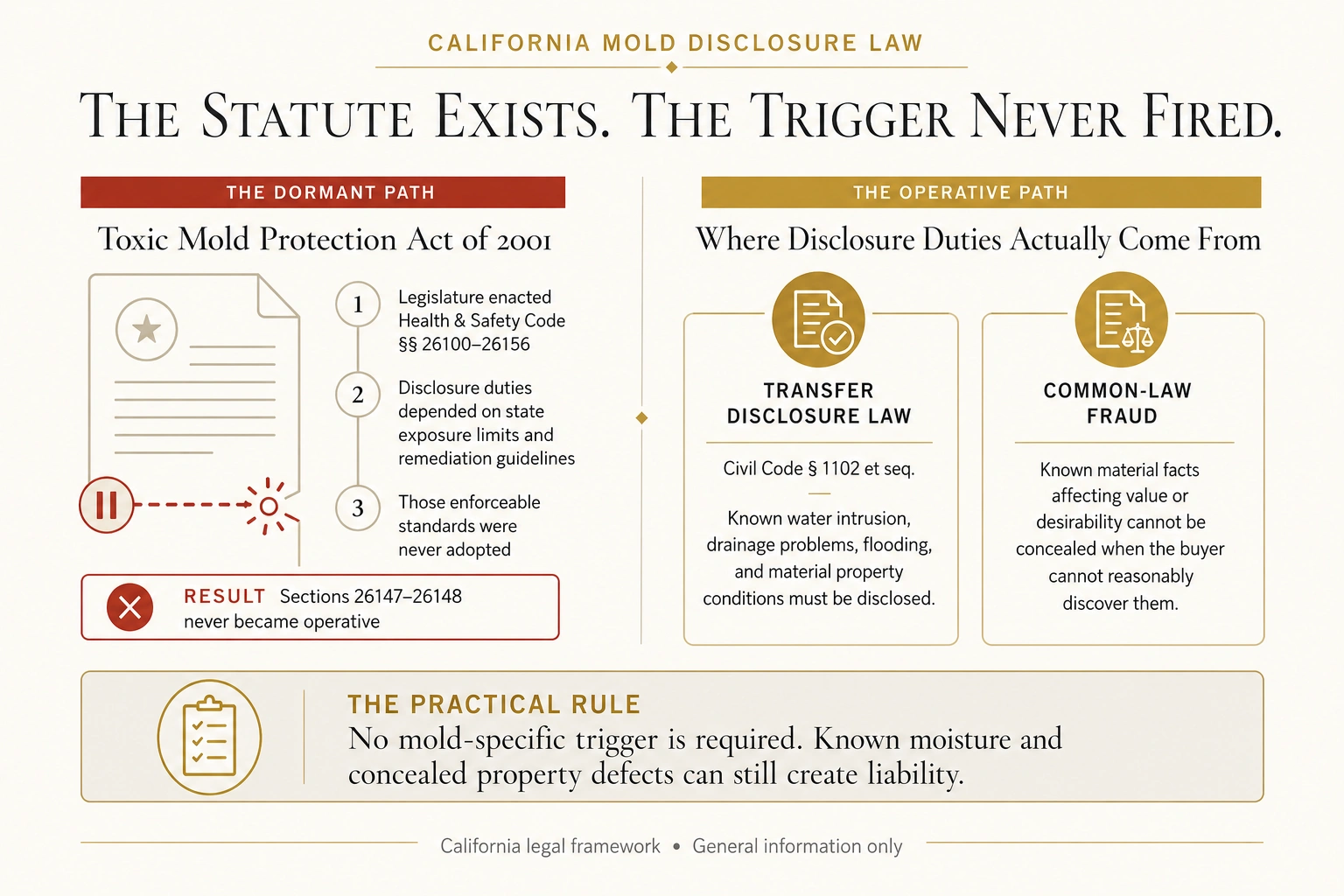
California passed a law in 2001 requiring written disclosure of known mold. It has never become operative, because it was written to activate only after the state adopted permissible exposure limits — and those limits were never adopted. That does not mean mold need not be disclosed. It means liability runs through the Transfer Disclosure Statement and sixty years of California fraud law instead, which is a harder standard for a seller, not an easier one.
The Four Things That Decide a California Mold Nondisclosure Case
- Knowledge
- What the seller or landlord actually knew, and when. A defect alone proves nothing; the case turns on proving awareness that was never passed along
- Materiality
- Whether the condition would affect a reasonable buyer's decision to purchase or the price paid — measured from the buyer's perspective, not the seller's
- Accessibility
- Whether the buyer could have discovered it through reasonable diligence. Concealed conditions behind drywall, fresh paint, or new flooring are the core fact pattern
- Timing
- When the buyer discovered or should have discovered the concealment, which starts the limitations clock on a fraud claim
Does California Law Require Sellers to Disclose Mold?
Yes — but not through the statute most people cite. California's Transfer Disclosure Law, Civil Code section 1102 and following, requires sellers of residential property with one to four dwelling units to deliver a completed Real Estate Transfer Disclosure Statement to the buyer before transfer of title. The TDS asks directly about known water intrusion, flooding, drainage problems, and conditions affecting the property. A seller who knows about a mold or moisture problem and answers those questions inaccurately has violated the statute and, separately, committed common-law fraud.
The confusion comes from a different law entirely. California's Toxic Mold Protection Act of 2001 is real, it is on the books, and it is routinely described online as imposing mold disclosure obligations. That description is wrong, and the reason is worth understanding precisely — because it changes which claims a buyer or tenant actually has.
The Toxic Mold Protection Act of 2001 (Senate Bill 732), codified at Health and Safety Code sections 26100 through 26156, directed the state health department to develop permissible exposure limits for indoor mold, along with assessment and remediation guidelines. It then created disclosure duties keyed to those limits: section 26147 requires a residential landlord to give written disclosure when the landlord knows or has reasonable cause to believe that mold — visible or hidden — is present and either exceeds the permissible exposure limits or poses a health threat under the department's guidelines.
Section 26147 contains its own trigger. Subdivision (e) provides that its requirements do not apply until at least six months after the department adopts the exposure standards and develops the remediation guidelines the Act calls for.
More than two decades later, no enforceable permissible exposure limits have been adopted. The trigger has never fired. The statutory mold disclosure requirement in California has therefore never become operative, and the same is true of the Act's local enforcement provisions, which are delayed on parallel terms.
The practical consequence: there is no freestanding California statute that currently obligates disclosure of mold as mold. Anyone relying on the Toxic Mold Protection Act as the source of a disclosure duty is relying on a provision that has not taken effect — and any legal position built on it is built on nothing.
Where the Duty Actually Comes From
Two independent sources, and a plaintiff typically pleads both. The statutory duty arises from the Transfer Disclosure Law. The common-law duty arises from California fraud and deceit doctrine developed across six decades of appellate decisions. They overlap heavily but carry different elements, different remedies, and different limitations periods — which is why they are pleaded together rather than in the alternative.
The Statutory Framework
Civil Code
§ 1102
Scope, and non-waivability. The Transfer Disclosure Law applies to transfers by sale, exchange, installment land sale contract, lease with an option to purchase, and other specified transactions of real property improved with or consisting of not less than one nor more than four dwelling units. Subdivision (c) is the provision that matters most in litigation: any waiver of the requirements of this article is void as against public policy.
Civil Code
§ 1102.1
"As-is" does not defeat the TDS — and the Legislature said so. Section 1102.1 records the Legislature's intent that delivery of a real estate transfer disclosure statement may not be waived in an "as is" sale, citing Loughrin v. Superior Court (1993) 15 Cal.App.4th 1188 by name. This is unusual and useful: the holding is written into the statute itself.
Civil Code
§ 1102.3
Delivery. The seller must deliver the completed written statement to the prospective buyer in one of the manners the statute specifies. Late delivery, incomplete delivery, and non-delivery are each independently actionable, and brokers carry their own delivery and record-keeping obligations.
Civil Code
§ 1102.6
The form itself. Section 1102.6 sets out the statutory TDS. It asks about known water intrusion, drainage and grading problems, flooding, structural conditions, and room additions or alterations made without required permits. A seller does not need to be asked about "mold" specifically to have a disclosure duty — the water intrusion and property condition questions capture it.
Civil Code
§ 1102.13
The remedy. A transfer is not invalidated solely because someone failed to comply with the article. But any person who willfully or negligently violates or fails to perform any duty prescribed by the article is liable in the amount of actual damages suffered by the transferee. Note the standard: negligence is enough. Intent is not required for statutory liability.
Civil Code
§ 2079
Broker liability. A listing or selling broker owes a duty of reasonably competent and diligent visual inspection of accessible areas and must disclose material facts that inspection would reveal. Buyers frequently name agents alongside sellers, particularly where the agent had actual knowledge of the condition or of prior repairs.
Health & Saf. Code
§§ 26100–26156
The Toxic Mold Protection Act — dormant. Enacted 2001. Disclosure duties under sections 26147 and 26148, and the enforcement provisions, are conditioned on the state's adoption of permissible exposure limits and remediation guidelines that have never been adopted. Cite it for context, never as the source of a duty.
Code Civ. Proc.
§ 338(d)
The clock. A fraud claim carries a three-year limitations period, which runs from the discovery of the facts constituting the fraud rather than from the closing date. Because concealed mold is by definition not discovered at closing, the discovery rule is central — and contested — in nearly every one of these cases.
The California Case Law That Governs Nondisclosure
The common-law duty predates the TDS by more than twenty years and remains broader than it. Four decisions do most of the work.
The Controlling Decisions
1963
Lingsch v. Savage
213 Cal.App.2d 729
Silence can be fraud. Where a seller knows of facts materially affecting the value or desirability of property, knows the facts are not accessible to the buyer, and fails to disclose them, that nondisclosure constitutes actual fraud — not merely a breach. The foundation of every California nondisclosure claim.
1983
Reed v. King
145 Cal.App.3d 261
Materiality is measured from the buyer's side. The duty extends to facts materially affecting value or desirability that are known to the seller and not reasonably discoverable by the buyer — including non-physical conditions. The court reversed dismissal, confirming the breadth of what "material" reaches.
1993
Loughrin v. Superior Court
15 Cal.App.4th 1188
"As-is" is not a shield. An "as-is" clause notifies a buyer that they take the property in its observable condition. It does not waive the TDS and does not relieve a seller of the duty to disclose known concealed defects. The Legislature later wrote this holding into Civil Code section 1102.1.
2009
Calemine v. Samuelson
171 Cal.App.4th 153, 161
Water intrusion history is disclosable. Addressing undisclosed prior water intrusion, the court reinforced that failing to disclose a known material condition is legally equivalent to affirmative misrepresentation. The closest modern authority to the mold fact pattern, and the case most often cited in these disputes.
How Seller Knowledge Actually Gets Proved
A buyer does not win by showing the house had mold. Almost every case comes down to a single contested question: did the seller know? That is proved circumstantially, by assembling a record that makes "I had no idea" implausible.
The Evidence That Establishes Knowledge
1
Permit and Municipal Records
Building department records are public and often decisive. A permit pulled for water damage repair, a plumbing permit, a re-roof, or a code enforcement complaint establishes both the condition and the date the owner knew of it. In Los Angeles County these records frequently contradict a TDS answered "no."
2
Contractor and Remediation Invoices
Invoices, estimates, and work orders from plumbers, roofers, restoration companies, or mold remediators. A seller who paid a remediation firm and then reported no known water intrusion has a serious problem. Subpoenas to local contractors often produce what the seller did not.
3
Insurance Claim History
A prior water-damage claim creates a paper trail with the carrier, an adjuster's file, and often photographs of the damage. CLUE reports and carrier records are among the most reliable sources of pre-sale knowledge because the seller generated them voluntarily.
4
Physical Evidence of Concealment
Fresh paint on one wall, new flooring in a single room, a patched section of drywall, sealed-off crawlspace access, or a recently installed vanity over damaged subfloor. Concealment evidence does double duty: it shows knowledge and it shows intent.
5
Prior Listings and Inspection Reports
Earlier MLS listings, photographs from a prior sale, a home inspection from a deal that fell through, or a pest report noting moisture. Sellers routinely forget that a failed escrow left an inspection report in someone else's file.
6
Tenant, Neighbor, and HOA Records
Prior tenants who complained in writing, neighbors who watched the repair work, and HOA maintenance requests or board minutes referencing leaks in the unit or building. In condominiums, HOA records are often the single richest source.
7
The Seller's Own Communications
Texts and emails with agents, contractors, and family members. Nondisclosure cases are frequently decided by a message the seller sent two years before listing describing exactly the problem they later reported not knowing about.
Mold Claims Between Landlords and Tenants
The disclosure framework above governs sales. A tenant's claim runs on an entirely different track, and the dormancy of the Toxic Mold Protection Act matters more here, because tenants have no TDS to fall back on.
A residential tenant's mold claim typically rests on the implied warranty of habitability and the statutory tenantability standards in Civil Code section 1941.1, together with Health and Safety Code section 17920.3, which defines substandard building conditions to include dampness of habitable rooms and inadequate sanitation. Persistent water intrusion that a landlord knew about and failed to repair after notice is the ordinary theory. Written notice, dated photographs, and repair requests preserved in writing carry these cases; verbal complaints rarely do. Commercial tenancies are governed largely by the lease itself, which makes the repair and maintenance clauses the starting point rather than the habitability statutes.
What to Preserve Before You Talk to Anyone
Buyers
The disclosure packet, intact
Keep the signed TDS, the Seller Property Questionnaire, natural hazard disclosures, all inspection reports, and every counteroffer and addendum. The case is built on what was represented versus what was true.
Buyers
Document before remediating
Photograph the condition, the location, and any evidence of prior repair before anything is torn out. Remediation destroys the evidence of concealment, which is often the strongest part of the claim.
Buyers
Pull the permit history
Municipal building records are public and cheap to obtain. They frequently establish the date of the owner's knowledge before a lawsuit is ever filed, which changes the settlement posture entirely.
Sellers
Over-disclose, in writing
Disclosing a repaired leak costs a negotiation. Concealing one costs a lawsuit with fee exposure. Since waiver is void and "as-is" does not protect you, disclosure is the only durable defense.
Tenants
Put every complaint in writing
Email or text creates a dated record of notice, which is the element landlords contest. Keep photographs, and keep copies of anything you send about lease and repair obligations.
Everyone
Watch the three-year clock
Fraud claims run three years from discovery under Code of Civil Procedure section 338(d), and other theories carry shorter periods. Delay is the most common way a viable claim becomes unviable.
Why This Comes Up So Often in Glendale and Los Angeles County
Mold nondisclosure disputes cluster in older housing stock, and Los Angeles County has an enormous amount of it. Glendale, Burbank, Pasadena, and the surrounding communities are dense with homes built between the 1920s and 1960s — original plumbing, pre-membrane shower pans, unlined crawlspaces, and decades of accumulated repairs that may or may not have been permitted.
Local Conditions That Produce These Disputes
Aging plumbing
Pre-1970 stock
Galvanized supply lines and cast-iron drains reaching end of life produce slow, concealed leaks inside wall cavities and under slabs. The damage is often years old before it becomes visible, which means the seller had time to observe it and repair around it.
Unpermitted work
Additions and conversions
Garage conversions, enclosed patios, and additions built without permits are common across the region and frequently lack proper flashing, vapor barriers, or drainage. The TDS asks specifically about alterations made without required permits, so this creates two disclosure failures from one condition — and often a zoning and code compliance problem as well.
Accessory dwelling units
Post-2017 construction
A decade of rapid ADU construction, some of it permitted and some not, has produced newer structures with drainage and waterproofing problems and inconsistent inspection records. ADU moisture issues now appear regularly in both sale disputes and landlord-tenant habitability claims.
Hillside drainage
Glendale and the foothills
Foothill and canyon properties in Glendale, La Cañada, and the Verdugo and San Gabriel foothills face subsurface water, retaining wall failures, and grading problems. The TDS asks about drainage and grading directly. These conditions also generate boundary and drainage disputes between neighboring owners.
Condominiums
Common-area water
Water intrusion frequently originates in common areas the individual seller does not control, which pulls the association into the dispute and raises questions about what the HOA knew and disclosed. Board minutes and maintenance logs become central evidence.
Post-event repairs
Fire, flood, and storm
Properties repaired after wildfire, storm, or flood damage carry documented histories through insurance claims and permits. Those records survive the sale even when the disclosure does not, and they establish knowledge with a date attached.
DiJulio Law Group handles mold and disclosure disputes as part of its California real estate law practice, including mold claims, failure to disclose defects, lease and habitability matters, and environmental and property condition issues. Related reading includes our case studies on partition standing and inherited property and Los Angeles rent ordinance preemption. The real estate practice center covers what to prepare before a first consultation.
Why This Matters
Five Things Buyers, Sellers, Landlords, and Tenants Get Wrong About California Mold Law
Mold is treated as a specialized technical subject, and that framing is where the mistakes start. In California it is a disclosure question and an evidence question, governed by statutes and cases that have nothing specifically to do with mold.
The Mold Statute Is Not the Law Here
The Toxic Mold Protection Act's disclosure provisions never became operative because the state never adopted the exposure limits they depend on. A claim built on that Act is built on a provision with no force.
"As-Is" Protects Almost Nothing
Waiver of the Transfer Disclosure Law is void as against public policy, and the Legislature codified the rule that an "as-is" sale does not waive TDS delivery. An as-is clause addresses observable condition, not concealed defects.
Negligence Is Enough for the Statute
Civil Code section 1102.13 imposes liability for actual damages on anyone who willfully or negligently fails to perform a duty under the article. A seller does not have to intend to deceive to face statutory exposure.
The Case Is About Knowledge, Not Mold
Finding mold establishes almost nothing on its own. Permits, invoices, insurance claims, prior listings, and the seller's own texts are what decide these disputes. Remediating before documenting destroys the best evidence.
The Clock Runs From Discovery
Fraud claims carry three years from discovery of the facts, not from closing. That helps buyers of concealed conditions, but the discovery date is contested in nearly every case, and waiting rarely improves a position.
Frequently Asked Questions
Does California require sellers to disclose mold?
Yes, through the Transfer Disclosure Law rather than through any mold-specific statute. Civil Code section 1102 and following requires sellers of residential property with one to four dwelling units to deliver a Real Estate Transfer Disclosure Statement, which asks about known water intrusion, drainage problems, flooding, and property conditions. A seller who knows of a mold or moisture problem and answers inaccurately faces statutory liability and a common-law fraud claim. California's Toxic Mold Protection Act of 2001 also contains disclosure provisions, but those have never become operative.
Why has the California Toxic Mold Protection Act never taken effect?
The Act, codified at Health and Safety Code sections 26100 through 26156, directed the state health department to adopt permissible exposure limits for indoor mold and to develop assessment and remediation guidelines. Its disclosure duties under section 26147 were written to apply only after those standards were adopted — specifically, no earlier than six months afterward. No enforceable permissible exposure limits have ever been adopted, so the trigger has never been met and the disclosure requirement has never become operative. The Act's local enforcement provisions are delayed on the same terms.
Can I sue a seller who did not disclose mold in California?
Potentially, if you can show the seller knew of the condition, that it was material to the value or desirability of the property, that it was not reasonably discoverable by you, and that you were damaged. Claims commonly pleaded include statutory violation of the Transfer Disclosure Law, intentional and negligent misrepresentation, concealment, and breach of contract. Under Lingsch v. Savage, a seller's silence about known material facts not accessible to the buyer constitutes actual fraud.
Does an "as-is" clause mean the seller does not have to disclose mold?
No. Any waiver of the Transfer Disclosure Law's requirements is void as against public policy, and Civil Code section 1102.1 records the Legislature's express intent that TDS delivery may not be waived in an "as is" sale, citing Loughrin v. Superior Court (1993) 15 Cal.App.4th 1188. An "as-is" clause tells a buyer they accept the property in its observable condition; it does not excuse a seller from disclosing known concealed defects.
How long do I have to sue for failure to disclose in California?
A fraud claim generally must be brought within three years under Code of Civil Procedure section 338(d), and that period runs from discovery of the facts constituting the fraud rather than from the close of escrow. Other theories carry different and sometimes shorter periods, and the discovery date is frequently disputed. Because the applicable deadline depends on which claims are available on your facts, this is worth confirming with an attorney early rather than late.
What damages are available in a mold nondisclosure case?
Civil Code section 1102.13 provides that a person who willfully or negligently fails to perform a duty under the Transfer Disclosure Law is liable for the actual damages the transferee suffered. Depending on the claims pleaded and the facts proved, recovery may address remediation and repair costs, diminution in the property's value, and consequential losses. Many California purchase agreements also contain attorney's fee provisions, which materially affects the economics on both sides.
How do you prove a seller knew about mold?
Circumstantially, and usually from records the seller created. Municipal permit and code enforcement files, contractor and remediation invoices, insurance claim history, physical evidence of concealment such as isolated fresh paint or replaced flooring, prior MLS listings and inspection reports from failed escrows, HOA maintenance records, prior tenant complaints, and the seller's own texts and emails. Whether the seller's claimed ignorance is believable is the central question in most of these disputes.
Should I remediate the mold before or after consulting an attorney?
Document first. Photograph the condition, its location, and any evidence of prior repair or concealment before anything is opened up or removed, and keep invoices and any testing reports. Health and safety come first and urgent remediation should not be delayed, but remediation destroys the physical evidence of concealment, which is frequently the strongest part of a nondisclosure claim.
Can a tenant sue a landlord over mold in California?
A residential tenant's claim generally rests on the implied warranty of habitability and the tenantability standards in Civil Code section 1941.1, along with Health and Safety Code section 17920.3, which treats dampness of habitable rooms and inadequate sanitation as substandard conditions. The usual theory is that the landlord knew of water intrusion and failed to repair it after notice. Written notice, dated photographs, and preserved repair requests are what carry these claims. Commercial tenancies turn primarily on the lease's repair and maintenance provisions.
Are real estate agents liable for failing to disclose mold?
They can be. Civil Code section 2079 imposes on listing and selling brokers a duty of reasonably competent and diligent visual inspection of accessible areas and disclosure of material facts that inspection would reveal. Agents with actual knowledge of a condition or of prior repairs face broader exposure, which is why buyers frequently name agents alongside sellers.
Does the seller have to disclose unpermitted work that caused water damage?
Yes. The statutory Transfer Disclosure Statement asks specifically about room additions, structural modifications, and other alterations or repairs made without necessary permits. Where an unpermitted addition or garage conversion also caused water intrusion, a seller who stays silent has failed on two separate lines of the form — and permit records make that failure straightforward to establish.
Do I need a mold attorney in Los Angeles or Glendale?
These disputes turn on disclosure law, evidence preservation, and limitations deadlines rather than on mold science, and the strongest evidence is often perishable. DiJulio Law Group advises buyers, sellers, property owners, and businesses on mold claims and disclosure disputes in Glendale, Los Angeles, and throughout Southern California. You can contact the firm or call 818-502-1700 to discuss a property condition matter.
How DiJulio Law Group Approaches Mold and Disclosure Disputes
These matters arrive in a predictable shape. A buyer opens a wall six months after closing. A tenant's complaints go unanswered through a wet winter. A seller receives a demand letter about a leak they repaired years earlier and genuinely believed was resolved. The legal framework is well settled. What varies is the evidence, and how much of it still exists by the time anyone calls a lawyer.
DiJulio Law Group has represented property owners, buyers, sellers, and businesses in Glendale, Los Angeles, and throughout Southern California for more than 35 years in real estate, business, construction, environmental, and mediation matters. Founding partner R. David DiJulio holds a background in environmental science alongside his legal practice and has handled California property condition, disclosure, and habitability litigation across that period.
The first work in a disclosure matter is diagnostic and largely factual: pulling the municipal permit history, identifying what records exist and where, reviewing the disclosure packet against the actual condition, and determining which limitations periods are running. That analysis frequently establishes the strength of a claim or a defense before a complaint is drafted — and where it points toward resolution, real estate mediation often resolves these disputes faster and at far lower cost than litigation.
Dealing With Undisclosed Mold or a Property Condition Dispute?
DiJulio Law Group advises buyers, sellers, owners, and businesses on California disclosure and property condition matters in Glendale, Los Angeles, and throughout Southern California.
This guide discusses California statutes and published appellate decisions for general informational purposes. It is not legal advice, does not create an attorney-client relationship, and does not describe or predict the outcome of any particular matter. Every property dispute depends on its own facts, records, and procedural posture, and the law changes. Consult a licensed California attorney about your situation.
Primary Sources
- California Civil Code, Division 2, Part 4, Title 4, Chapter 2, Article 1.5, "Disclosures Upon Transfer of Residential Property," §§ 1102–1102.19. California Legislative Information, official statutory text. leginfo.legislature.ca.gov
- California Civil Code § 1102.1 (legislative intent; delivery of the transfer disclosure statement may not be waived in an "as is" sale, citing Loughrin v. Superior Court (1993) 15 Cal.App.4th 1188). California Legislative Information, official statutory text. leginfo.legislature.ca.gov
- Senate Bill 732 (2001–2002 Reg. Sess.), the Toxic Mold Protection Act of 2001, enacting Health and Safety Code §§ 26100–26156. California Legislative Information, official bill text. leginfo.legislature.ca.gov
- California Health and Safety Code § 26147 (toxic mold written disclosure requirement; subdivision (e) conditions applicability on the department's adoption of exposure standards and remediation guidelines). codes.findlaw.com
Authorities Cited
- Cal. Civ. Code §§ 1102, 1102.1, 1102.2, 1102.3, 1102.6, 1102.13 (Transfer Disclosure Law).
- Cal. Civ. Code § 2079 (broker duty of visual inspection and disclosure).
- Cal. Civ. Code §§ 1709, 1710 (deceit).
- Cal. Civ. Code § 3343 (damages for fraud in the purchase or sale of property).
- Cal. Civ. Code §§ 1941, 1941.1 (landlord repair obligations and tenantability).
- Cal. Health & Saf. Code §§ 26100–26156, esp. §§ 26103, 26105, 26130, 26147, 26148, 26154 (Toxic Mold Protection Act of 2001).
- Cal. Health & Saf. Code § 17920.3 (substandard building conditions, including dampness of habitable rooms).
- Cal. Code Civ. Proc. § 338(d) (three-year limitations period for fraud, running from discovery).
- Lingsch v. Savage (1963) 213 Cal.App.2d 729.
- Reed v. King (1983) 145 Cal.App.3d 261.
- Alexander v. McKnight (1992) 7 Cal.App.4th 973.
- Loughrin v. Superior Court (1993) 15 Cal.App.4th 1188.
- Shapiro v. Sutherland (1998) 64 Cal.App.4th 1534.
- Calemine v. Samuelson (2009) 171 Cal.App.4th 153.
0 Comments