
Full Citation & Procedural Posture
Holguin Family Ventures, LLC v. County of Ventura
(2024) 104 Cal.App.5th 157
- Court
- Court of Appeal, Second District, Division 6
- Docket
- No. B328569
- Decided
- July 24, 2024 · Published August 13, 2024
- Disposition
- Judgment for the County affirmed
- Doctrines
- Legal nonconforming use · Conditional use permits · Standard of review
- Property
- Old Creek Ranch Winery, Ventura County
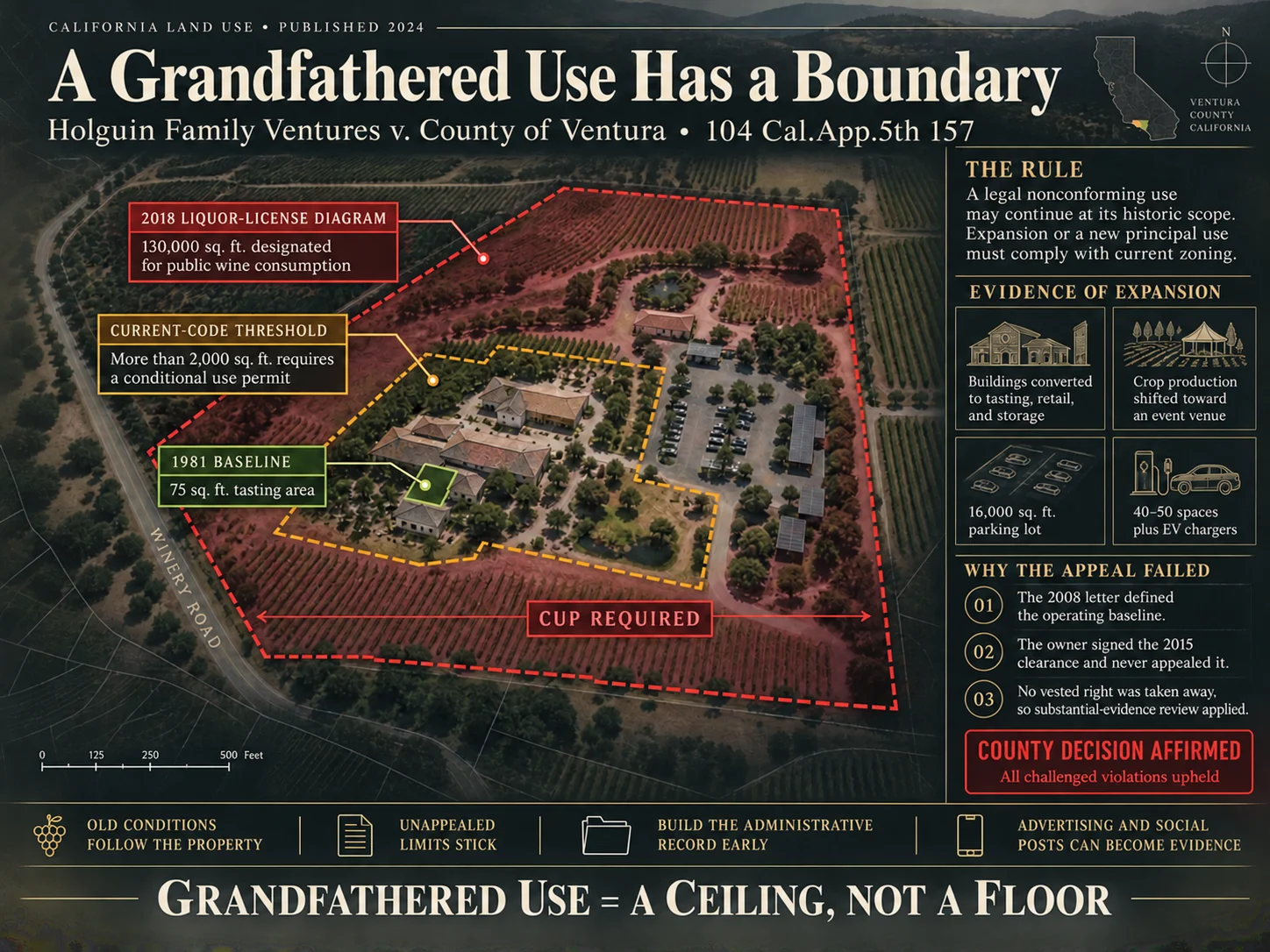
In 1981, Ventura County approved a 75-square-foot wine tasting area inside a 600-square-foot farm winery. In 2018, the property's new owner filed a liquor license diagram designating 130,000 square feet for public wine consumption. Everything between those two numbers is what California calls a legal nonconforming use, and this published decision explains exactly how far one can stretch before it snaps. If you have received a notice of violation, are preparing for a zoning appeal hearing, or are buying property that operates under a grandfathered use anywhere in Los Angeles County, this is the case that tells you what you actually have.
A legal nonconforming use is a use that was lawful before a zoning change made it nonconforming. It may continue, but it cannot be expanded or converted into a different principal use without the permit the current code requires. The Court of Appeal upheld Ventura County's findings that the owners had tripled the winery's footprint, turned agricultural buildings into a tasting room, a gift shop, and a warehouse, and changed the ranch's principal use from crop production to a wine tasting and event venue, all without a conditional use permit.
The court also held that because the County had not taken away any part of the use as it existed when the rules changed, no fundamental vested right was affected. That meant the trial court correctly reviewed the County's decision under the deferential substantial evidence standard rather than exercising independent judgment. And because the owner signed and never appealed the 2015 zoning clearance that incorporated a 2008 baseline letter, it was bound by those limits.
The practical rule: a grandfathered use is a ceiling, not a floor, and the permit file defines where the ceiling is.
75 sq ft
Tasting area approved in 1981
130,000
Square feet on the 2018 liquor license diagram
155
Findings the Board of Supervisors adopted
4,813
Pages in the administrative record
A Farm Winery at the End of a One-Lane Road
Old Creek Ranch covers roughly 800 acres north of the City of Ventura, at the dead end of Old Creek Road. Holguin Family Ventures owns about 329 of those acres, zoned Agricultural Exclusive, and the winery sits on its parcel. Its lessee, OCRW, Inc., runs the operation.
The winery's legal history starts with a 1981 County zoning clearance for a temporary produce stand inside an existing winery. The clearance recorded the winery at 30 by 20 feet, or 600 square feet, and the produce stand at 15 by 5 feet, or 75 square feet. A 1990 clearance added 676 square feet, bringing the permitted total to roughly 1,276 square feet.
Between those two permits, in 1985, the County amended its Non-Coastal Zoning Ordinance to require a discretionary conditional use permit for any winery offering public tours or a tasting room, and for any winery with more than 2,000 square feet of structures. Because the ranch's winery and tasting area already existed under a ministerial clearance, they became a legal nonconforming use: lawful to continue, but no longer permitted as of right if anyone started fresh.
The Letter That Defined the Baseline
In December 2007, the County cited the prior owner for operating a tasting room without a conditional use permit. Her lawyer responded that the 75-square-foot produce stand had always been intended as a tasting area within the permitted winery, and that the tasting area had remained the same size and operated the same way since 1981. The argument worked. In January 2008, the Planning Director rescinded the violation.
Then, on March 5, 2008, the Planning Director sent a second letter documenting the baseline of what could continue without a permit: all activities had to stay incidental and subordinate to wine production, weekday visitors of roughly 50 to 75 a day and up to 150 on Saturdays, and marketing or educational events capped at 15 or 25 guests. Weddings, birthday parties, reunions, and receptions would require a conditional use permit. The prior owner did not appeal.
That is the pivot of the entire case. A letter written to defend the prior owner, describing a small tasting room in modest terms, became the legal measure of what every future owner could do on that land.
Drawn to scale: what was approved versus what was designated
- 1981 approval
- Ministerial cap
- 2018 designation
What the New Owner Bought, and What It Signed
Holguin Family Ventures purchased the property in June 2015 and closed the winery for about three years of construction and renovation. Before reopening, on August 10, 2015, its president wrote to the Planning Division. The letter expressly referenced the March 5, 2008 letter and asked for slightly longer operating hours than it allowed. Nine days later, the Planning Division replied that exceeding the 2008 parameters would require a conditional use permit.
In September 2015, the County issued an Inauguration of Use zoning clearance, ZC15-0948, for an existing winery of up to 2,000 square feet covering bottling, processing, and storage. It noted the permitted produce stand with a nonconforming tasting room, set tasting hours of 11:00 a.m. to 5:00 p.m., stated that no special events would be permitted until a conditional use permit issued, and directed the reader to the prior correspondence with the previous owner. Andrew Holguin signed a certification that he had read and understood its terms and conditions and agreed to abide by them. No one appealed it.
That certification ended the owner's best argument before it began. On appeal, the owners said a new buyer could not have known about a 2008 letter sent to someone else. The court pointed to their own August 2015 letter, which quoted the 2008 letter by date.
The owner's own 2015 letter quoted the 2008 baseline by date. That single document defeated the argument that a new buyer could not have known the limits. The due diligence lesson of Holguin
Forty-Three Years of Permits and Letters
1981
A 75-square-foot beginning
A ministerial zoning clearance approves a produce stand inside an existing 600-square-foot winery.
1985
The rules change
The County requires a conditional use permit for tasting rooms and for wineries over 2,000 square feet. The existing winery becomes a legal nonconforming use.
1990
A permitted addition
A 676-square-foot addition brings the permitted winery to roughly 1,276 square feet, still under the cap.
2007–2008
The baseline letter
A violation against the prior owner is rescinded after her lawyer describes the tasting area as unchanged since 1981. A March 5, 2008 letter fixes visitor counts, hours, and event limits. It is never appealed.
2015
Purchase and a signed clearance
Holguin buys the property, cites the 2008 letter in its own correspondence, then signs zoning clearance ZC15-0948 limiting the winery to 2,000 square feet and barring special events without a permit.
2018
Reopening, complaints, and a stop work order
Neighbors complain of traffic and events. The liquor license diagram shows 130,000 square feet. The County stops work on a 40-plus space paved lot with electric vehicle chargers built on former farmland.
2019–2021
Two rounds of hearings
The Planning Commission and Board deny the appeals unanimously. A court sends the matter back for adequate findings, and at a new hearing the Board adopts 155 findings of fact.
2022–2024
Affirmed and published
The trial court upholds the Board under substantial evidence review. The Second District affirms on July 24, 2024 and certifies the opinion for publication on August 13.
The Fight That Decided the Case: Which Standard of Review
The owners' lead argument on appeal was not that the County got the facts wrong. It was that the trial court used the wrong lens. They wanted the court to independently reweigh a 4,813-page administrative record. The court declined, and the reason is the most portable lesson in the opinion.
Land use decisions are reviewed through administrative mandamus under Code of Civil Procedure section 1094.5. If the decision substantially affects a fundamental vested right, the trial court exercises its independent judgment on the evidence. If it does not, the court asks only whether substantial evidence supports the agency's findings, viewing the record in the light most favorable to the agency. The difference is often outcome-determinative.
Two Standards, Two Very Different Hearings
Independent Judgment
Fundamental vested right affected
- When it applies
- The agency's action takes away or substantially impairs a right the owner already holds.
- What the court does
- Reweighs the evidence itself and reaches its own conclusions on the record.
- Example
- Goat Hill Tavern v. City of Costa Mesa: refusing to renew the permit of a tavern operating legally for 35 years destroyed an established business.
Substantial Evidence
No fundamental vested right affected
- When it applies
- The agency leaves the existing right intact and regulates only what goes beyond it.
- What the court does
- Presumes the findings are supported and reverses only if no reasonable person could reach them.
- Example
- Holguin: the owners could still operate the winery and tasting room exactly as the use existed in 1985.
Why it mattered. The owners argued they were defending an existing right, not seeking to expand one. The court accepted the framing and rejected the conclusion: if there is a vested right to the 1985 use, the County had not narrowed it at all. In 1985 the winery was 600 square feet and the tasting area was 75 square feet inside it. Everything the County cited was beyond that line.
Which means the characterization you give an agency's action at the administrative stage shapes the standard a court will later apply. An owner who can show the government took something away gets a fresh look. An owner who is told to stop doing something new generally does not.
Every Violation the Court Upheld
The County's 2019 notice of violation listed several items. The owners challenged four of them plus the denial of the parking lot clearance. Each one turned on the same two definitions in the County ordinance: an expansion means increasing the area or volume occupied by or devoted to a use, and a change of use occurs where a new use is initiated in place of or in addition to a previous one.
Five Challenges, Five Rulings for the County
Expansion and change of principal use Upheld
The footprint had tripled, tasting occurred across the grounds rather than inside the original building, and the grapes were now grown and made into wine off site. A property historically in crop production had become, in the planner's words, a de facto bar and event venue. A 1985 historical geography documenting orchards, berries, and vineyards supplied the evidence of the original agricultural use.
2,000-square-foot agricultural building Upheld
Permitted as agricultural storage. Used for a yoga and wine tasting event and pourer training, fitted with a built-in bar and barrel tables, and described by the owner online as the new tasting room.
900-square-foot agricultural shed Upheld
Permitted as general storage. At inspection it held books, china, wine baskets, shirts, and olive oil for sale, beneath a sign reading Winery above another advertising holiday gifts.
Roughly 3,000 square feet of wine storage Upheld
The owners called bottled wine an agricultural product. The ordinance counts wine storage toward a winery's square footage, and the clearance placed storage inside the 2,000-square-foot winery.
Paved lot and electric vehicle chargers Upheld
About 16,000 square feet of farmland soils of statewide importance paved for 40 to 50 cars. The court agreed the lot and the winery expansion were a single project, because the lot was far larger than the original tasting room could ever have needed.
Two procedural rulings closed the remaining doors. The trial court's denial of leave to add a new declaratory relief claim was not an abuse of discretion, because the requested clarification was unnecessary and the motion came late. And the County's Outdoor Events Ordinance did not help the owners, because it excludes events already addressed by a permit and wineries in the agricultural zone are separately regulated.
How a Zoning Violation Appeal Actually Works
The part of Holguin most owners should study is not the appellate reasoning. It is the sequence that produced the record the court later reviewed. By the time a land use dispute reaches a judge the evidence is closed, and everything that mattered was decided at the counter, the inspection, and the hearing.
Five Stages, and Where Each One Is Won or Lost
Notice of violation
Code compliance issues a notice, usually after a complaint or an inspection. The appeal deadline starts here and it is short. In Holguin, an inspection the owner partly refused produced the finding that the winery had expanded significantly from its 1980s footprint.
Staff determination on the permit route
Planning staff decide whether a request can be handled ministerially through a zoning clearance or requires a discretionary permit. Here, staff concluded the parking lot and chargers belonged in a conditional use permit rather than a clearance.
Planning commission hearing
The first hearing on the appeal. This is where evidence enters the administrative record: staff reports, photographs, permits, advertisements, and neighbor testimony. Little can be added later.
Appeal to the governing board
A city council or board of supervisors hears the final administrative appeal and adopts findings. A court sent Holguin back once because the findings were inadequate. On the second pass the Board adopted 155 of them.
Writ petition in superior court Record is closed
Review runs under Code of Civil Procedure section 1094.5 on the administrative record alone. A court will not hear evidence you did not present at the hearing, and under substantial evidence review it reads what is there in the agency's favor.
Land use enforcement often arrives alongside other regulatory exposure. Agricultural and industrial sites face environmental permitting and hazardous materials inspections on separate tracks, and a violation in one program frequently prompts scrutiny in another. Holguin itself surfaced fire access findings about road width and secondary access. See environmental law and environmental enforcement and compliance.
Does This Describe a Property You Own or Are Buying?
Grandfathered uses are everywhere in Los Angeles County: a duplex in a single-family zone, a corner market in a residential block, a small manufacturer in a neighborhood that rezoned around it, a restaurant whose seating predates current parking rules. If any of the following fits, the principles in Holguin already apply to you.
Six Signs a Property Is Running on a Nonconforming Use
The use would not be allowed if someone applied for it today. That alone makes it nonconforming, and it means any growth needs a permit the property may not qualify for.
The seller described the use as grandfathered or legal nonconforming. Ask for the documents that prove its scope, not just its existence.
There is old correspondence between a prior owner and the planning department. As Holguin shows, a letter to someone else can define your limits.
You plan to add seating, hours, events, parking, or square footage. Each can be an expansion, even when the structure itself does not change.
A building permitted for one purpose is quietly used for another. Storage used as a showroom or a barn used as a venue is a change of use. See disclosure of unpermitted work.
You have been asked to sign a zoning clearance or accept permit conditions. Signing without appealing can bind you to terms you later want to contest.
The permit file answers most of this. Every clearance, condition, violation notice, and letter in the city or county file defines the scope of what you can lawfully continue. Read it before closing, not after the first complaint.
Before you expand, buy, or sign
Not sure what your grandfathered use actually allows?
A free consultation with DiJulio Law Group covers what the permit file shows, where the ceiling sits, and whether a conditional use permit is the better path. Nothing is filed without your direction.
How to Protect a Legal Nonconforming Use
The owners in Holguin lost on nearly every point, but most of what cost them was avoidable. These are the moves that preserve the value of a grandfathered use rather than put it at risk.
Five Moves That Preserve a Grandfathered Use
Document the baseline yourself
Before anyone else does
Assemble the permits, photographs, business records, and licenses that show the use as it existed when the rules changed. Whoever documents the baseline first usually defines it. In Holguin, that was a prior owner's lawyer describing a small tasting room modestly to win a different argument.
Appeal what you disagree with
On the deadline, not later
A landowner who accepts the benefits of a permit without challenging its conditions generally cannot contest them afterward. The owners here argued earlier clearances allowed more than 2,000 square feet. The time to raise that was 2015, when the clearance issued.
Apply for the permit first
Growth needs the current rules
Where the plan exceeds the baseline, a conditional use permit or variance is the lawful route, and it is far cheaper before construction than after a stop work order. See zoning, permits, and entitlements.
Keep permitted buildings on purpose
Uses, not just walls
A building approved for storage must be used for storage. Conversions to retail, assembly, or hospitality are changes of use even when nothing is built, and social media posts become evidence of how a space is really used.
Frame the government action correctly
It sets the standard of review
If an agency is taking away part of an existing lawful use, say so and build the record for independent judgment review. If you are asking to do more, expect deference to the agency. Mediation and negotiated conditions often resolve these matters before a hearing.
How These Disputes Arise Across Los Angeles County
Holguin came from the Second Appellate District, the same appellate court that hears appeals from Los Angeles County. Its reasoning applies directly to land use disputes in Glendale, the City of Los Angeles, and unincorporated county areas, each of which has its own zoning code and nonconforming use rules.
Where Nonconforming Use Disputes Come From
Glendale
City code · Development Services
Older commercial corridors and hillside neighborhoods carry uses and structures that predate current standards. Permit and planning records are held by the City of Glendale Development Services division. See also our Glendale real estate practice.
City of Los Angeles
Zoning code · City Planning
Restaurants, markets, small industrial users, and multi-unit buildings operating under prior approvals are common. Seating, hours, alcohol service, and parking are the usual flashpoints. Current zoning information is published by Los Angeles City Planning. See Los Angeles real estate litigation.
Unincorporated LA County
Title 22 · Regional Planning
Agricultural, equestrian, and rural residential areas raise the same issue Holguin did: a farm use drifting toward hospitality or events. The LA County Department of Regional Planning handles zoning for areas outside city limits.
Commercial tenants
Leases · operating limits
A tenant can inherit a landlord's nonconforming status without realizing it, then trigger a violation by changing the operation. Use clauses and permit representations in the lease matter. See commercial leases.
Acquisitions
Due diligence · closing
A buyer paying for a business's revenue is often paying for a use that cannot legally grow. Permit history belongs in the diligence checklist alongside title and environmental review. See transactional real estate.
Environmental permitting
Hazardous materials · inspections
Businesses that store or handle regulated materials answer to a unified program agency in addition to the planning department. A land use violation and an environmental inspection often follow one another, on separate timelines and with separate penalties. See enforcement and compliance.
Fire and access
Hillside · high severity zones
In Holguin, the fire division noted the site sat in a high and moderate fire severity zone and lacked the road width and secondary access a new approval would require. Intensifying a use on a narrow road invites exactly that scrutiny.
DiJulio Law Group advises owners, buyers, tenants, and businesses on these issues as part of its California real estate law practice, including zoning and land use, transactions and due diligence, and construction and environmental matters. More decisions are collected in our California case study library, including Nellie Gail Ranch v. McMullin, where a city's height and slope requirements for a retaining wall shaped the outcome.
Why This Matters
Six Things Holguin Settles About Grandfathered Uses
A legal nonconforming use is valuable precisely because it could not be approved today. That same fact is what makes it fragile.
A Ceiling, Not a Floor
The use may continue at its historic scope. Any expansion or change of principal use needs whatever permit the current code requires.
Expansion Is Measured by Use
Hours, visitors, events, parking, and floor area devoted to the use all count. A building does not have to grow for the use to expand.
Old Letters Bind New Owners
A baseline accepted by a prior owner and incorporated into a later permit can define the limits for every buyer that follows.
Unappealed Conditions Stick
Accepting a permit's benefits without challenging its conditions generally forfeits the right to contest them later.
The Standard Often Decides It
Independent judgment applies only when a fundamental vested right is taken away. Regulating growth beyond the baseline gets deferential review.
Your Posts Are Evidence
Advertisements, event listings, and social media showed how each building was really used. They carried as much weight as the inspection.
Frequently Asked Questions
What is a legal nonconforming use in California?
A legal nonconforming use is one that existed lawfully before a zoning restriction took effect and does not conform to the ordinance as it continues afterward. It may generally keep operating at its existing scope, but it cannot be expanded or changed into a different use without complying with the current code, which often means obtaining a conditional use permit or other discretionary approval. Local ordinances also commonly limit rebuilding after damage and end the right if the use is discontinued for a set period.
Can I expand a grandfathered use without a permit?
Generally no. In Holguin Family Ventures v. County of Ventura (2024) 104 Cal.App.5th 157, the Court of Appeal upheld findings that a winery operating as a legal nonconforming use violated the county zoning ordinance by expanding its footprint and converting agricultural buildings to tasting, retail, and storage uses without a conditional use permit. The right to continue a nonconforming use protects what already exists; growth beyond that baseline must meet current rules.
What counts as an expansion or change of use?
It depends on the local ordinance, but definitions are typically broad. The Ventura County ordinance applied in Holguin defines expansion as increasing the area or volume occupied by or devoted to a use, and a change of use as initiating a new use in place of or in addition to a previous one. Under those definitions, more visitors, longer hours, events, a paved parking lot, or using a storage building as a showroom can each qualify, even without new construction.
Does a new owner inherit the limits placed on a prior owner?
Often, yes. In Holguin, a 2008 letter from the planning director to the prior owner established the baseline for the nonconforming use, and a 2015 zoning clearance issued to the new owner incorporated that correspondence. Because the new owner signed the clearance and did not appeal it, the court held it was bound by those limits. The owner's own 2015 letter quoting the 2008 letter defeated the argument that it could not have known about them.
What standard does a court use to review a zoning decision?
Land use decisions are reviewed through administrative mandamus under Code of Civil Procedure section 1094.5. If the decision substantially affects a fundamental vested right, the trial court exercises independent judgment on the evidence. Otherwise it applies the substantial evidence standard, presuming the agency's findings are supported and reversing only if no reasonable person could reach them. Courts rarely apply independent judgment to land use decisions outside classic vested-rights situations.
What is a conditional use permit?
A conditional use permit is a discretionary approval that allows a use the zoning code permits only under specified conditions, after review and usually a public hearing. It can impose limits on hours, occupancy, parking, events, and operations. Because it is discretionary, the agency can deny it or condition it heavily, which is why a grandfathered use that avoids the requirement is often so valuable and why expanding one is scrutinized closely.
What happens if I do not appeal a zoning clearance or permit condition?
You may lose the ability to challenge it. The court in Holguin relied on the rule that a landowner who acquiesces in a permit condition, by agreeing to it or failing to challenge its validity while accepting the permit's benefits, cannot later contest it. The owners argued earlier permits allowed more than 2,000 square feet, but because they never appealed the 2015 clearance that set that limit, the argument came too late.
Can a parking lot count as an expansion of a business?
It can. In Holguin, the owners paved roughly 16,000 square feet of farmland for 40 to 50 parking spaces with electric vehicle chargers and argued parking was not part of the winery. The court held a reasonable person could find the lot was an integral part of the winery's expansion, because it was far larger than the original small tasting room could have needed and was designed to attract more visitors. The lot and the expansion were treated as a single project.
How do I find the permit history for a property in Glendale or Los Angeles?
Request the planning and building records from the agency with jurisdiction. In Glendale, that is the City of Glendale Development Services division. In the City of Los Angeles, start with Los Angeles City Planning. For unincorporated areas, contact the LA County Department of Regional Planning. Ask specifically for zoning clearances, conditional use permits, violation notices, and correspondence with prior owners.
How do I appeal a zoning violation or notice of violation?
Appeals run through the local agency before they reach a court. A notice of violation is typically appealed to a planning commission or hearing officer, and that decision can be appealed again to a city council or board of supervisors. The deadlines are short and strictly applied. Because a court later reviews only the administrative record under Code of Civil Procedure section 1094.5, every document, photograph, permit, and expert opinion you want considered must be presented at the administrative hearing rather than afterward.
What is the difference between a variance and a conditional use permit?
A variance excuses a property from a physical development standard such as a setback, height, or lot coverage requirement, usually where something about the parcel makes strict compliance a hardship. A conditional use permit authorizes a use the zone allows only subject to review and conditions. Both are discretionary and both generally require findings and a public hearing, but they answer different questions: a variance concerns the dimensions of what you build, a conditional use permit concerns what you do there.
What are land use entitlements?
Entitlements are the discretionary approvals a project needs before it can be built or operated: conditional use permits, variances, zone changes, general plan amendments, subdivision approvals, development agreements, and any environmental review those approvals trigger. They generally run with the land rather than the owner, which is why a buyer inherits both their benefits and their conditions. Holguin is a reminder that conditions attached to an earlier approval can bind every later owner.
Can a zoning violation lead to environmental enforcement?
They frequently travel together. A site inspection prompted by a land use complaint can surface issues under separate environmental programs, including hazardous materials handling, stormwater, or grading, each administered by a different agency with its own timeline and penalties. In Holguin, the county fire division separately noted the property sat in a high and moderate fire severity zone without the road width or secondary access a new approval would require. See environmental law.
Do I need a land use attorney in Los Angeles or Glendale?
If you are buying a property with a grandfathered use, planning to expand an existing operation, responding to a notice of violation, or preparing for a planning commission or board hearing, early legal review usually changes the outcome, because the administrative record built at the hearing is what a court will later review. DiJulio Law Group handles zoning and land use matters including violation hearings, appeals, variances, conditional use permits, and entitlements in Glendale, Los Angeles, and throughout Southern California. You can contact the firm or call 818-502-1700.
How DiJulio Law Group Approaches Zoning and Land Use Matters
These matters rarely start in court. They start with a stop work order, a notice of violation, a neighbor complaint, a denied clearance, or a buyer's question about what a property is actually allowed to do. The outcome is usually shaped long before any lawsuit, by what goes into the administrative record.
The first work is to pull the complete permit and planning file, reconstruct the baseline of any nonconforming use, identify which approvals and conditions are binding and which appeal deadlines are still open, and decide whether the better path is defending the existing use, negotiating conditions, or applying for the permit the expansion requires.
DiJulio Law Group has represented owners, buyers, tenants, and businesses in Glendale, Los Angeles, and throughout Southern California for more than 35 years in real estate, business, construction, environmental, and mediation matters. Founding partner R. David DiJulio brings a background in environmental science, which matters in agricultural land, grading, fire access, and site condition questions. Senior Litigator and Trial Attorney Valeria Granata handles trial and appellate work in California real estate and business matters.
Facing a Zoning Violation or Planning a Change of Use?
Bring the permit file if you have it, any violation notices, and the correspondence with the city or county. The first conversation is about what those records allow and which deadlines are running.
- Free initial consultation
- 35+ years in California real estate matters
- You speak with an attorney, not an intake screener
- Serving Glendale, Los Angeles, and Southern California
This case study discusses a published California appellate decision for general informational purposes. It is not legal advice, does not create an attorney-client relationship, and does not describe, promise, or predict the outcome of any matter. DiJulio Law Group was not counsel in Holguin Family Ventures, LLC v. County of Ventura. Facts stated here are drawn from the published opinion. Zoning rules differ by city and county and change over time. Consult a licensed California attorney about your situation.
Primary Sources
- Holguin Family Ventures, LLC v. County of Ventura (2024) 104 Cal.App.5th 157, No. B328569 (Cal. Ct. App., 2d Dist., Div. 6, July 24, 2024), certified for publication August 13, 2024. Full opinion text. caselaw.findlaw.com
- Same opinion, Justia case law archive. law.justia.com
- Same opinion with publication order, CourtListener. courtlistener.com
- California Code of Civil Procedure § 1094.5 (administrative mandamus). California Legislative Information, official statutory text. leginfo.legislature.ca.gov
- City of Glendale, Community Development, Development Services. glendaleca.gov
- Los Angeles City Planning. planning.lacity.gov
- Los Angeles County Department of Regional Planning, Land Use and Zoning. planning.lacounty.gov
- Coblentz Patch Duffy & Bass, Summary of Select 2024 California Real Estate and Land Use Cases (Feb. 11, 2025). coblentzlaw.com
- Ojai Valley News, Supervisors deny three appeals for winery (Sept. 20, 2019), contemporaneous coverage of the Board hearing. ojaivalleynews.com
Authorities Cited in the Opinion
- Cal. Code Civ. Proc. §§ 1085, 1094.5.
- Ventura County Non-Coastal Zoning Ordinance §§ 8101-3.1, 8102-0, 8104-1.2, 8105-4, 8107-46, 8111-7.1, 8113-10.3(b).
- Ideal Boat & Camper Storage v. County of Alameda (2012) 208 Cal.App.4th 301, 313 (definition of legal nonconforming use).
- SP Star Enterprises, Inc. v. City of Los Angeles (2009) 173 Cal.App.4th 459, 468–469 (standards of review).
- Goat Hill Tavern v. City of Costa Mesa (1992) 6 Cal.App.4th 1519, 1527–1531 (fundamental vested right; distinguished).
- Saraswati v. County of San Diego (2011) 202 Cal.App.4th 917, 926–927.
- Akella v. Regents of University of California (2021) 61 Cal.App.5th 801, 814.
- Young v. City of Coronado (2017) 10 Cal.App.5th 408, 419–421.
- Inyo Citizens for Better Planning v. Inyo County Bd. of Supervisors (2009) 180 Cal.App.4th 1, 13.
- Rossco Holdings Inc. v. State of California (1989) 212 Cal.App.3d 642, 654 (acquiescence in permit conditions).
- Record v. Reason (1999) 73 Cal.App.4th 472, 486 (leave to amend).
- Olive v. General Nutrition Centers, Inc. (2018) 30 Cal.App.5th 804, 827–828.
- Berkeley Hills Watershed Coalition v. City of Berkeley (2019) 31 Cal.App.5th 880, 896.
- D'Amico v. Board of Medical Examiners (1974) 11 Cal.3d 1, 19.

0 Comments