
Full Citation & Procedural Posture
Tsvetana Yvanova v. New Century Mortgage Corporation
(2016) 62 Cal.4th 919
- Court
- Supreme Court of California
- Docket
- No. S218973
- Decided
- February 18, 2016 · Unanimous
- Disposition
- Court of Appeal reversed and remanded
- Doctrines
- Wrongful foreclosure · Void assignment · Borrower standing
- Property
- Woodland Hills, Los Angeles County
A Woodland Hills homeowner lost her house at a 2012 trustee's sale. The document that gave the foreclosing bank its authority was an assignment signed in December 2011 in the name of a lender that had been liquidated in bankruptcy three years earlier, transferring her loan into an investment trust that had closed to new loans nearly five years earlier. The trial court and Court of Appeal said she had no right to complain about a transaction she was not part of. The California Supreme Court, unanimously, said she did. If you are facing a trustee's sale in Glendale or Los Angeles, or your home has already been sold, this is the decision that defines what you can still challenge.
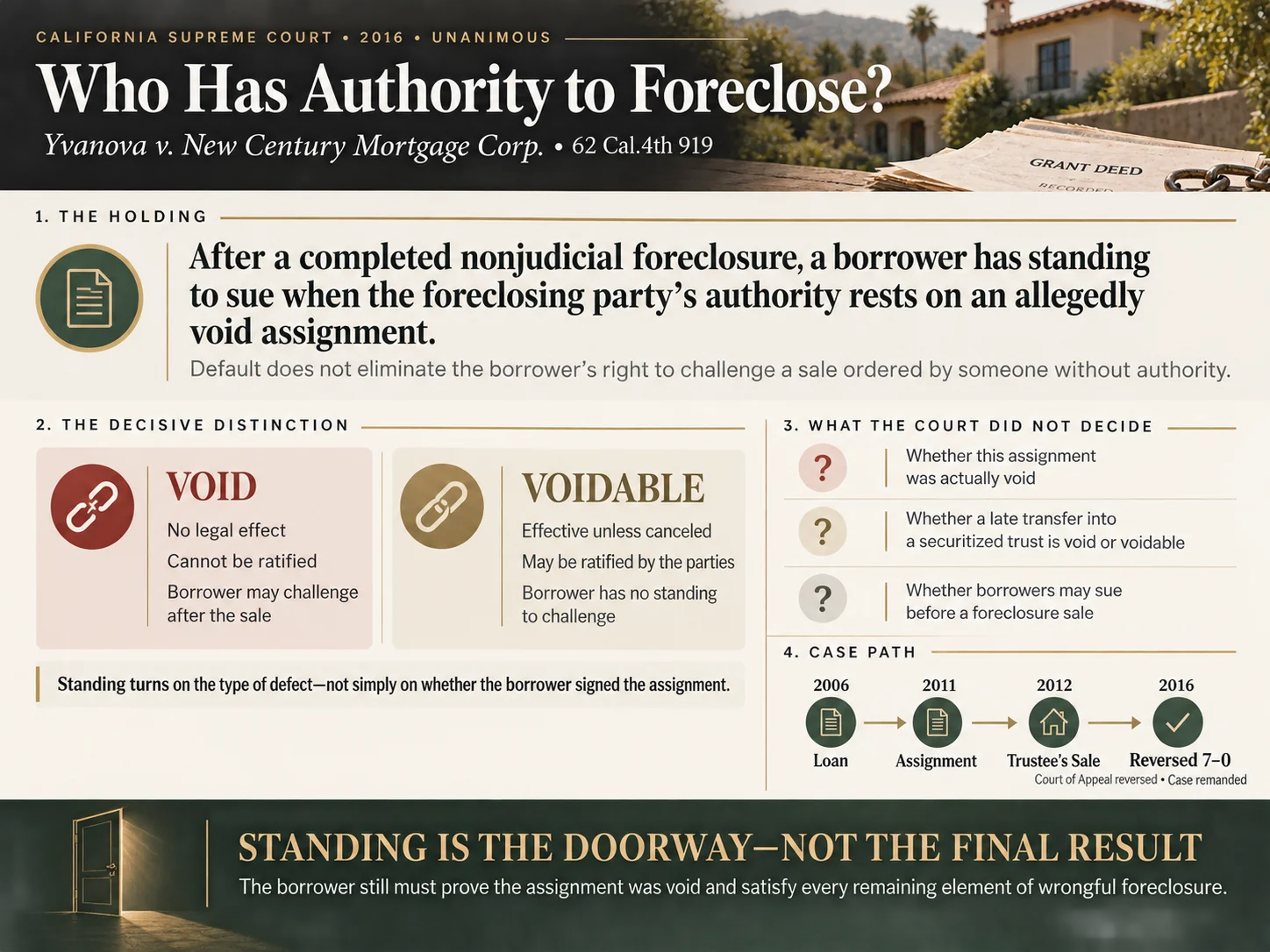
In a California nonjudicial foreclosure, only the current holder of the beneficial interest under the deed of trust, meaning the original lender, its assignee, or an agent of one of them, may direct the trustee to sell the property. A borrower whose home has been sold at a trustee's sale has standing to sue for wrongful foreclosure on the theory that the assignment giving the foreclosing party its authority was void, even though the borrower was in default and was not a party to the assignment.
The line the court drew is between void and voidable. A voidable assignment can be ratified by the parties to it, so only they may challenge it. A void assignment has no legal effect at all, so a borrower challenging it is not enforcing someone else's contract but protecting her own right to be foreclosed on only by someone with authority.
The court called its ruling narrow, and it is. It applies after a sale has occurred. It does not authorize lawsuits to stop a threatened foreclosure, does not decide whether this particular assignment was void, and does not resolve the other elements of a wrongful foreclosure claim.
$483,000
Loan secured by the 2006 deed of trust
3 yrs 4 mo
After the lender's liquidation that the assignment was signed
4 yrs 11 mo
After the investment trust closed to new loans
7–0
Vote of the California Supreme Court
A Loan, a Bankruptcy, and a Trust That Had Already Closed
In 2006, Tsvetana Yvanova signed a deed of trust securing a $483,000 note on her home in Woodland Hills, in the San Fernando Valley. The lender and original beneficiary was New Century Mortgage Corporation, one of the largest subprime lenders of that era.
New Century filed for bankruptcy on April 2, 2007. On August 1, 2008, it was liquidated and its assets were transferred to a liquidation trust.
Then, on December 19, 2011, a document was executed in New Century's name assigning Yvanova's deed of trust to Deutsche Bank National Trust Company, as trustee for a Morgan Stanley mortgage-backed securities trust. The assignment had been prepared by the loan servicer, Ocwen Loan Servicing, which also signed as New Century's attorney in fact. It was recorded on December 30, 2011. According to the complaint, the Morgan Stanley trust had a closing date, the deadline for loans to be transferred into its pool, of January 27, 2007.
On August 20, 2012, a new foreclosure trustee, Western Progressive, recorded a substitution of trustee and a notice of trustee's sale. On September 14, 2012, the home was sold at public auction to an investor, THR California LLC.
When the assignment was signed, both parties' windows had closed
- Allegedly void assignment
- Recorded events
- Sale
How the Lower Courts Shut the Door
Yvanova sued, first representing herself, pleading a single claim for quiet title against the lender, the servicer, the foreclosure trustee, Deutsche Bank, Morgan Stanley entities, and the trust. She alleged the December 2011 assignment was void for two reasons: New Century's assets had already been transferred to a bankruptcy trustee in 2008, and the Morgan Stanley trust had closed to new loans in 2007.
The Los Angeles County Superior Court sustained the defendants' demurrer without leave to amend. The Court of Appeal affirmed, holding the quiet title claim failed because she had not offered to pay the debt, and then addressed whether she could amend to plead wrongful foreclosure instead. It said no. Following Jenkins v. JPMorgan Chase Bank (2013), it held that a borrower is an unrelated third party to the assignment of her own loan and has no standing to complain about defects in it.
That was the prevailing view in most California courts at the time. The Supreme Court took the case to resolve a direct conflict between Jenkins and Glaski v. Bank of America (2013), which had held the opposite.
How Nonjudicial Foreclosure Works in California
Most California home loans are secured by a deed of trust rather than a mortgage. A deed of trust has three parties: the borrower (trustor), the lender (beneficiary), and a trustee holding a power of sale. That power lets the property be sold without going to court, which is why the process is called nonjudicial. The court walked through the statutory sequence.
The Statutory Sequence, Step by Step
Notice of default
The trustee, mortgagee, or beneficiary records a notice of default and election to sell under Civil Code section 2924, subdivision (a)(1). Only one of those parties may record it.
Three-month waiting period
No notice of sale may issue until at least three months after the notice of default is recorded.
Notice of trustee's sale
At least 20 days before the sale, the notice is published, posted, and recorded under sections 2924 and 2924f.
Auction
Unless postponed, or the borrower reinstates or redeems, the property is sold to the highest bidder under section 2924g.
No deficiency Borrower protection
A trustee's sale generally extinguishes the debt, and the lender may not recover any shortfall under Code of Civil Procedure section 580d.
The trustee in this system is not a true fiduciary. It acts as an agent for both sides, and it may start the process only at the direction of whoever currently holds the note and the beneficial interest. A note can be sold many times, and the deed of trust follows it. The borrower generally cannot object to those transfers. But when the borrower defaults, only the current beneficiary can order the sale.
Void Versus Voidable: The Distinction That Decided the Case
The defendants' position was that a borrower can never challenge an assignment she was not a party to. The court agreed with half of that. Everything turned on what kind of defect is alleged.
Two Kinds of Defective Assignment
Voidable
Borrower has no standing
- What it means
- The transaction has a defect, but one of its parties has the power to either cancel it or ratify it.
- Legal effect
- Valid unless and until a party to it elects to avoid it.
- Who may challenge
- Only the parties to the assignment. A borrower raising it would be asserting their rights, not hers.
Void
Borrower has standing after a sale
- What it means
- The transaction never had legal effect. It binds no one and is a mere nullity.
- Legal effect
- None, and it cannot be ratified, even if every party to it wants it to stand.
- Who may challenge
- A foreclosed borrower may, because she is asserting her own right not to be foreclosed on by someone without authority.
Why it mattered. If an assignment in the chain is void, the foreclosing party never became the beneficiary, never had authority to order a sale, and the sale it ordered is wrongful. The court adopted the reasoning of federal appellate courts in Culhane and Reinagel, joined courts across the country taking the same view, and disapproved Jenkins, Siliga, Fontenot, and Herrera to the extent they held otherwise.
The lenders' strongest argument was prejudice. The borrower was in default, they said, so it made no difference which bank foreclosed; the real owner of the loan would have done the same. The court rejected that for purposes of standing. A borrower owes the debt to a particular creditor, not to the world at large, and the foreclosure could be traced directly to the authority claimed through the assignment. Accepting the lenders' logic would mean anyone, even a stranger to the debt, could order a trustee's sale and the borrower would have no recourse.
Banks are neither private attorneys general nor bounty hunters. Quoted by the California Supreme Court from Miller v. Homecomings Financial
Which means the identity of the party foreclosing is not a technicality. The mortgage contract is an agreement that, on default, the right party may sell through the required procedure. A sale ordered by the wrong party breaks that agreement, even if some other party could lawfully have done the same thing.
What the Court Decided, and What It Left Open
Much of the commentary after Yvanova overstated it. The opinion is careful about its own limits, and anyone relying on it needs to be equally careful.
The Scope of the Holding
Standing after a completed sale Decided
A foreclosed borrower may sue for wrongful foreclosure alleging a void assignment, despite default and despite not being a party to the assignment.
Suits to stop a pending sale Not decided
The court expressly declined to hold that a borrower may preempt a threatened foreclosure by suing to test the foreclosing party's authority. Earlier appellate decisions restricting such suits were outside its review.
Whether a late transfer into a trust is void Not decided
Whether an assignment into a securitized trust after its closing date is void or merely voidable under New York trust law was expressly left open.
Tender and prejudice as elements Not decided
The court noted that tender has been excused where the foreclosure deed is facially void, but did not decide whether this plaintiff had to allege tender or prove prejudice to win.
Whether this assignment was actually void Not decided
The lenders argued the 2011 document merely confirmed a 2007 assignment executed in blank. That factual dispute was left for the lower courts on remand.
Notice what this means for the lawsuit itself. The Supreme Court did not hand Yvanova her house back. It reversed a ruling that she could not even try, and sent the case back to the Court of Appeal to reconsider whether she should be allowed to amend. At oral argument, her counsel conceded she was seeking only damages.
From Loan to Supreme Court
2006
The loan
A $483,000 note secured by a deed of trust on a Woodland Hills home, with New Century as lender and beneficiary.
Jan 2007
The trust closes
The Morgan Stanley investment trust reaches its closing date for accepting loans, according to the complaint.
2007–2008
The lender disappears
New Century files for bankruptcy in April 2007 and is liquidated in August 2008, its assets moved to a liquidation trust.
Dec 2011
The assignment
An assignment in New Century's name, prepared by the servicer as its attorney in fact, transfers the deed of trust to Deutsche Bank as trustee. Recorded December 30.
2012
Substitution, notice, and sale
A new foreclosure trustee is substituted and a notice of sale recorded in August. The home is sold at auction on September 14.
2013–2014
Dismissed without leave to amend
The Superior Court sustains the demurrer. The Court of Appeal affirms, following Jenkins and declining to follow Glaski.
Feb 2016
Reversed, 7–0
The Supreme Court holds a foreclosed borrower has standing to challenge a void assignment and remands. The Attorney General and several consumer and legal aid organizations had filed briefs supporting the borrower.
Quiet Title or Wrongful Foreclosure: Which Claim Fits
Yvanova filed a quiet title claim, and it was dismissed before the standing question ever mattered. That detail is worth more to most homeowners than the holding itself, because choosing the wrong claim is one of the most common ways a viable foreclosure case is lost on a demurrer.
Two Different Claims, Two Different Purposes
Quiet Title
Establishes who owns the property
- What it asks for
- A judicial declaration of title against competing claims, clearing liens, deeds, or interests clouding the record.
- The usual obstacle
- A borrower seeking to clear a lien securing a debt they still owe generally must tender the amount owed. Yvanova's claim failed on exactly that point.
- Best suited to
- Clouded title, a wild deed, a lien already satisfied, or a defect in the record chain. See quiet title and adverse possession.
Wrongful Foreclosure
Challenges how the sale was conducted
- What it asks for
- Damages, or in some circumstances an order setting the sale aside, because the sale was illegal, fraudulent, or willfully oppressive.
- The usual obstacle
- Standing and prejudice. Yvanova removed the standing barrier for allegations that the assignment was void.
- Best suited to
- A completed trustee's sale ordered by a party whose authority rests on a defective chain of assignments. See foreclosure defense.
The practical read. Quiet title asks a court to say who owns the property. Wrongful foreclosure asks whether the party that sold it had the right to. They are often pleaded together, but they carry different elements and different obstacles, and the tender rule that defeated the quiet title count in this case does not apply the same way to a damages claim for wrongful foreclosure.
Is Your Foreclosure Worth a Second Look?
Most foreclosures are carried out by the party entitled to carry them out. But the chain of documents behind a loan that has been sold, securitized, or serviced by several companies is often messier than borrowers assume. These are the circumstances that justify reading the recorded documents closely.
Six Circumstances Worth Examining
Your original lender went out of business, merged, or was acquired. An assignment signed in the name of an entity that no longer existed is the fact pattern at the center of Yvanova.
An assignment was recorded shortly before the notice of default. A last-minute recording is not wrong in itself, but it deserves a look at who signed it and on whose behalf.
The same company appears on both sides of the paperwork. In Yvanova, the servicer prepared the assignment, signed it as the assignor's attorney in fact, and was the contact for both parties.
You asked for the documents showing the right to foreclose and did not get them. California requires servicers to tell borrowers they may request them.
The trustee was substituted during the process. Every substitution must trace back to someone with authority to make it.
Your home has already been sold. Yvanova's standing ruling is specifically about completed sales. Deadlines are running.
Every one of these is visible in the public record. The deed of trust, assignments, substitutions of trustee, notice of default, and notice of sale are all recorded with the county, and you can request copies directly.
Before the sale date, or after it
Facing foreclosure in Glendale or Los Angeles?
A free consultation with DiJulio Law Group covers what the recorded documents show, which options are still open, and which deadlines are running. Nothing is filed without your direction.
Your Options Before and After a Trustee's Sale
Yvanova matters most after a sale. Before one, other tools usually do more, and they are time-sensitive. These are the main routes, roughly in the order they become available.
Five Routes, in Order of Timing
Free foreclosure counseling
As soon as you fall behind
The LA County Department of Consumer and Business Affairs runs a Homeowner Notification Program and a foreclosure prevention unit that helps homeowners work with lenders. It is free and it starts before anything is filed.
Reinstatement
Until shortly before the sale
California law generally lets a borrower cure the default by paying the amount in arrears plus permitted costs, stopping the foreclosure, up to five business days before the scheduled sale under Civil Code section 2924c.
Loss mitigation and the Homeowner Bill of Rights
Before and during the process
California's Homeowner Bill of Rights, enacted in 2012 after the sale in this case, bars foreclosure by anyone other than the beneficiary, trustee, or their designated agent, requires servicers to tell borrowers they may request copies of the assignments showing the right to foreclose, and requires the servicer to substantiate that right. It also restricts proceeding with a sale while a complete loan modification application is pending.
Examine the recorded chain
Before the sale if possible
Request the recorded documents from the Los Angeles County Registrar-Recorder/County Clerk and trace every assignment and substitution back to the original beneficiary. The same review exposes wild deeds and forged transfers, as in Aguayo v. Amaro.
Wrongful foreclosure
After a completed sale
This is where Yvanova applies. A borrower may allege the sale was ordered by a party whose authority rested on a void assignment. The claim has further elements, and remedies depend on the facts and on who now holds title. See foreclosure defense.
How Foreclosure Disputes Present in Glendale and Los Angeles
Yvanova began in the Los Angeles County Superior Court and passed through the Second Appellate District before reaching the Supreme Court. The same recorded-document review applies to every foreclosure across the county.
Where These Disputes Come From
Glendale
Owner-occupied · small multifamily
Long-held homes and small rental buildings with loans refinanced several times over, often transferred between servicers. See our Glendale real estate practice and foreclosure defense.
San Fernando Valley
Woodland Hills · Burbank · Van Nuys
The property in Yvanova was in Woodland Hills. Loans originated before 2008 were especially likely to pass through lenders that later failed, which is what created her fact pattern.
Service members
Federal protections
Active-duty service members and their families have additional federal foreclosure protections beyond California law. See foreclosure defense for military families.
Inherited homes
Probate · successors
Heirs often learn of a default only when a notice is posted. An unopened estate cannot easily negotiate with a servicer, which compounds the problem. See partition and heirs.
Post-sale title
Buyers at auction
A properly conducted sale is generally conclusive in favor of a bona fide purchaser, which affects what remedies remain. Buyers of foreclosed property should review the chain as part of due diligence.
DiJulio Law Group advises homeowners, heirs, investors, and businesses on these issues as part of its California real estate law practice, including foreclosure defense, quiet title, and real estate transactions. More decisions are collected in our California case study library.
Why This Matters
Six Things Yvanova Settles About Wrongful Foreclosure
The ruling is narrow, and much of what circulated about it afterward was not. These are the points the opinion actually supports.
Only the Right Party May Foreclose
The original beneficiary, its assignee, or an agent of one of them. A sale ordered by anyone else is wrongful.
Default Does Not End the Inquiry
Being behind on payments does not strip a borrower of standing to challenge a foreclosure resting on a void assignment.
Void Is Not Voidable
A void transfer cannot be ratified. A merely voidable one can, and only its parties may challenge it.
It Applies After a Sale
The court declined to authorize suits to stop a pending foreclosure. Pre-sale tools are different and faster.
Standing Is Not Winning
The borrower still has to prove the assignment was void and satisfy the remaining elements of the claim.
The Record Tells the Story
Every assignment, substitution, and notice is recorded. Reading them is the first step, not the last.
Frequently Asked Questions
What did Yvanova v. New Century Mortgage decide?
The California Supreme Court held in Yvanova v. New Century Mortgage Corp. (2016) 62 Cal.4th 919 that a borrower whose home has been sold at a nonjudicial foreclosure has standing to sue for wrongful foreclosure on the theory that an assignment of the deed of trust to the foreclosing party was void. The borrower's default and the fact that she was not a party to the assignment do not defeat standing. The court described its ruling as narrow and did not decide whether the assignment in that case was actually void.
What is wrongful foreclosure in California?
Wrongful foreclosure is a claim against a beneficiary or trustee that conducts an illegal, fraudulent, or willfully oppressive sale of property under a deed of trust. A foreclosure initiated by a party with no authority to do so is wrongful. Courts have also required showings such as prejudice and, in some circumstances, tender of the amount owed, though tender has been excused where the foreclosure deed is facially void.
What is the difference between a void and a voidable assignment?
A void transaction has no legal effect, binds no one, and cannot be ratified even if its parties want it to stand. A voidable transaction has a defect but remains effective unless a party to it elects to cancel it, and the parties may instead ratify it. Under Yvanova, a foreclosed borrower may challenge an assignment as void, but only the parties to an assignment may challenge it as voidable.
Can I stop a foreclosure by challenging the assignment before the sale?
Not on the strength of Yvanova. The Supreme Court expressly declined to hold that a borrower may preempt a threatened nonjudicial foreclosure with a lawsuit questioning the foreclosing party's authority, and earlier appellate decisions have restricted such suits. Before a sale, the more reliable tools are reinstatement, loss mitigation, the protections in California's Homeowner Bill of Rights, and prompt legal review of the recorded documents.
How does nonjudicial foreclosure work in California?
The trustee, mortgagee, or beneficiary records a notice of default under Civil Code section 2924. After at least three months, a notice of trustee's sale is published, posted, and recorded at least 20 days before the sale. Unless the sale is postponed or the borrower reinstates or redeems, the property is auctioned to the highest bidder. The trustee may act only at the direction of the current beneficiary or its agent, and the sale generally bars the lender from recovering any deficiency.
Do I have to pay what I owe before I can sue for wrongful foreclosure?
Sometimes. California courts have generally required a borrower seeking to set aside a foreclosure sale to tender the secured debt, but tender has been excused in several circumstances, including where the foreclosure deed is facially void because the entity that initiated the sale lacked authority. The Supreme Court in Yvanova noted this rule but did not decide whether that borrower had to allege tender. The answer depends on the remedy sought and the facts.
How can I find out who holds my loan and what has been recorded?
Request the recorded documents from the Los Angeles County Registrar-Recorder/County Clerk, including the deed of trust, every assignment, any substitution of trustee, and the notices of default and sale. Los Angeles County also operates a Homeowner Notification Program that mails owners copies of documents recorded against their homes. You can also ask your servicer for the assignments it relies on to foreclose.
What is the California Homeowner Bill of Rights?
It is a set of foreclosure protections enacted in 2012. Among other provisions, it bars any entity from initiating foreclosure unless it is the holder of the beneficial interest, the original or substituted trustee, or the holder's designated agent; requires servicers to inform borrowers they may request copies of the assignments showing the right to foreclose; and requires servicers to ensure the documentation substantiates that right. The legislative history cites reports of foreclosures initiated by companies with no authority to foreclose.
Can a lender collect the rest of the debt after a nonjudicial foreclosure?
Generally no. Under Code of Civil Procedure section 580d, a trustee's sale under a deed of trust generally extinguishes the debt, and the lender cannot recover a deficiency judgment for any shortfall between the sale price and what was owed. That protection is one reason lenders in California overwhelmingly foreclose nonjudicially rather than through the courts.
What is a quiet title action, and how is it different from wrongful foreclosure?
A quiet title action asks a court to declare who owns a property and to clear competing claims from the record, such as a lien, an abstract of judgment, or a deed from someone who never held title. Wrongful foreclosure instead challenges how a trustee's sale was conducted, typically seeking damages or an order setting the sale aside. Yvanova originally pleaded quiet title, and it failed because she had not tendered the debt. The Supreme Court's ruling concerned whether she could amend to plead wrongful foreclosure instead. See quiet title in California.
Can I stop a trustee's sale in California?
Several routes can stop or postpone a sale, but they are time-sensitive. California law generally allows a borrower to reinstate by curing the default up to five business days before the scheduled sale. A complete loan modification application can restrict the servicer from proceeding under the Homeowner Bill of Rights. A bankruptcy filing triggers an automatic stay. Courts may issue injunctive relief in some circumstances, though Yvanova expressly did not authorize preemptive suits merely questioning the foreclosing party's authority. Act well before the sale date rather than in the final days.
What foreclosure protections do active-duty service members have?
The federal Servicemembers Civil Relief Act provides protections beyond California law for borrowers who took out a mortgage before entering active duty. Among them, a lender generally may not foreclose on the property during the period of military service or for a defined period afterward without a court order or a valid waiver, and interest on pre-service obligations may be limited while the member is serving. These protections are separate from and additional to the California foreclosure statutes. See foreclosure defense for military families.
What does foreclosure defense actually involve?
It starts with establishing where the matter sits on the statutory clock, because that determines which options remain. From there it means obtaining and reviewing the recorded chain of documents, checking whether the servicer complied with the notice and loss mitigation requirements, evaluating reinstatement and modification options, and, where a sale has already occurred, assessing whether the party that ordered it had authority. Much of the work is documentary and can be done before any lawsuit is filed.
Do I need a foreclosure attorney in Glendale or Los Angeles?
If you have received a notice of default or notice of sale, or your home has already been sold, the timelines are short and the options narrow quickly. Legal review of the recorded chain, the servicer's compliance, and the available pre-sale and post-sale remedies usually changes what is possible. DiJulio Law Group advises homeowners, heirs, and military families on foreclosure defense, trustee sale issues, and quiet title in Glendale, Los Angeles, and throughout Southern California. You can contact the firm or call 818-502-1700.
How DiJulio Law Group Approaches Foreclosure Matters
Foreclosure matters move on a statutory clock that runs whether or not anyone is paying attention. The first job is to establish where in that clock the matter sits and what is still possible from that point: reinstatement, loss mitigation, postponement, or, after a sale, a claim based on what the recorded documents actually show.
That review means pulling the deed of trust, every recorded assignment and substitution of trustee, the notices of default and sale, and the servicer's correspondence, then tracing whether each party in the chain had authority to act when it did. It also means being candid about what the documents do not support.
DiJulio Law Group has represented homeowners, heirs, investors, and businesses in Glendale, Los Angeles, and throughout Southern California for more than 35 years in real estate, business, construction, environmental, and mediation matters. Founding partner R. David DiJulio and Senior Litigator and Trial Attorney Valeria Granata handle trial and appellate work in California real estate matters.
Received a Notice of Default or Notice of Sale?
Bring the notices, your loan documents, and any letters from your servicer. The first conversation is about where you are on the statutory timeline and which options are still open.
- Free initial consultation
- 35+ years in California real estate matters
- You speak with an attorney, not an intake screener
- Serving Glendale, Los Angeles, and Southern California
This case study discusses a published decision of the California Supreme Court for general informational purposes. It is not legal advice, does not create an attorney-client relationship, and does not describe, promise, or predict the outcome of any matter. DiJulio Law Group was not counsel in Yvanova v. New Century Mortgage Corporation. Facts are drawn from the published opinion and are stated as alleged in the complaint where the court so described them. Foreclosure law and deadlines change; consult a licensed California attorney promptly about your situation.
Primary Sources
- Yvanova v. New Century Mortgage Corp. (2016) 62 Cal.4th 919, No. S218973 (Cal. Feb. 18, 2016). Full opinion text. caselaw.findlaw.com
- Supreme Court of California, case information for S218973. supreme.courts.ca.gov
- Same opinion, Justia case law archive. law.justia.com
- California Civil Code § 2924 (notice of default; who may initiate foreclosure). leginfo.legislature.ca.gov
- California Civil Code § 2924c (reinstatement). leginfo.legislature.ca.gov
- California Code of Civil Procedure § 580d (no deficiency after trustee's sale). leginfo.legislature.ca.gov
- Los Angeles County Department of Consumer and Business Affairs, Homeowner Notification Program. dcba.lacounty.gov
- Los Angeles County Registrar-Recorder/County Clerk, real estate records requests. lavote.gov
- Orrick, Herrington & Sutcliffe, analysis of the decision (Feb. 2016). orrick.com
Authorities Cited in the Opinion
- Cal. Civ. Code §§ 2924, 2924f, 2924g, 2936, 2923.55, 2924.17; Cal. Code Civ. Proc. §§ 367, 580d.
- Glaski v. Bank of America (2013) 218 Cal.App.4th 1079 (approved on standing).
- Jenkins v. JPMorgan Chase Bank, N.A. (2013) 216 Cal.App.4th 497 (disapproved in part).
- Siliga v. Mortgage Electronic Registration Systems, Inc. (2013) 219 Cal.App.4th 75 (disapproved in part).
- Fontenot v. Wells Fargo Bank, N.A. (2011) 198 Cal.App.4th 256 (disapproved in part).
- Herrera v. Federal National Mortgage Assn. (2012) 205 Cal.App.4th 1495 (disapproved in part).
- Biancalana v. T.D. Service Co. (2013) 56 Cal.4th 807, 813, 819.
- Moeller v. Lien (1994) 25 Cal.App.4th 822, 830.
- Dreyfuss v. Union Bank of California (2000) 24 Cal.4th 400, 411.
- Chavez v. Indymac Mortgage Services (2013) 219 Cal.App.4th 1052, 1062.
- Colby v. Title Ins. and Trust Co. (1911) 160 Cal. 632, 644.
- Cockerell v. Title Ins. & Trust Co. (1954) 42 Cal.2d 284, 291–292.
- Gomes v. Countrywide Home Loans, Inc. (2011) 192 Cal.App.4th 1149.
- Culhane v. Aurora Loan Services of Nebraska (1st Cir. 2013) 708 F.3d 282.
- Reinagel v. Deutsche Bank Nat. Trust Co. (5th Cir. 2013) 735 F.3d 220.
- Miller v. Homecomings Financial, LLC (S.D.Tex. 2012) 881 F.Supp.2d 825, 832.
- Levitin, The Paper Chase: Securitization, Foreclosure, and the Uncertainty of Mortgage Title (2013) 63 Duke L.J. 637.
0 Comments