
LA's Rent Ordinances: One Struck Down, One Upheld Apartment Association of Greater Los Angeles v. City of Los Angeles (2026)
Los Angeles adopted two renter-protection ordinances on the same day in 2023. On April 15, 2026, the Second District Court of Appeal struck one down and upheld the other in a single opinion. The city's relocation assistance mandate is preempted by the Costa-Hawkins Rental Housing Act. Its eviction threshold rule survives. One is now unenforceable against exempt units. The other is before the California Supreme Court. If you own or rent property in the Los Angeles area, the rules that applied last year are not the rules that apply today.
Case at a Glance
- What was challenged
- Two City of Los Angeles ordinances adopted after COVID-era tenant protections expired, both effective March 27, 2023: the Eviction Threshold Ordinance and the Relocation Assistance Ordinance
- Who brought it
- The Apartment Association of Greater Los Angeles, a rental housing trade association, by petition for writ of mandate and complaint for declaratory and injunctive relief in Los Angeles Superior Court
- The theory
- State law preemption — that both ordinances conflicted with the Costa-Hawkins Rental Housing Act and with California's unlawful detainer statutes
- The result
- The relocation assistance requirement was held preempted by Costa-Hawkins. The eviction threshold requirement was upheld as a valid exercise of the city's police power regulating the substantive grounds for eviction
The Two Ordinances and the Two Different Outcomes
This was one lawsuit, one appeal, and one opinion — but the two ordinances at issue failed and survived for entirely different reasons. Understanding why the court split them is the difference between knowing which rules still bind you and guessing.
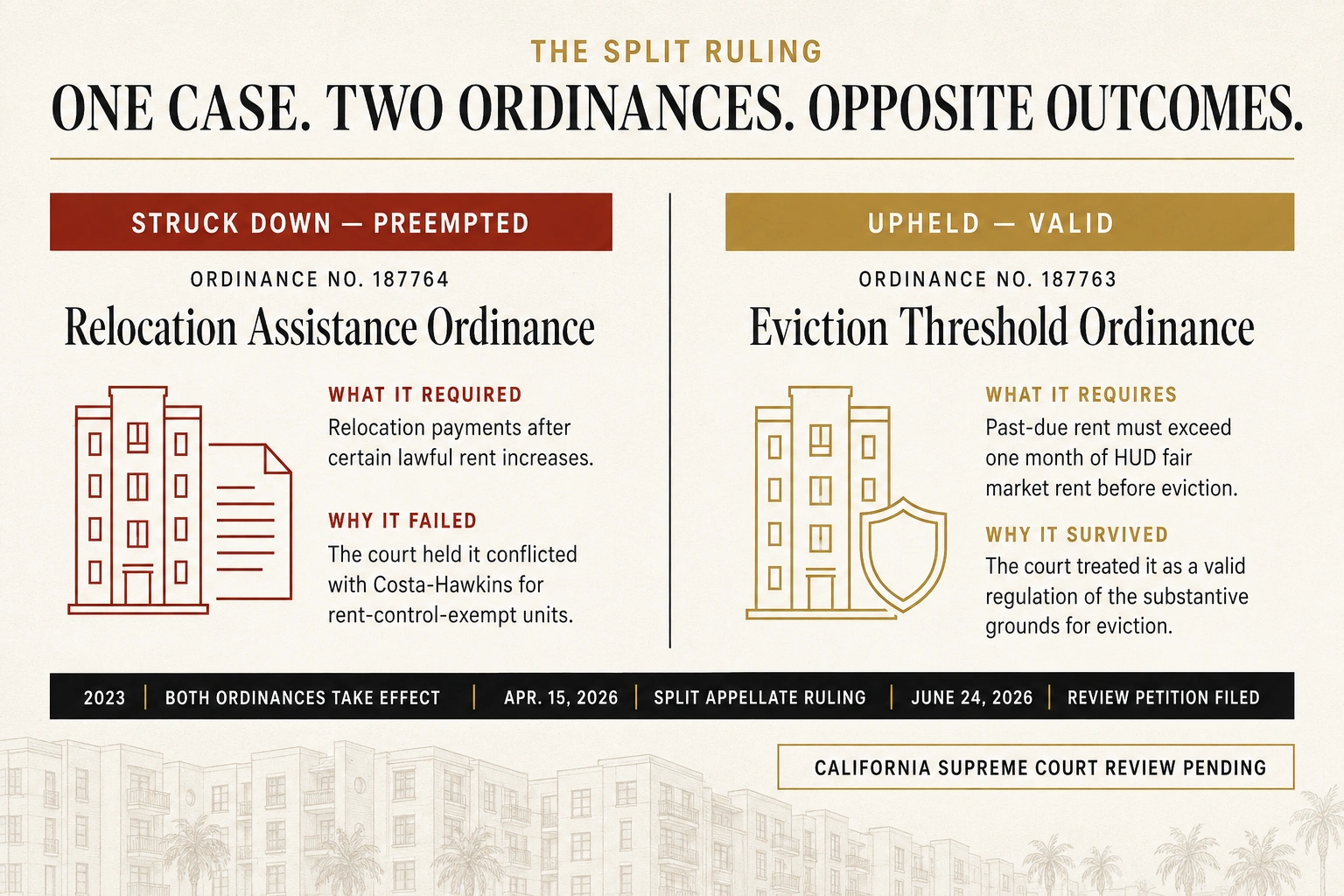
Ordinance No. 187764
Relocation Assistance Ordinance
L.A. Mun. Code § 165.09 · Also called the Economic Displacement Ordinance
What it required
Payment of relocation assistance to certain tenants in non-rent-controlled units who moved out after a specified lawful rent increase. It reached units exempt from local rent control under Costa-Hawkins — single-family homes, condominiums, and newer construction.
Why it failed
Relying in part on its earlier decision in California Apartment Assn. v. City of Pasadena, the court held the requirement was preempted by the Costa-Hawkins Rental Housing Act because it imposed a burden on landlords exercising a state-law right to raise rents on qualifying units. Requiring those payments when Costa-Hawkins specifically authorizes owners of non-rent-controlled units to increase rent to fair market value cannot stand.
Ordinance No. 187763
Eviction Threshold Ordinance
L.A. Mun. Code §§ 151.09(A), 165.03(A)
What it requires
A landlord may not evict for nonpayment of rent unless the amount owed exceeds one month of fair market rent, as set by the U.S. Department of Housing and Urban Development. Small or short-term arrears cannot support an unlawful detainer.
Why it survived
The court concluded the ordinance regulates the substantive grounds for eviction, not the procedures governing unlawful detainer actions — making it functionally similar to a just-cause eviction rule, and within the city's police power. The association's argument that it impermissibly altered statutory unlawful detainer timelines was rejected.
How the Case Reached This Point
From City Council Vote to the California Supreme Court
Early 2023
Los Angeles Replaces Its COVID-Era Protections
As pandemic-era tenant protections wound down, the Los Angeles City Council adopted two replacement ordinances. Ordinance No. 187763 set a past-due-rent threshold before eviction. Ordinance No. 187764 required relocation payments after certain rent increases. Both took effect March 27, 2023.
March 2023
The Association Sues
The Apartment Association of Greater Los Angeles filed suit in Los Angeles Superior Court, seeking a writ of mandate plus declaratory and injunctive relief to stop enforcement of both ordinances. The sole theory was preemption — that state law already occupied this ground.
Trial Court
The City Wins Both
Tenant advocacy organizations Community Power Collective and InnerCity Struggle intervened to defend the ordinances alongside the city. The trial court rejected the association's preemption claims as to both ordinances, and the association appealed to the Second District.
Interim
The Pasadena Decision Changes the Math
While the appeal was pending, the same appellate district decided California Apartment Assn. v. City of Pasadena, addressing when a local rent measure crosses into territory preempted by Costa-Hawkins. That reasoning would supply the framework for half of this opinion.
April 15, 2026
The Split Decision
The Court of Appeal held the Relocation Assistance Ordinance preempted by Costa-Hawkins and the Eviction Threshold Ordinance valid. Two ordinances adopted the same day, challenged in the same suit, decided in the same opinion — opposite results.
April 17, 2026
A Partial Victory, Publicly Framed
The association announced the ruling as a win, noting that owners of condominiums, single-family homes, and other rental property exempt from state or local rent caps in the City of Los Angeles would no longer be subject to the relocation requirement. Its board president called it a partial victory.
June 24, 2026
Petition for Review Filed
The association filed a petition for review in the California Supreme Court challenging the Eviction Threshold Ordinance holding, arguing the threshold is an improper procedural restriction that extends the unlawful detainer timeline and prevents owners from initiating eviction for nonpayment. That petition remains pending.
Why Costa-Hawkins Decided Half of This Case
The Costa-Hawkins Rental Housing Act, Civil Code section 1954.50 and following, is the state statute that limits what California cities may do with rent control. It does two things that mattered here. It exempts entire categories of housing from local rent control — single-family homes, condominiums, and units first certified for occupancy after February 1, 1995. And it guarantees owners the right to set the initial rent on a vacancy and to raise rents on exempt units to market.
Once state law confers that right, a city cannot charge you for using it. That is the whole preemption analysis in one sentence. The Relocation Assistance Ordinance did not cap rents directly — it attached a payment obligation to a lawful increase, which functions as a cap by making the increase expensive. The Eviction Threshold Ordinance did something categorically different: it defined when nonpayment counts as grounds to evict, a subject cities have long regulated through just-cause ordinances.
The Legal Framework the Court Applied
Civil Code
§ 1954.50 et seq.
The Costa-Hawkins Rental Housing Act. The state statute governing the boundaries of local rent control. It preserves local authority to regulate rents on covered units while removing that authority entirely as to exempt categories of housing. The relocation requirement fell because it burdened a right this statute confers.
Civil Code
§ 1954.52
Which units are exempt from local rent control. Single-family residences, condominiums, and dwellings first certified for occupancy after February 1, 1995 are outside local rent control. These are the units the Relocation Assistance Ordinance reached — and the reason it was vulnerable.
Civil Code
§ 1954.53
The right to set and raise rents. Owners of exempt units may establish the initial rental rate and, for those units, raise rent to market. A local rule that penalizes the exercise of that right conflicts with the statute even if it never states a maximum rent.
L.A. Mun. Code
§§ 151.09(A), 165.03(A)
The Eviction Threshold Ordinance. Codified in both the Rent Stabilization Ordinance and the newer tenant protection chapter, these provisions bar eviction for nonpayment unless the past-due amount exceeds one month of HUD fair market rent. Upheld as substantive regulation of eviction grounds.
L.A. Mun. Code
§ 165.09
The Relocation Assistance Ordinance. Required relocation payments to tenants of non-rent-controlled units who vacated following specified lawful rent increases. Held preempted. Owners of Costa-Hawkins-exempt units in the City of Los Angeles are no longer subject to this requirement.
Civil Code
§§ 1946.2, 1947.12
The Tenant Protection Act of 2019 (AB 1482). Separate from Costa-Hawkins and unaffected by this ruling. It caps annual rent increases at 5 percent plus regional CPI, to a maximum of 10 percent, and requires just cause to terminate most tenancies. This is the statute that governs Glendale, which has no local rent control ordinance of its own.
Code Civ. Proc.
§ 1161 et seq.
California's unlawful detainer statutes. The association argued the threshold requirement impermissibly modified these procedures. The court disagreed, drawing the line between a local rule that changes eviction procedure — which is preempted — and one that changes the substantive grounds for eviction, which is not.
What the Court Held
The Holdings That Change Practice
A payment triggered by a lawful rent increase is rent regulation. A city cannot require relocation assistance as the price of exercising a Costa-Hawkins right. The label on the payment does not control; its effect on the rent-setting right does.
Costa-Hawkins exemption is a shield, not just a label. Owners of single-family homes, condominiums, and newer construction in Los Angeles are not merely exempt from rent caps — they are protected from local rules that make lawful increases costly.
Substance versus procedure is the operative distinction for eviction rules. A local ordinance defining what does and does not constitute grounds for eviction operates in the same territory as a just-cause ordinance and survives preemption. One that rewrites unlawful detainer timelines or pleading requirements does not.
The eviction threshold falls within the city's police power. The court did not treat the threshold as an incidental procedural gloss but as a legitimate substantive policy choice about when nonpayment justifies displacement.
The Pasadena framework is now doing real work. The court applied its earlier Costa-Hawkins preemption reasoning from the Pasadena case to a different city and a differently structured ordinance. That analysis is no longer confined to one charter amendment.
Half of this is not final. A petition for review on the Eviction Threshold Ordinance was filed in the California Supreme Court on June 24, 2026. Anyone relying on the threshold holding should verify its status before acting.
What This Means for Glendale and Los Angeles County Property Owners and Tenants
Here is the part almost nobody gets right: the rules depend entirely on which city your property sits in, and the boundaries are not intuitive. A landlord who owns a duplex in Glendale, a condominium in the City of Los Angeles, and a fourplex in an unincorporated pocket of Los Angeles County is operating under three different rulebooks simultaneously — and this decision changed only one of them.
Which Rules Apply Where — Los Angeles Area Rent Regulation
Glendale
State law only
Glendale has no local rent control ordinance. The city council has not enacted rent stabilization, so the statewide Tenant Protection Act — AB 1482 — is the only rent protection available to most Glendale renters. It generally applies to multi-unit buildings first certified for occupancy at least 15 years ago and exempts a large share of Glendale's housing stock, including single-family homes and condominiums. With no local rent board, AB 1482 is effectively self-enforced through the courts. This decision does not change anything in Glendale directly — but the preemption reasoning would apply if Glendale ever adopted a similar measure.
City of Los Angeles
Directly affected
The Rent Stabilization Ordinance covers older multifamily buildings, and the two ordinances in this case layered additional rules on top. The relocation assistance requirement is no longer enforceable against Costa-Hawkins-exempt units. The eviction threshold remains in force pending Supreme Court review. City notices, forms, and administrative guidance may be revised in response — use current versions.
Unincorporated L.A. County
Separate ordinance
The county's Rent Stabilization and Tenant Protections Ordinance governs unincorporated areas, limiting annual increases on stabilized units by CPI and requiring just cause to evict. It has its own past-due-rent threshold, which increased to two months of fair market rent effective April 16, 2026 — a different number from the City of Los Angeles rule, in a jurisdiction that can begin across the street.
Pasadena
Charter rent control
Pasadena's voter-approved charter rent control produced the earlier appellate decision this court relied on. Our case study on that ruling covers what changed for Pasadena landlords and tenants and why it established the preemption framework now being applied city by city.
Where cases are filed
Venue
Glendale unlawful detainer matters are heard at the Burbank courthouse of the Los Angeles Superior Court. Because Glendale has no rent board, a tenant asserting AB 1482 rights and a landlord defending a rent increase are both litigating in court rather than before an administrative body. Filing location, applicable ordinance, and available defenses all turn on the property's address.
Practical Steps After This Ruling
What to Do Now — Owners and Tenants
Step One
Confirm your unit's status
Everything follows from whether the unit is subject to local rent control or exempt under Costa-Hawkins. Certificate of occupancy date, property type, and city all matter. Guessing here produces the wrong answer to every question that follows.
Step Two
Re-check your notices and forms
A notice drafted against the relocation ordinance may now overstate obligations; one drafted before the threshold ruling may understate them. City forms and administrative guidance can change in response to a decision like this.
Step Three
Review the lease itself
Many disputes turn on lease terms rather than ordinances — rent escalation clauses, notice provisions, attorney's fee provisions, and whether the written agreement tracks what the parties actually do.
Step Four
Consider resolution before filing
Preemption litigation took this association three years and produced a split result still under review. Real estate mediation resolves most individual landlord-tenant disputes faster and at a fraction of the cost.
Step Five
Track the pending petition
The eviction threshold holding is not final. If the Supreme Court grants review, the ordinance's status could change again. Build that uncertainty into any decision with a long timeline.
Step Six
Document everything
Rent ledgers, notices served, proof of service, repair requests, and payment records decide outcomes in landlord-tenant cases far more often than legal theories do.
DiJulio Law Group handles landlord-tenant and lease disputes as part of its California real estate law practice, including residential and commercial lease matters, transactional real estate, and co-ownership disputes such as those addressed in our case study on partition standing and inherited property. Commercial tenants and landlords may also want to review our analysis of force majeure and commercial lease obligations. The real estate practice center covers what to prepare before a first consultation.
Why This Matters
Five Things Every Los Angeles Area Landlord and Tenant Should Take From This Decision
Two ordinances, adopted the same day by the same city council, challenged in the same lawsuit, decided in the same opinion — and only one survived. That outcome tells you something specific about where the legal line sits, and it is not where most people assume.
Local Rules Are Not Automatically Valid
A duly enacted city ordinance can be unenforceable from the day it passes. Both of these were in effect for three years before an appellate court held one of them preempted. Compliance with a local rule is not the same as the rule being lawful.
Exemption Status Is the First Question
Whether a unit is covered by local rent control or exempt under Costa-Hawkins determines which rules bind it. That single fact decided which half of this ruling applies to a given property.
Cities Can Still Regulate Evictions
This was not a wholesale defeat for tenant protections. The court upheld a rule that meaningfully limits evictions for small arrears, confirming that defining the grounds for eviction remains within municipal authority.
Address Determines Outcome
Glendale, the City of Los Angeles, unincorporated county areas, and Pasadena each apply different rules, thresholds, and enforcement mechanisms. A portfolio spread across the region is a portfolio under four legal regimes.
This Is Still Moving
A petition for review is pending, city guidance may be revised, and the Legislature can respond. Landlord-tenant law in the Los Angeles area is not a settled body of rules but an actively contested one.
Frequently Asked Questions
What did the court decide in Apartment Association of Greater Los Angeles v. City of Los Angeles?
On April 15, 2026, the California Court of Appeal, Second District, issued a split decision on two City of Los Angeles renter-protection ordinances. It held the Relocation Assistance Ordinance (Ordinance No. 187764) preempted by the Costa-Hawkins Rental Housing Act, and it upheld the Eviction Threshold Ordinance (Ordinance No. 187763) as a valid exercise of the city's police power regulating the substantive grounds for eviction.
Is the Los Angeles relocation assistance ordinance still in effect?
The Court of Appeal held the relocation assistance requirement preempted by state law as applied to units exempt from local rent control under Costa-Hawkins. Owners of condominiums, single-family homes, and other rental property in the City of Los Angeles that is exempt from state or local rent caps are no longer subject to the requirement. Because further appeals, city action, or legislative changes may still occur, confirm current requirements before serving any notice.
Do Los Angeles landlords still have to pay relocation assistance after a rent increase?
Not for units exempt from local rent control under Costa-Hawkins — that is what the court struck down. Relocation assistance obligations arising from other sources, such as the Rent Stabilization Ordinance's provisions for no-fault terminations on covered units, are separate rules that this decision did not address. The distinction turns on which ordinance provision and which unit type is involved.
What is the Los Angeles eviction threshold ordinance?
Ordinance No. 187763, codified at Los Angeles Municipal Code sections 151.09(A) and 165.03(A), bars a landlord from evicting for nonpayment of rent unless the past-due amount exceeds one month of fair market rent as set by the U.S. Department of Housing and Urban Development. It took effect March 27, 2023. The Court of Appeal upheld it in April 2026, and a petition for review was filed in the California Supreme Court on June 24, 2026.
How much rent does a tenant have to owe before eviction in Los Angeles?
In the City of Los Angeles, more than one month of HUD fair market rent for the applicable unit size. In unincorporated Los Angeles County, the threshold under the county's Rent Stabilization and Tenant Protections Ordinance increased to two months of fair market rent effective April 16, 2026. The figures are published by jurisdiction and change over time, so verify the current amount for the specific property.
Does Glendale have rent control?
No. Glendale has not enacted a local rent control or rent stabilization ordinance. Renters in Glendale are protected by California's statewide Tenant Protection Act of 2019 (AB 1482), which caps rent increases and requires just cause for eviction in eligible units, but exempts single-family homes, condominiums, and newer construction. Glendale has no rent board, so these rights are asserted in court rather than before an administrative agency.
How much can a landlord raise rent in Glendale?
For units covered by AB 1482, annual increases are capped at 5 percent plus the regional change in the Consumer Price Index, to a maximum of 10 percent in any 12-month period. Units exempt from AB 1482 — including many single-family homes and condominiums where the owner has given the required notice — are not subject to that cap. Because Glendale adds no local ordinance, the state cap is the ceiling where it applies.
What is the Costa-Hawkins Rental Housing Act?
Costa-Hawkins, Civil Code section 1954.50 and following, is the California statute that sets the outer limits of local rent control. It exempts single-family residences, condominiums, and units first certified for occupancy after February 1, 1995 from local rent control, and it preserves an owner's right to set the initial rent on a vacancy and to raise rents on exempt units. It is the statute that defeated the Los Angeles relocation assistance requirement.
Which Los Angeles rental units are exempt from rent control?
Under Costa-Hawkins, single-family homes, condominiums, and dwellings first certified for occupancy after February 1, 1995 are exempt from local rent control. In the City of Los Angeles, the Rent Stabilization Ordinance generally covers older multifamily buildings, so newer construction sits outside it. Exemption from rent caps does not necessarily mean exemption from just-cause eviction rules, which can apply more broadly — the two questions are separate.
Where are Glendale eviction cases filed?
Unlawful detainer cases for Glendale properties are heard at the Burbank courthouse of the Los Angeles Superior Court. Because Glendale has no local rent board or administrative complaint process for rent matters, disputes over rent increases and terminations are resolved through the courts.
Do I need a lawyer for a landlord-tenant dispute in Glendale or Los Angeles?
The applicable rules change by city, by unit type, and — as this decision shows — by court ruling, and a defective notice can defeat an otherwise valid case. DiJulio Law Group has advised residential and commercial property owners on lease disputes and California real estate matters in Glendale, Los Angeles, and throughout Southern California for more than 35 years. You can contact the firm or call 818-502-1700.
How DiJulio Law Group Approaches Landlord-Tenant and Lease Disputes
Most landlord-tenant matters do not turn on constitutional preemption. They turn on a notice that was served three days early, a rent ledger nobody kept, a lease provision that was never updated when the building changed hands, or an ordinance that applied to the property next door but not to this one. The legal issues are usually narrow. The consequences of getting them wrong are not.
DiJulio Law Group has represented residential and commercial property owners and businesses in Glendale, Los Angeles, and throughout Southern California for more than 35 years in real estate, business, construction, and mediation matters. Founding partner R. David DiJulio has handled California real estate and property litigation across that period, including lease disputes, unlawful detainer matters, ownership and title claims, and habitability and disclosure litigation.
For a lease or rent dispute, the first work is diagnostic: confirming which ordinance governs the property, whether the unit is exempt under Costa-Hawkins or covered by AB 1482, what the lease actually says, and whether the notices already served can support the position a client wants to take. That analysis often reveals a faster resolution than litigation — and when it does not, it produces a case built on the right rules.
Questions About a Lease, Rent Increase, or Eviction Matter?
DiJulio Law Group advises property owners, businesses, and tenants on California lease and real estate disputes in Glendale, Los Angeles, and throughout Southern California.
This case study discusses a California appellate decision and related municipal ordinances for general informational purposes. It is not legal advice, does not create an attorney-client relationship, and does not describe a matter handled by DiJulio Law Group. Rent regulation in the Los Angeles area changes frequently, and a petition for review in this case was pending as of publication. Outcomes depend on the specific property, unit type, applicable ordinance, and procedural posture. Consult a licensed California attorney about your situation.
Primary Sources
- Apartment Association of Greater Los Angeles v. City of Los Angeles, No. B336071 (Cal. Ct. App., 2d Dist., Apr. 15, 2026). Official opinion, Judicial Council of California. courts.ca.gov
- California Civil Code § 1954.52 (units exempt from local rent control under the Costa-Hawkins Rental Housing Act). California Legislative Information, official statutory text. leginfo.legislature.ca.gov
- California Civil Code § 1946.2 (just cause for termination of tenancy, Tenant Protection Act of 2019). California Legislative Information, official statutory text. leginfo.legislature.ca.gov
- Los Angeles County Department of Consumer and Business Affairs, Rent Stabilization and Tenant Protections Ordinance program page, including the fair market rent eviction threshold effective April 16, 2026. dcba.lacounty.gov
- Apartment Association of Greater Los Angeles, "Apartment Association of Greater L.A. Announces 'Win' in Lawsuit Against L.A. City," April 17, 2026. businesswire.com
- Apartment Association of Greater Los Angeles, "Apartment Assoc. of Greater Los Angeles Appeals Decision in Eviction Threshold Lawsuit," June 24, 2026. businesswire.com
Statutes and Ordinances Referenced
- Costa-Hawkins Rental Housing Act, Cal. Civ. Code §§ 1954.50–1954.535 (including §§ 1954.52, 1954.53).
- Tenant Protection Act of 2019 (AB 1482), Cal. Civ. Code §§ 1946.2, 1947.12.
- Cal. Code Civ. Proc. § 1161 et seq. (unlawful detainer).
- L.A. Mun. Code §§ 151.09(A), 165.03(A) (Eviction Threshold Ordinance, Ordinance No. 187763).
- L.A. Mun. Code § 165.09 (Relocation Assistance Ordinance, Ordinance No. 187764).
- L.A. Mun. Code ch. XV, art. 1 (Los Angeles Rent Stabilization Ordinance).
- L.A. County Code tit. 8, ch. 8.52 (Rent Stabilization and Tenant Protections Ordinance).
- California Apartment Assn. v. City of Pasadena (Cal. Ct. App., 2d Dist.) — Costa-Hawkins preemption framework applied in this decision.

0 Comments