
Full Citation & Procedural Posture
Nellie Gail Ranch Owners Association v. McMullin
(2016) 4 Cal.App.5th 982
- Court
- Court of Appeal, Fourth District, Division 3
- Docket
- No. G051244
- Decided
- October 3, 2016 · Certified for publication
- Disposition
- Judgment affirmed; fee appeal dismissed
- Doctrines
- Adverse possession · Quiet title · Equitable easement · Encroachment
- Property
- Laguna Hills, Orange County, California
In 2009, a couple on a hilltop cul-de-sac in Orange County spent roughly $150,000 building a retaining wall, a sports court, and a level backyard on more than 6,100 square feet of land they did not own. Seven years later, the Court of Appeal ordered them to pay for tearing it all out and restoring the hillside. Their adverse possession claim failed on the one element almost no California claimant can satisfy. Their fallback claim failed because of a line one of them drew on a page and never labeled. If you own property along an uncertain line, this is the case that explains what you actually have.
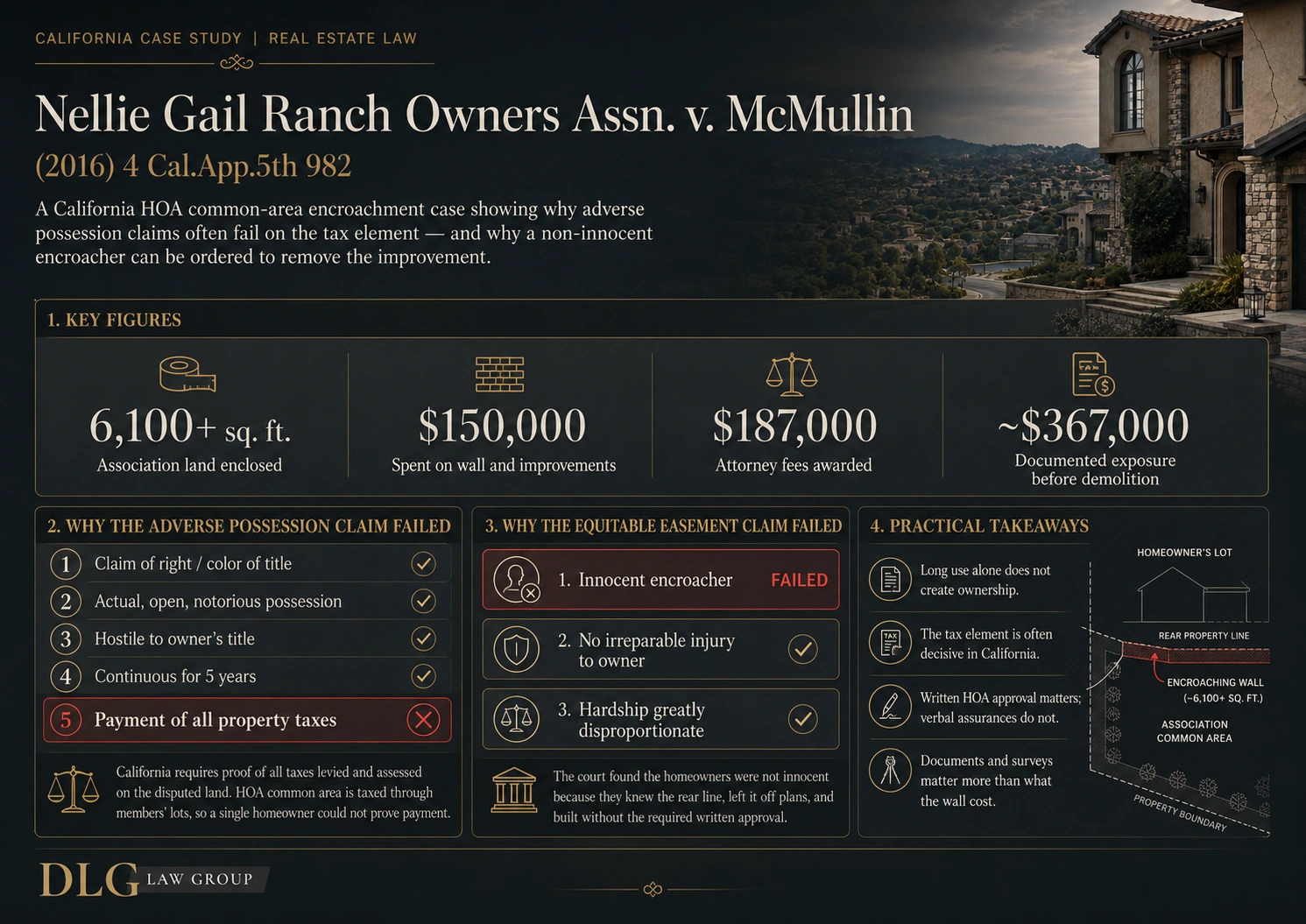
A homeowner cannot acquire homeowners association common area by adverse possession simply by fencing it, improving it, and using it for years. California requires the adverse possessor to have paid all property taxes levied and assessed on the disputed land for five years, proven by certified county tax collector records. Common area owned by an association is taxed. Its value is folded into the assessment on every member's individual lot under Revenue and Taxation Code section 2188.5. A single member therefore cannot show they paid the taxes on that parcel, and the claim collapses.
The court also refused to grant an equitable easement letting the wall stay in exchange for money. An equitable easement requires the encroacher to be innocent. The trial court found these owners were not. They knew where the property line was, they left it off every plan they submitted, and they began construction without the written approval they knew was required.
6,100+
Square feet of association land enclosed
$150,000
Spent on the wall and improvements
$187,000
Attorney fees awarded against them
0
Plans submitted showing the rear property line
What Happened on Lot 274
Nellie Gail Ranch is a 1,407-unit planned development spread across roughly 1,350 acres in Laguna Hills. The association owns the community's common areas — horse trails, an equestrian center, parks, and open-space canyon lots. In December 2000, Donald and Cynthia McMullin bought a home there at the end of a hilltop cul-de-sac with canyon views. Their back slope ran down to lot 274, a fifteen-acre canyon parcel the association owned and had dedicated as open space. One of the community's horse trails ran directly behind their property.
In January 2008 the McMullins applied to the association's Architectural Review Committee for a substantial backyard project: replaster the pool, rebuild the deck, add a bar and solar heater, replace the wrought iron fence at the rear with an eight-foot retaining wall, backfill behind it, and lay a sports court and garden on the flat pad the fill would create. The committee denied the application and told them in writing that any future submission needed a fully dimensioned site plan showing property lines.
Two weeks later they submitted a revised, more detailed plan. It identified the boundaries with the neighbors on either side. It did not identify the rear boundary with lot 274. The committee denied that application too, and repeated the requirement in writing — this time specifying that the plan come from a licensed civil engineer. It also suggested a workaround: submit a narrower application covering only the pool work, so the project could get moving. The McMullins did, and in April 2008 that limited application was approved, subject to a condition that expressly prohibited modifying the grade on the slope behind the existing retaining wall.
Roughly a year later, Cynthia went to the committee's office to file new plans for the wall and sports court. A community relations employee told her the plans were unnecessary because the project was already approved, checked the association's computer system, and repeated it. That employee left the association a few weeks afterward and never testified at trial. No one obtained written confirmation of the conversation. In May 2009 the McMullins pulled a building permit from the City of Laguna Hills, and construction began. No witness at trial could explain how they obtained that permit without written association approval.
By the time the association's compliance manager put the pieces together in August 2009 and issued a stop-work letter, the wall, the pad, and the sports court were essentially finished. What remained was backfill, finish grading, irrigation, drainage, and landscaping.
What the submitted site plans left out
- Retaining walls
- Rear property line (drawn, never labeled)
- Disputed property
The Dashed Line
This is the detail that decided the case, and it is easy to miss on a first reading. Donald McMullin prepared every site plan the couple submitted. On each one, he drew two short dashed lines extending outward from the ends of the existing six-foot retaining wall. He never labeled them. He never explained what they represented.
They were the rear property line.
The association only worked that out later, after it had denied application after application and asked in writing, more than once, for a plan that showed property lines. When the committee finally demanded a licensed surveyor's drawing in October 2009, the McMullins hired one — and Donald instructed the surveyor to leave the rear property line off the plan.
In an encroachment case, that sequence is worth more than any expert. It is the difference between a mistake and a decision. California law treats those two things very differently, and everything the McMullins had left depended on landing on the right side of that divide.
An honest boundary error is a problem you can usually buy your way out of. A boundary error the record shows you understood is a wall you pay to demolish. The practical lesson of Nellie Gail
How Sixteen Years Unfolded
Dec 2000
Purchase
The McMullins buy a hilltop home backing onto lot 274, a fifteen-acre association open-space canyon parcel crossed by a community horse trail.
Jan–Mar 2008
Two applications, two denials
The Architectural Review Committee rejects both submissions and tells the McMullins twice, in writing, that future plans must be fully dimensioned and show property lines — the second time, prepared by a licensed civil engineer.
Apr 2008
Narrow approval, express condition
A pool-only application is approved — on the condition that the McMullins not modify the grade on the slope behind the existing retaining wall. The wall and sports court remain unapproved.
May 2009
Construction begins anyway
Relying on an unrecorded oral statement from a staff member who later left the association and never testified, the McMullins pull a city building permit and start building. They had no written approval, and they knew written approval was required.
Aug 2009
Stop-work letter arrives too late
The compliance manager checks the file, finds no approval for a wall, and orders work stopped. By then the wall, the pad, and the sports court are essentially complete.
Oct 2009
The surveyor is told to leave it off
After a fourth denial, the McMullins hire a surveyor as instructed — and Donald directs him not to include the rear property line on the plan submitted to the association.
Dec 2009
– Jan 2010
The board stands down — provisionally
The board votes not to pursue the wall as a covenant violation and directs the committee to settle on screening. The McMullins spend about $20,000 on landscaping, irrigation, and drainage. At the time of the vote, the board did not know how far onto its land the wall sat.
Jul 2010
The city forces the issue
Laguna Hills writes to both sides: the wall sits entirely on association property and does not comply with the city's height and slope requirements. Either the association approves it and it is brought into compliance, or it comes out.
2011–2012
Two surveys, one answer
The association's surveyor finds the original wall sat on the property line and the new one encloses more than 6,100 square feet of lot 274. The McMullins' own surveyor confirms it. The parties later stipulate the two surveys do not meaningfully differ.
Jul 2012
The community says no
The association puts a sale of the disputed strip to a member vote at an appraised price. Of 572 members voting, only 142 favor the sale. The negotiated off-ramp closes.
Jun 2013
– Nov 2014
Suit, six-day trial, judgment
The association sues to quiet title and compel removal. The McMullins cross-complain for adverse possession and prescriptive, implied, and equitable easements. They lose on every theory. Neither side requests a statement of decision — a choice that shapes the appeal.
Oct 2016
Affirmed, and published
The Fourth District affirms in full and dismisses the challenge to the $187,000 fee award for lack of jurisdiction. Four law firms petition to have the opinion certified for publication. The court grants the request.
Why the Adverse Possession Claim Failed
California recognizes adverse possession, and it is genuinely available. It is also one of the hardest claims in property law to win. The conduct requirements are ordinary. The obstacle is a statutory tax requirement that most claimants cannot satisfy, and that most do not learn about until a lawyer explains it.
A claimant must establish five elements. Four of them describe how the land was used. The fifth describes who paid the county.
The Five Elements — and Where This Claim Died
Claim of right or color of title
Possession must rest on a claim of right, or on a written instrument that appears to convey title but is defective. Color of title carries a good-faith requirement: the claimant must have actually relied on the flawed document without knowing it was flawed.
Actual, open, and notorious occupation
The occupation must be visible enough to put a reasonably attentive owner on notice. The trial court found this element unproven here as well, though the Court of Appeal did not need to reach it.
Hostile and adverse to the owner's title
Use with the owner's permission is never hostile. This is why a request to buy the land, an application for approval, or an acknowledgment of the owner's rights can quietly reset a claimant's position.
Continuous and uninterrupted for five years
Five unbroken years under Code of Civil Procedure section 325. Worth noting on these facts: construction began in May 2009 and suit was filed in June 2013 — the court resolved the case without needing to test the clock.
Payment of all taxes levied and assessed Fatal
The claimant must have timely paid every state, county, and municipal tax levied and assessed on the disputed land for the full five years, and must prove it with certified records of the county tax collector. Failure on this element ends the claim regardless of how the land was used. The McMullins did not dispute that they paid nothing on the disputed strip.
The argument they made, and why it did not work
The McMullins did not claim they paid the taxes. They argued they were excused from paying them, relying on Hagman v. Meher Mount Corp. (2013) 215 Cal.App.4th 82. That was a Ventura County boundary case in which a neighbor won adverse possession over land owned by a tax-exempt religious nonprofit. Because the owner's exemption meant the county levied nothing, the claimant had nothing to pay, and the court excused the element.
That exception is real, but it is narrow: the claimant carries the burden of proving that no taxes were levied or assessed at all. The McMullins offered two pieces of evidence. The first was a 1984 quitclaim deed transferring lot 274 to the association that recited no documentary transfer tax, which they said showed the parcel was worthless. The second was recent tax statements that did not bill the association for lot 274 and listed no separate value for it.
Neither carried the burden. Nothing in the deed said the lot had no value, and at trial both sides agreed the disputed property did have value. They simply disagreed on how much. The tax statements did not show an absence of taxation either. They showed the opposite, because they noted that common area values were separately assessed.
The structural trap: how association common area is taxed
This is the part that generalizes far beyond Nellie Gail Ranch, and it is the reason adverse possession against a homeowners association is close to unwinnable in California.
Revenue and Taxation Code section 2188.5 provides that in a planned development, each separately owned lot is assessed on a value that includes both the lot itself and the owner's proportionate, undivided share of the association's common areas. Common area is not untaxed. It is taxed through every member's individual bill.
For a would-be adverse possessor, that creates a closed loop. Taxes on the disputed strip were levied and assessed, so the Hagman exception does not apply. But they were never billed to the strip as its own parcel, so no certified tax collector record can show that one homeowner paid them. The claimant is caught between the two halves of section 325.
Which means, if you have maintained a strip of your neighbor's land or your association's common area for years and assumed it became yours: it almost certainly did not. The tax element quietly disqualifies most of the fact patterns in which California owners believe they have a claim. The same trap catches ordinary neighbor disputes, because adjoining lots are assessed by lot number and you cannot separate out the taxes on a disputed sliver.
That is worth knowing early rather than after you have spent money on the land. Our California adverse possession page covers how the elements apply to residential, commercial, and rural parcels, and where the narrow exceptions actually live.
Why the Fallback Claim Failed: The Equitable Easement Gate
When adverse possession fails, encroachers turn to a second, more forgiving doctrine. California courts have discretion to refuse an injunction and instead create an easement in the encroacher's favor, compelling the property owner to accept money rather than removal. Courts call this an equitable easement. The blunter description in the case law is a judicially created easement by a kind of non-statutory eminent domain.
Because the remedy takes property rights from an owner who did nothing wrong, courts approach it cautiously and the scales start tipped toward the owner. Three conditions must all be present. Miss one and the court has no discretion to grant it at all.
All three must be satisfied — the test is conjunctive
Drawn from Hirshfield v. Schwartz (2001) 91 Cal.App.4th 749 and Shoen v. Zacarias (2015) 237 Cal.App.4th 16, both applied in Nellie Gail.
Factor 1 — Failed here
The encroacher must be innocent
The encroachment must be neither willful nor negligent. An encroacher is willful if they know they are building on the neighbor's land and act without a good-faith belief in the right to do so. Where a court finds the defendant was not innocent, it should issue the injunction.
Factor 2 — Not reached
Irreparable injury to the owner
Unless the public would be harmed, the court should grant the injunction where the owner will suffer irreparable injury regardless of the injury an injunction causes the encroacher.
Factor 3 — Not reached
Greatly disproportionate hardship
The hardship of removal must be greatly disproportionate to the owner's hardship from letting the encroachment stay — and the encroacher bears the burden of proving it clearly.
The McMullins never got past the first gate. The trial court found they were not innocent, and the appellate court held substantial evidence supported that finding. They knew where the rear line ran. They left it unlabeled on every plan despite repeated written demands. They represented that the new wall would follow the old fence line, when it actually enclosed more than two thousand additional square feet. And they began construction on a vague oral remark, after four written denials.
They pointed to the association's later approval of the landscape screening as evidence the association had blessed the wall. The court was unmoved. That approval came after the wall already stood on association land, and the $20,000 screening amounted to under twelve percent of the project's cost. The court also declined to weigh whether money would have been an adequate remedy, because that question belongs to the second factor and the case ended at the first. As the doctrine puts it, the rule exists to keep a wrongdoer from acquiring land by paying a penalty.
The same analysis governs ordinary boundary and encroachment disputes between neighbors. The first question a California court asks about a wall, fence, driveway, or deck over the line is not how much it cost. It is what the builder knew.
Which means your exposure was largely fixed before the concrete was poured. If you have a survey, showed the line on your plans, and built inside it, you are in a strong position even if the line later turns out to be wrong. If the file shows you knew and proceeded anyway, the cost of the structure will not save it. That is why the documents matter more than the dollars, and why they are worth assembling before anyone sends a letter.
What the Encroachment Actually Cost
Every figure below appears in the published record. It is worth sitting with, because these numbers are the argument for solving a boundary problem while it is still small.
The Ledger, From the Published Record
~$150,000
The improvements themselves. Retaining wall, backfill, level pad, and sports court — all subject to a removal order.
~$20,000
The screening plan. Landscaping, irrigation, and drainage installed after the board said it would not pursue the wall as a violation.
~$187,000
The association's attorney fees, awarded under the Davis-Stirling prevailing-party provision. The challenge to this award was dismissed on appeal for want of a separate notice of appeal.
~$10,000
The association's costs, added to the judgment.
~$367,000
Identifiable in the record — before the demolition even begins.
Not included, because the opinion does not quantify them: the cost of removing the sports court, cutting the wall down to grade to the city's satisfaction, regrading the slope, and restoring native California vegetation — all payable by the McMullins under the injunction — plus their own legal fees across a six-day bench trial, a rehearing petition, and an appeal.
Does This Describe Your Property?
Most people reading this are not planning a 6,100 square foot encroachment. They are looking at something smaller and older that has started to feel uncertain. If any of the following sounds like your situation, the doctrines above are already running in the background, and the five-year clocks may already be moving.
Six Situations That Put These Rules in Play
A retaining wall, deck, or patio sits below or beyond your fence line, and you are not certain who built it or when. On hillside lots this is the most common encroachment in Southern California, and the most expensive to unwind.
A driveway, path, or parking pad crosses the boundary and has been used that way for decades. Long use may support an easement claim. It rarely supports an ownership claim.
You have maintained land you assumed was yours because a fence, hedge, or wall has marked it since before you bought. In California, a fence is not a property line, and time alone does not make it one.
Your association has raised a structure that has stood for years, or you received a violation notice about improvements a prior owner made. Fee-shifting under the governing documents makes these disputes escalate faster than their value suggests.
A survey ordered during escrow turned up something unexpected. Encroachments discovered mid-transaction become a title problem, a financing problem, and sometimes a disclosure problem at once, on a closing timeline.
You are about to build near a line and have not had the parcel surveyed. This is the only item on the list you can still solve cheaply, and it is the one that decided Nellie Gail.
None of these means you have lost anything yet. What they mean is that the outcome will be decided by records that already exist: the survey, the permit file, the architectural submissions, the tax assessment structure, and the correspondence. Those records are easiest to read, and easiest to act on, before either side has taken a position.
Talk it through before it hardens
Not sure where your property line actually runs?
A free consultation with DiJulio Law Group covers what your records show, which clocks are running, and what a realistic resolution looks like. No obligation, and nothing is filed on your behalf without your direction.
What Is Available When Adverse Possession Is Not
Losing on adverse possession is not the same as losing the property question. The McMullins pleaded four theories and had a fifth option outside court that they let close. If you are the one on the wrong side of a line, these are the routes that actually remain open, roughly in order of how often they work.
Five Routes That Survive a Failed Adverse Possession Claim
Negotiated purchase or lot line adjustment
Best odds · Cheapest · Act early
Buying the strip or formally moving the line resolves the problem permanently and produces recordable title, which is what a future buyer and lender will want. It requires a willing counterparty, so the window is widest before either side has taken a legal position. The McMullins had this route and lost it when 430 of 572 voting members declined to sell. See transactional real estate.
Boundary line agreement
Where both owners are uncertain
Where the true line is genuinely unclear and both owners have long treated a fence or wall as the boundary, a written and recorded agreement can settle it without litigation. It works best where the uncertainty is mutual and documented, and it fails where one side always knew the answer.
Prescriptive easement
Use, not ownership · No tax element
A right to keep using the land for a specific purpose while the neighbor keeps title. It carries no tax-payment requirement, which is exactly why it succeeds where adverse possession fails. The limit is real: California courts will not grant an exclusive prescriptive easement that amounts to possession of residential land. Good for driveways and access, poor for walled-off yard space. See easement rights.
Equitable easement
Only if you were genuinely innocent
The court lets the improvement stay and orders you to pay the owner instead. All three Hirshfield factors must be met, and innocence is the gate the McMullins could not pass. If you built from a survey and can show it, this route is realistically available to you in a way it never was to them.
Mediation before filing
Preserves every option above
Boundary disputes are unusually well suited to mediation because the parties keep living next to each other, and because the underlying facts are usually fixed by a survey rather than contested. Mediating early also keeps the fee-shifting exposure from compounding. See real estate mediation.
What This Means for California Property Owners
Nellie Gail reads like an unusual case because of the scale of the encroachment. The mechanics are not unusual at all. The same doctrines decide fence, driveway, retaining wall, and deck disputes across Southern California every year. In almost all of them, the outcome turns on documents created long before anyone spoke to a lawyer.
Practical Takeaways by Situation
Before you build
Get the survey, and put the line on the plan
A licensed boundary survey costs a fraction of a wall. Once it exists, show it on every submission. An owner who documents the line and builds inside it is nearly always innocent for equitable easement purposes.
In an HOA
Written approval, or none
Verbal assurances from staff are worth nothing if the governing documents require written architectural approval. Get it in writing, keep it, and read the conditions attached to it.
If you find an encroachment
Document knowledge, then act
Permit files, architectural applications, emails, and surveys establish what the encroacher understood and when. Delay can also trigger limitations arguments, so a quiet file is not a safe file.
If you are the encroacher
Negotiate while a deal still exists
The McMullins had a path: buy the strip. It closed when 430 of 572 voting members said no. Lot line adjustments, easements, and purchase agreements are cheapest before positions harden.
Board members
Do not stand down before you know the facts
This board voted not to pursue the wall without knowing how far it extended. That vote nearly became an estoppel defense. Establish the boundary first, then decide.
Everyone
Watch the fee-shifting exposure
Actions to enforce association governing documents carry prevailing-party fees. In neighbor disputes, purchase agreements and recorded covenants often do too. Fees frequently exceed the value of the land.
How These Disputes Present in Glendale and Los Angeles County
Orange County produced this decision, but the fact patterns it governs are everywhere in Los Angeles County. They are especially common in the foothill communities around Glendale, where hillside lots, retaining walls, and decades of incremental building make the exact line between two parcels a live question far more often than owners expect.
Where These Cases Come From
Hillside lots
Glendale · La Cañada · Verdugos
Sloped parcels get flattened over time with retaining walls, terracing, and fill — each one an opportunity to drift downslope onto a neighbor's land or a municipal open-space parcel. Retaining walls are the single most common encroachment structure in foothill communities, and the most expensive to remove. These matters overlap heavily with zoning and land use compliance.
Pre-war subdivisions
Los Angeles · Pasadena · Burbank
Neighborhoods platted in the 1920s through 1940s often have fences and hedges that were placed by convenience rather than survey, then treated as the boundary for generations. Long use does not convert a fence into a property line in California — the tax element still has to be met.
Planned developments
Common area and CC&Rs
Condominium and planned-development communities across the region combine association-owned common area with architectural approval requirements and prevailing-party fee provisions. That is precisely the combination that made Nellie Gail so costly, and it repeats constantly in HOA governance and covenant disputes.
Shared access
Driveways · trails · utility corridors
Where a driveway, path, or utility corridor crosses a boundary, owners frequently plead adverse possession and easement theories together in the alternative. The doctrines have different elements and different outcomes — a point our case study on implied easements in Romero v. Shih examines in detail.
Inherited property
Estates · co-owners
Family properties held through delayed probate or shared among heirs produce possession claims between people who are not strangers, which changes the hostility analysis substantially. Related reading: partition standing among heirs.
Sale-triggered discovery
Escrow · title · disclosure
Many encroachments surface only when a survey is ordered during a sale, at which point they become a title problem, a financing problem, and sometimes a disclosure problem at the same time. Handling them before listing is far cheaper than during escrow.
DiJulio Law Group advises property owners, associations, buyers, and businesses on these matters as part of its California real estate law practice, including adverse possession and quiet title, boundary and encroachment disputes, easement rights and access, zoning and land use, and transactional real estate. The real estate practice center explains what to gather before a first consultation, and the real estate resource library covers common property-rights questions. Additional decisions are collected in our California case study library.
Why This Matters
Six Things California Property Owners Get Wrong About Adverse Possession
Adverse possession is the most widely misunderstood doctrine in California property law, largely because it is taught everywhere as a story about long use and almost nowhere as a story about tax records.
Long Use Is Not Enough
Occupying, fencing, mowing, and improving land for decades establishes nothing on its own. Without five years of paid taxes proven by certified county records, the claim fails at the threshold.
The Tax Element Is Usually Decisive
Because adjoining lots are assessed by lot number, a claimant to a strip of a neighbor's parcel ordinarily cannot show they paid its taxes. That is the real reason successful California claims are rare.
HOA Common Area Is Taxed
Association common area is not exempt. Its value is assessed to every member's lot, so no single member can prove they paid the taxes on it. Adverse possession against your own association is close to structurally impossible.
Money Is Not a Default Remedy
An equitable easement is discretionary, not available on request. If the court finds the encroacher was not innocent, the analysis stops there and the owner gets removal — whatever the wall cost to build.
What You Left Off the Plan Is Evidence
Omissions in applications, drawings, and surveys are read as choices. A property line drawn but never labeled, on plan after plan, is what converted this case from an error into willful conduct.
Procedure Can Cost You the Appeal
The McMullins lost review of a $187,000 fee award because they did not separately appeal it, and lost two defenses they had pleaded but never argued at trial. Preservation is substantive.
Frequently Asked Questions
What are the elements of adverse possession in California?
A claimant must prove five things: possession under a claim of right or color of title; actual, open, and notorious occupation sufficient to give the owner reasonable notice; possession hostile and adverse to the owner's title; continuous and uninterrupted possession for five years; and payment of all taxes levied and assessed on the property throughout that five-year period. Code of Civil Procedure section 325 requires the tax payments to be established by certified records of the county tax collector. All five elements must be met, and the claimant carries the burden on each.
Why is adverse possession so rare in California?
The tax element. Most adverse possession situations involve a strip of a neighbor's parcel — a fence line, a driveway, a wall — and California counties assess adjoining lots by lot number rather than by disputed sliver. The claimant cannot produce certified tax collector records showing they paid the taxes on the specific land they occupied, because those taxes were billed to the record owner as part of the whole parcel. Courts have long held that a claimant's failure to pay taxes on the land claimed is fatal to the claim. Conduct that would satisfy the doctrine in many other states routinely fails here for that reason alone.
Have there been successful adverse possession cases in California?
Yes, though they tend to involve unusual tax circumstances. In Hagman v. Meher Mount Corp. (2013) 215 Cal.App.4th 82, a Ventura County neighbor succeeded against a tax-exempt religious nonprofit, because the owner's exemption meant no taxes were levied on the land and the claimant was therefore excused from paying them. The court also held that a public benefit corporation is not a public entity immune from adverse possession under Civil Code section 1007. Cases like Hagman succeed on the exception to the tax element rather than by satisfying it, which is a useful indicator of how narrow the path is.
Can you claim adverse possession against an HOA in California?
It is very difficult, and Nellie Gail Ranch Owners Assn. v. McMullin explains why. Association common area is not tax exempt. Under Revenue and Taxation Code section 2188.5, the value of the common area is assessed to each separately owned lot in the development, so property taxes on it are levied and paid — by every member, through their individual bills. That means a claimant can neither show the land was untaxed, which would excuse the element, nor show that they personally paid the taxes on that parcel, which would satisfy it. The claim fails from both directions.
What is the difference between adverse possession and a prescriptive easement?
Adverse possession transfers ownership; a prescriptive easement grants a right to a particular use while the record owner keeps title. A prescriptive easement does not require payment of taxes, which makes it easier to establish. California courts, however, will not use a prescriptive easement to give a claimant what amounts to exclusive possession of residential land, because that would be adverse possession without the tax requirement. Encroachers who ask for an exclusive prescriptive easement over a neighbor's yard generally do not get it.
What is an equitable easement in California?
It is a court-created interest that lets an encroaching improvement remain in place while compensating the property owner in damages, instead of ordering removal. Under Hirshfield v. Schwartz and Shoen v. Zacarias, three conditions must all be present: the encroacher must be innocent, meaning the encroachment was neither willful nor negligent; the owner must not face irreparable injury; and the hardship to the encroacher from removal must be greatly disproportionate to the owner's hardship from letting it stay, proven clearly by the encroacher. If any one is missing, the court has no discretion to grant the easement. Doubtful cases are decided in the property owner's favor.
What happens if my neighbor builds a fence or wall on my property in California?
A property owner is generally entitled to a mandatory injunction requiring an adjoining owner to remove an encroaching improvement. The neighbor can try to defeat that by seeking an equitable easement, but must first establish that the encroachment was innocent. Evidence about what the builder knew — surveys, permit applications, plans, correspondence — therefore matters more than the cost of the structure. Prompt action also matters, because delay can support limitations and estoppel arguments.
How long do I have to bring a quiet title action against an encroacher?
Code of Civil Procedure section 318 sets a five-year period for an action to recover real property, and that clock is triggered when an adverse possessor begins to use and occupy the land in a manner that would support a claim of title. An encroacher who argues the owner's quiet title action is time barred therefore has to establish every element of adverse possession to show the claim expired — including the tax element. That is why the two doctrines are usually litigated together, and why an owner should not treat a long-standing encroachment as settled simply because it has been there a while.
Can I be ordered to pay my HOA's attorney fees in a dispute like this?
Yes. Civil Code section 5975, part of the Davis-Stirling Common Interest Development Act, provides for an award of reasonable attorney fees and costs to the prevailing party in an action to enforce a common interest development's governing documents. In Nellie Gail, the association recovered roughly $187,000 in fees and $10,000 in costs, and the Court of Appeal never reached the merits of the challenge because the homeowners failed to file a separate notice of appeal from the post-judgment fee order. Fee exposure frequently exceeds the value of the land at issue, which should shape strategy from the first letter.
Does approval from my HOA's staff count as approval?
Not where the governing documents require written approval from an architectural committee. In this case, a staff member twice told a homeowner verbally that plans were already approved. The homeowners relied on that, obtained a city permit, and built. The employee left shortly afterward and never testified, no written confirmation existed, and four written denials were already in the file. The court treated proceeding on that oral remark as evidence the homeowners were not innocent. Written approval, with its conditions read carefully, is the only reliable authorization.
If I cannot claim adverse possession, what are my options?
Several routes usually remain. A negotiated purchase of the disputed strip or a formal lot line adjustment produces recordable title and is normally the cleanest result, though it needs a willing neighbor and works best before either side has taken a legal position. A recorded boundary line agreement can settle a genuinely uncertain line. A prescriptive easement grants the right to keep using the land for a specific purpose and carries no tax-payment requirement, which is why it succeeds where adverse possession fails, although California courts will not grant one that amounts to exclusive possession of residential land. An equitable easement lets the improvement stay in exchange for damages, but only if you were an innocent encroacher. Mediation before filing preserves all of these and keeps fee exposure from compounding.
What should I do before building near a property line in Glendale or Los Angeles?
Commission a licensed boundary survey and keep the record of it, show the surveyed line on every plan submitted to a city or an association, obtain written approvals before work starts and read the conditions attached, and confirm that any permit issued matches the work actually planned. On hillside lots, verify the setback and grading rules that apply to retaining walls specifically. A survey costs a small fraction of a wall, and it is the single document that most reliably establishes good faith if a dispute ever arises.
Do I need a quiet title or adverse possession attorney in Glendale or Los Angeles?
These disputes turn on surveys, tax records, architectural files, permit history, and limitations deadlines, and the analysis is usually decided long before trial by what those records show. DiJulio Law Group advises property owners, buyers, sellers, and associations on adverse possession and quiet title, boundary and encroachment disputes, and easement matters in Glendale, Los Angeles, and throughout Southern California. You can contact the firm or call 818-502-1700 to discuss a property boundary matter. Where the parties still have room to deal, real estate mediation often resolves these cases for a fraction of what litigation costs.
How DiJulio Law Group Approaches Boundary and Possession Disputes
Boundary matters arrive in a familiar shape. A survey ordered during escrow shows a neighbor's driveway over the line. An association sends a violation notice about a wall that has stood for a decade. A homeowner who has maintained a strip of hillside for twenty years learns it was never theirs. In each case, the governing law is well settled. What varies is the paper trail, and how much of it still exists.
The first work is diagnostic. That means locating and reading the surveys, pulling the municipal permit and code enforcement history, obtaining the architectural committee file and the governing documents, tracing the tax assessment structure for the parcel, and identifying which limitations periods are already running. That analysis usually establishes the strength of a claim or a defense before a complaint is drafted. It also frequently changes what a reasonable resolution looks like for both sides.
DiJulio Law Group has represented property owners, buyers, sellers, associations, and businesses in Glendale, Los Angeles, and throughout Southern California for more than 35 years in real estate, business, construction, environmental, and mediation matters. Founding partner R. David DiJulio brings a background in environmental science alongside his legal practice. That matters in hillside, grading, drainage, and open-space disputes, where the physical facts drive the legal ones. Senior litigator Valeria Granata handles trial and appellate work in California real estate and business matters.
Dealing With an Encroachment, a Boundary Dispute, or a Claim to Your Property?
Bring what you have: the survey if one exists, the permit or architectural file, the governing documents, and any correspondence. The first conversation is about what those records show and which deadlines are already running, not about filing anything.
- Free initial consultation
- 35+ years in California real estate matters
- You speak with an attorney, not an intake screener
- Serving Glendale, Los Angeles, and Southern California
This case study discusses a published California appellate decision and related statutes for general informational purposes. It is not legal advice, does not create an attorney-client relationship, and does not describe, promise, or predict the outcome of any particular matter. DiJulio Law Group was not counsel in Nellie Gail Ranch Owners Association v. McMullin. Every property dispute depends on its own facts, records, surveys, and procedural posture, and the law changes. Consult a licensed California attorney about your situation.
Primary Sources
- Nellie Gail Ranch Owners Association v. McMullin (2016) 4 Cal.App.5th 982, No. G051244 (Cal. Ct. App., 4th Dist., Div. 3, Oct. 3, 2016), certified for publication. Full opinion text. caselaw.findlaw.com
- California Code of Civil Procedure § 325 (adverse possession; five-year occupation and payment of taxes established by certified records of the county tax collector). California Legislative Information, official statutory text. leginfo.legislature.ca.gov
- California Code of Civil Procedure § 318 (five-year limitations period for an action to recover real property). California Legislative Information, official statutory text. leginfo.legislature.ca.gov
- California Revenue and Taxation Code § 2188.5 (assessment of planned development interests, including each owner's share of association common area). California Legislative Information, official statutory text. leginfo.legislature.ca.gov
- California Civil Code § 5975 (Davis-Stirling Common Interest Development Act; enforcement of governing documents and prevailing-party attorney fees). California Legislative Information, official statutory text. leginfo.legislature.ca.gov
- California Civil Code § 1007 (occupancy conferring title; exclusion of property dedicated to public use and property of public utilities). California Legislative Information, official statutory text. leginfo.legislature.ca.gov
- Hagman v. Meher Mount Corp. (2013) 215 Cal.App.4th 82 (Cal. Ct. App., 2d Dist., Div. 6) — the tax-exemption exception to the payment element, and public benefit corporations under Civil Code § 1007. Full opinion text. caselaw.findlaw.com
- California Courts, official published opinions of the California Supreme Court and Courts of Appeal. courts.ca.gov
- Davis-Stirling.com case summary of Nellie Gail Ranch Owners Assn. v. McMullin, maintained as a reference resource on California common interest development law. davis-stirling.com
Authorities Cited in the Opinion
- Cal. Code Civ. Proc. §§ 318, 325, 632.
- Cal. Civ. Code §§ 1007, 5975(c).
- Cal. Rev. & Tax. Code § 2188.5(a)(1).
- Main Street Plaza v. Cartwright & Main, LLC (2011) 194 Cal.App.4th 1044, 1054 (elements of adverse possession).
- Gilardi v. Hallam (1981) 30 Cal.3d 317, 326 (burden on the tax element; lot-number assessment).
- Glatts v. Henson (1948) 31 Cal.2d 368, 372.
- Mesnick v. Caton (1986) 183 Cal.App.3d 1248, 1260 (failure to pay taxes is fatal).
- Hagman v. Meher Mount Corp. (2013) 215 Cal.App.4th 82, 90–91 (levy and assessment; exemption exception).
- Lake Forest Community Assn. v. County of Orange (1978) 86 Cal.App.3d 394, 397 (taxation of association common area).
- Brown Derby Hollywood Corp. v. Hatton (1964) 61 Cal.2d 855, 858–859 (mandatory injunction; willful encroachment).
- Hirshfield v. Schwartz (2001) 91 Cal.App.4th 749, 759, 764–765 (equitable easement; three-factor test).
- Shoen v. Zacarias (2015) 237 Cal.App.4th 16, 19–21 (conjunctive test; scales tipped toward the owner).
- Tashakori v. Lakis (2011) 196 Cal.App.4th 1003, 1008–1009.
- Linthicum v. Butterfield (2009) 175 Cal.App.4th 259, 265, 267.
- Salazar v. Matejcek (2016) 245 Cal.App.4th 634, 649.
- Harrison v. Welch (2004) 116 Cal.App.4th 1084, 1095–1096 (limitations and adverse possession).
- Acquired II, Ltd. v. Colton Real Estate Group (2013) 213 Cal.App.4th 959, 970 (implied findings doctrine).
- Fladeboe v. American Isuzu Motors Inc. (2007) 150 Cal.App.4th 42, 59–60.
- Colony Hill v. Ghamaty (2006) 143 Cal.App.4th 1156, 1171–1172 (separate notice of appeal for fee orders).

0 Comments