
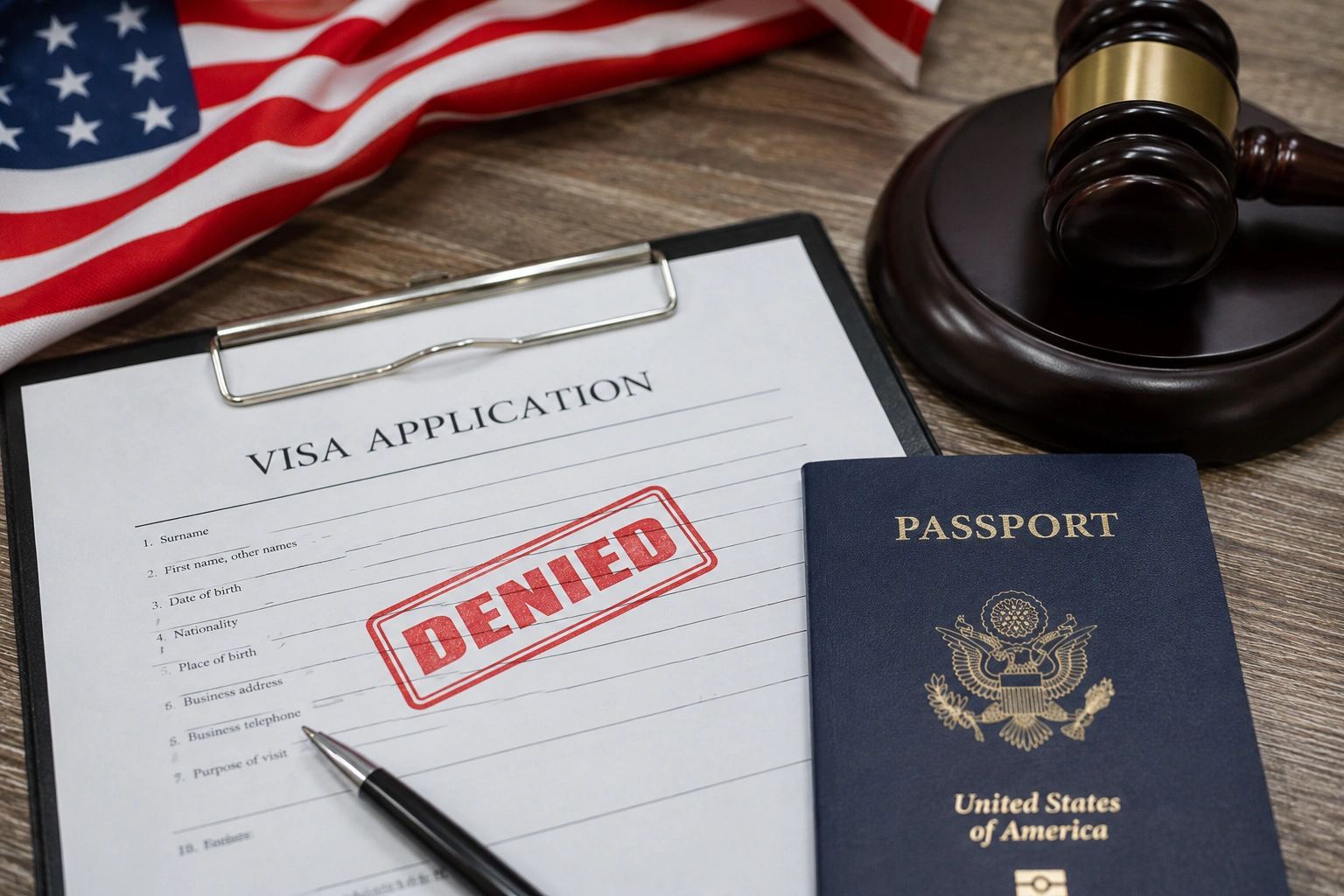
Nine Years. Three Presidents. A Visa Denied Based on Tattoos.
The Supreme Court Ruling That Closed the Courthouse Door on Immigrant Families.
Sandra Muñoz is a U.S. citizen and immigration attorney in Los Angeles. Her husband Luis's family-based visa was denied in 2015 — the consulate cited his tattoos and alleged gang membership, providing no factual basis. She spent nine years fighting through every available channel. In June 2024, the Supreme Court ruled 6-3 against her. Every immigrant family in America lives with the consequences.
Case at a Glance
- The family
- Sandra Muñoz, a U.S. citizen and immigration attorney in Los Angeles, married Luis Asencio-Cordero, a Salvadoran citizen, in 2010. They have a U.S.-citizen child together
- What happened
- In 2015 Luis's immigrant visa was denied at the San Salvador consulate — based on a consular officer's belief, drawn from his tattoos, that he was a member of MS-13. No factual basis was provided for three years
- What Sandra argued
- As a U.S. citizen, she has a constitutional liberty interest in living with her husband in the United States, and due process required the government to explain its decision
- What the Supreme Court held
- U.S. citizens have no fundamental liberty interest in their noncitizen spouse's admission. Consular visa decisions are not subject to judicial review in federal court
A Marriage, a Visa Application, and a Silence That Lasted Years
Luis Asencio-Cordero arrived in the United States from El Salvador in 2005. He and Sandra Muñoz met, fell in love, and married in 2010. Sandra was a practicing immigration attorney in Los Angeles — someone who understood the system she was navigating. They had a child together, a U.S. citizen. They wanted to build their life in the country where Sandra was born and where their child was growing up.
Sandra filed an immigrant visa petition with U.S. Citizenship and Immigration Services on her husband's behalf — the standard first step in the family-based immigration process for spouses of U.S. citizens. USCIS approved the petition. Luis then traveled to El Salvador to attend his visa interview at the U.S. consulate in San Salvador. In December 2015, the consulate denied his application.1
The denial cited 8 U.S.C. § 1182(a)(3)(A)(ii) — a provision making inadmissible any noncitizen a consular officer believes seeks to engage in unlawful activity. No further explanation was given. No facts were provided. No evidence of any crime was cited. Luis denied any gang affiliation. Sandra immediately began asking why.
The Fight for an Explanation
Sandra wrote to the State Department. She sought help from Congresswoman Judy Chu. She submitted a declaration from a court-approved gang expert, Humberto Guizar, who reviewed Luis's tattoos and attested they were not representative of any known criminal gang. The State Department responded that the rebuttal contained no new information. Three presidential administrations — Obama, Trump, Biden — came and went. The visa remained denied. The family remained separated.2
In January 2017, Sandra and Luis sued in the United States District Court for the Central District of California. It was not until November 2018 — three years after the denial — that the State Department disclosed for the first time that its consular officer had concluded Luis was a member of MS-13, based in part on his tattoos and his in-person interview.2
2010
Sandra Muñoz and Luis Asencio-Cordero marry. Sandra, a U.S. citizen and immigration attorney in Los Angeles, and Luis, a Salvadoran citizen who arrived in the U.S. in 2005, begin building their life together. They will have a U.S.-citizen child.
December 2015
Visa denied at the San Salvador consulate. After USCIS approved Sandra's immigrant visa petition for Luis, he attends his interview in El Salvador. The consulate denies his application under the "unlawful activity" provision, citing no factual basis. The family is separated.
April 2016
Sandra submits gang expert declaration. After requesting the reason for denial, Sandra and Luis submit exculpatory evidence from gang expert Humberto Guizar, who attests that Luis's tattoos are not affiliated with any known criminal organization. The State Department responds that the submission contains "no new information."
January 2017
Lawsuit filed in the Central District of California. Sandra and Luis sue the Department of State in federal court, arguing the denial without explanation violated Sandra's constitutional liberty interest in living with her husband in the United States.
November 2018
Three years later — the government finally gives a reason. In discovery, the State Department discloses for the first time that the consular officer denied Luis's visa based on a belief he was a member of MS-13, in part based on his tattoos and his in-person interview. No criminal record existed.
October 2022
Ninth Circuit rules for Sandra. The U.S. Court of Appeals for the Ninth Circuit holds that Muñoz has a constitutionally protected liberty interest in her husband's visa application, and that the State Department violated due process by failing to give her a reason for the denial in a timely manner. The decision also holds the government forfeited its right to consular nonreviewability by the delay.
June 21, 2024
Supreme Court reverses 6-3. In an opinion authored by Justice Barrett, the Court holds that U.S. citizens have no fundamental liberty interest in their noncitizen spouse's admission to the United States. The doctrine of consular nonreviewability bars federal court review of the visa denial. Sandra and Luis's nine-year legal fight ends at the Supreme Court.
The Legal Doctrine That Decided the Case
To understand why a U.S. citizen with an approved petition, a gang expert's declaration, and nine years of documented effort could not prevail in court, it is necessary to understand a doctrine that most Americans have never heard of: consular nonreviewability.
What the Supreme Court's 6-3 Decision Actually Said
Justice Barrett's majority opinion acknowledged that Sandra had suffered real harm from her husband's inability to join her in the United States. It acknowledged that Congress has historically extended special treatment to marriage in immigration matters — expedited processing, immediate relative classification, priority visa categories. But it drew a line between those statutory benefits and constitutional rights.
The Court applied the standard from Washington v. Glucksberg (1997) — the test for whether an asserted liberty interest is "fundamental" and therefore constitutionally protected. Under that standard, an interest must be deeply rooted in the nation's history and tradition, and carefully described. The majority held that the right to have a noncitizen spouse admitted to the United States does not meet that standard. Congress can choose to facilitate immigration for spouses of citizens, and it has. But it has never made spousal immigration a constitutional guarantee, and the Court declined to create one.4
Justice Sotomayor's dissent, joined by Justices Kagan and Jackson, argued that the right to live with one's spouse in one's own country is exactly the kind of intimate liberty interest the Due Process Clause protects, and that denying a U.S. citizen the ability to live in the United States with her husband — without explanation, without recourse — is a profound deprivation of that liberty that the majority improperly dismissed.
What Families Are Left With
After Muñoz, the options available to families in similar situations are limited. There is no constitutional right to judicial review of a consular denial. There is no statutory right to a detailed factual explanation for denials based on national security or criminal inadmissibility grounds. The consular officer's decision, backed by a bare citation to a statutory provision, is final.
What remains are the administrative processes that have always existed — and the practical reality that how a visa case is built, documented, and presented before the consulate interview has never mattered more.
Why This Matters
What Every Immigrant Family in Southern California Should Understand After Muñoz
Sandra Muñoz did everything right. She filed the right petition. She hired the right expert. She pursued every available channel for nine years. The Supreme Court's ruling is not a statement about her case specifically — it is a statement about the legal framework every immigrant family now operates under. Understanding that framework is the starting point for protecting your own.
Consular Decisions Are Effectively Unreviewable
After Muñoz, there is no judicial remedy for a visa denial based on national security or criminal inadmissibility grounds. The consular officer's decision is final. The only recourse is administrative — and administrative recourse is not guaranteed.
Pre-Interview Preparation Is Everything
With no path to judicial review, the consulate interview is where a family-based visa case is determined. Thorough documentation, proactive addressing of potential inadmissibility issues, and experienced legal counsel before the interview are no longer merely helpful — they are the primary protection available.
Approved USCIS Petitions Are Not Final Approval
An approved I-130 or other immigrant petition means USCIS has accepted the qualifying relationship. It does not mean a visa will be issued. The consulate conducts its own independent admissibility determination — and that determination is now beyond judicial reach.
Waivers and Alternative Pathways Must Be Explored Early
For applicants with potential inadmissibility issues — prior removal, certain criminal history, health grounds — understanding waiver availability and preparing the strongest possible waiver application before or alongside the visa process is essential in the post-Muñoz landscape.
How DiJulio Law Group Approaches Family-Based Immigration in Southern California
The Muñoz decision is a landmark ruling that reshaped the legal landscape for immigrant families across the country. For families in the greater Los Angeles area — one of the most diverse immigrant communities in the United States — its practical consequences are immediate. The pathway to bringing a spouse, parent, or child to the United States runs through a consular process that now offers no meaningful judicial recourse if something goes wrong.
DiJulio Law Group has represented individuals and families in family-based visa petitions, investor visas, employment-based visas, and immigration matters throughout Glendale, Los Angeles, and Southern California for more than 35 years. Our attorneys speak multiple languages and understand the specific challenges that immigrant families in the greater Los Angeles area face — including the communities from Latin America, Asia, and the Middle East who make up a significant share of the region's population.
In a post-Muñoz environment, the preparation that goes into a visa application — the documentation, the proactive addressing of potential issues, the legal strategy for inadmissibility grounds — matters more than it ever has. If you are beginning the family-based immigration process, or if a visa application has been denied or is at risk of denial, the time to engage experienced counsel is before the consulate interview, not after.
Navigating a Family Visa or Immigration Matter?
DiJulio Law Group assists families with immigration matters throughout Glendale, Los Angeles, and Southern California. Consultations are confidential and available in multiple languages.
Sources & Citations
- Oyez, Department of State v. Munoz, Case No. 23-334. oyez.org
- National Immigrant Justice Center, Case Timeline: U.S. Department of State v. Muñoz. immigrantjustice.org
- FindLaw, Full Opinion: Department of State v. Muñoz, 602 U.S. 899 (2024). caselaw.findlaw.com
- Justia U.S. Supreme Court, Department of State v. Muñoz. supreme.justia.com
- American Immigration Council, "Judicial Review of Visa Decisions After the Supreme Court's Decision in Department of State v. Muñoz," July 2025. americanimmigrationcouncil.org



0 Comments