
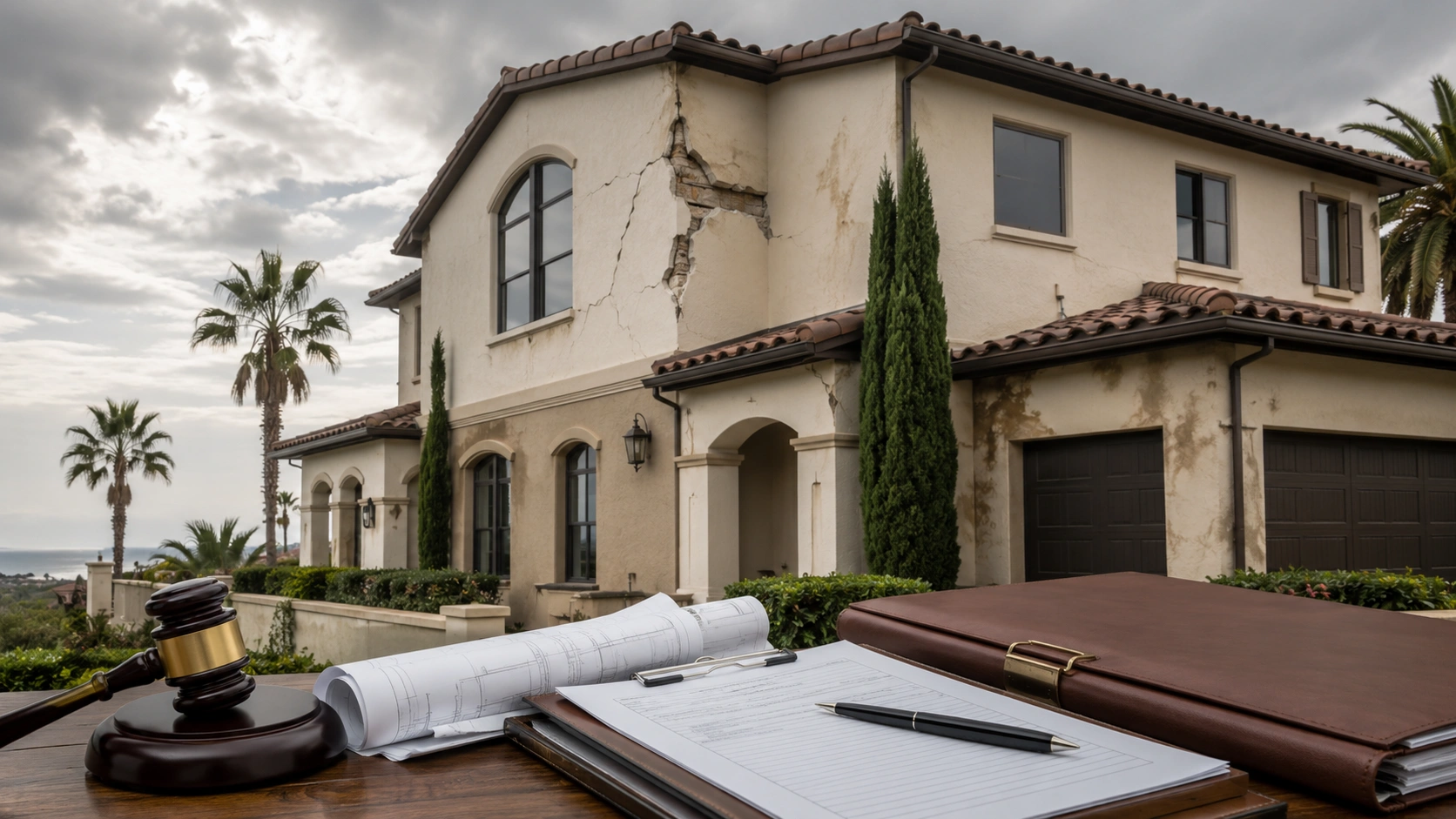
37 Homeowners. Defective Foundations, Roofs, and Plumbing.
A California Supreme Court Ruling That Changed How Every Construction Defect Case Must Begin.
When dozens of California homeowners sued their builder for widespread defects in 2013, their attorneys tried a familiar strategy: file on common law claims and skip the mandatory pre-litigation process. The California Supreme Court's 2018 ruling closed that door permanently — and established the rules every homeowner in Southern California must follow today.
Case at a Glance
- The properties
- 37 new single-family homes in Albany, Kern County, purchased from developer and general contractor McMillin Albany LLC after January 2003
- The defects alleged
- Foundations, plumbing, electrical systems, roofs, windows, floors, and chimneys — defects alleged across nearly every major system of construction
- The legal strategy attempted
- Homeowners filed common law claims — negligence, strict liability, breach of warranty — and deliberately dismissed their SB 800 statutory claim to avoid the pre-litigation process
- The Supreme Court's ruling
- SB 800 is the virtually exclusive remedy for construction defect claims in new residential homes sold after January 1, 2003. Common law claims cannot be used to bypass it
The Homes, the Defects, and the Strategy That Failed
Carl and Sandra Van Tassel, along with dozens of their neighbors, had purchased new single-family homes from McMillin Albany LLC at various times after January 2003. The development was in Albany, in Kern County — modest new construction in California's Central Valley. By 2013, the homeowners had documented what they described as defects in nearly every major system of their homes: the foundations, plumbing, electrical, roofing, windows, floors, and chimneys.1
Represented by experienced construction defect attorneys, the homeowners filed suit against McMillin. Their complaint included eight causes of action — negligence, strict product liability, breach of contract, breach of warranty, and a statutory claim for violation of California Civil Code Section 896, the construction standards codified in the Right to Repair Act.
Then the homeowners made a calculated move. They voluntarily dismissed their Section 896 statutory claim — the SB 800 claim — and proceeded only on the common law causes of action. The logic was straightforward: the Right to Repair Act requires a lengthy pre-litigation notice-and-repair process before a homeowner can file suit. By dropping the statutory claim and proceeding only on negligence and strict liability, the homeowners' attorneys argued the Act no longer applied. They could go straight to court.2
McMillin immediately moved to stay the litigation, arguing the homeowners were required to follow the Act's pre-litigation procedures regardless of how they characterized their claims. The trial court denied the motion. McMillin appealed.
The Appellate Split That Forced the Supreme Court's Hand
The homeowners' strategy was not invented from thin air. It was based on a real split in California appellate authority that had existed since 2013. In Liberty Mutual Insurance Co. v. Brookfield Crystal Cove LLC, the Fourth District Court of Appeal had held that where a construction defect causes actual property damage, homeowners retain their common law claims and are not required to go through the Act's pre-litigation process. Two years later, in Burch v. Superior Court, the same district reaffirmed that position.3
The Fifth District disagreed. In its 2015 decision in the same McMillin case, the Fifth District held that the Right to Repair Act was the exclusive remedy for all construction defect claims on new residential homes sold after 2003 — regardless of whether the defects caused property damage, and regardless of how the homeowner chose to plead the claims. Common law negligence and strict liability claims were displaced by the statute.3
California builders and developers had been living with this conflict for years. Depending on which appellate district governed a given property, the same set of construction defects could be subject to entirely different procedural requirements. The California Supreme Court granted review to resolve it once and for all.
What the Supreme Court Actually Decided
In a unanimous opinion authored by Justice Goodwin Liu, the California Supreme Court affirmed the Fifth District and resolved the split decisively in favor of builders. The court held that the Right to Repair Act is the virtually exclusive remedy for construction defect claims arising from new residential homes sold after January 1, 2003 — whether those claims involve pure economic loss, property damage, or both.4
The court's reasoning rested on the legislative history and text of the Act. When the Legislature passed SB 800 in 2002, it did so comprehensively — establishing detailed construction standards, a mandatory pre-litigation process, a right to repair for builders, and specific remedies for homeowners. The Legislature explicitly exempted only personal injury claims from the Act's coverage. Everything else — economic loss, property damage, structural failure — was captured by the statute.4
The practical consequence was immediate: homeowners cannot plead their way around SB 800 by dropping the statutory claim and relying only on common law theories. If the claim arises from a construction defect in a new home sold after January 1, 2003, the Act applies. The pre-litigation process must be completed. And if a homeowner files suit before doing so, the builder is entitled to a stay pending compliance.
Before McMillin (the Liberty/Burch rule)
Two Paths for Homeowners
Where a construction defect caused actual property damage, homeowners could sue on common law negligence and strict liability without completing SB 800's pre-litigation process. The statutory path and the common law path existed in parallel.
After McMillin (2018 — current law)
One Mandatory Path
SB 800 is the virtually exclusive remedy for all new residential construction defect claims sold after January 1, 2003 — whether the damage is economic or physical. Common law claims cannot be used to bypass the pre-litigation process. Personal injury claims remain the only exception.
The SB 800 Pre-Litigation Process: What Homeowners Must Do Before Filing Suit
The Right to Repair Act was designed to give builders a structured opportunity to fix defects before the costs and disruptions of litigation begin. For homeowners, understanding and correctly executing the pre-litigation process is not optional — it is a prerequisite to filing a lawsuit, and failure to follow it can result in a court stay and significant delay.
Written Notice of Claim
Day 0The homeowner sends written notice to the builder, sent certified mail, describing each alleged defect in reasonable detail — identifying its nature and location to the extent known. This is the trigger for the entire pre-litigation timeline. The notice must be served before any lawsuit is filed.
Builder Acknowledgment
Within 14 daysThe builder must acknowledge receipt of the homeowner's claim within 14 days. The builder may also request relevant documents at this stage. If the builder fails to acknowledge within 14 days, the homeowner may proceed directly to litigation.
Builder Inspection
Within 14 days of acknowledgmentThe builder has 14 days after acknowledgment to conduct a physical inspection of the alleged defects. The builder may conduct testing, open walls, and assess damage. A second inspection may be conducted within an additional 40 days if needed. The homeowner must provide reasonable access.
Repair Offer or Cash Settlement
Within 30 days of inspectionWithin 30 days of completing its inspection, the builder may offer to repair the defects and compensate for related damages, or make a cash settlement offer in lieu of repairs. The offer must include a timeline for completing repairs. A builder who makes no offer within this window forfeits the right to repair and the homeowner may proceed to litigation.
Homeowner Response
Within 30 days of offerThe homeowner has 30 days to accept or decline the repair offer, with a reason stated for any refusal. If a cash offer is made, the homeowner may accept it or proceed directly to litigation — this is one of the few points where the homeowner retains that choice. If repairs are accepted, they must begin within 14 days and be completed with utmost diligence.
Litigation — If Process Fails
After process completes or builder defaultsIf the pre-litigation process is completed without resolution — or if the builder misses any statutory deadline — the homeowner may file suit. At this stage, the homeowner has complied with McMillin's requirements and litigation may proceed under SB 800's standards.
The SB 800 Construction Standards — What Builders Are Held To
The Right to Repair Act does more than create a pre-litigation process. Civil Code Section 896 establishes specific construction standards — functional performance requirements that California builders must meet for new residential homes. These standards are the benchmarks against which defect claims are measured, and they carry their own statutes of limitations.
Structural Defects
10 years
Load-bearing components, foundations, framing, shear walls — anything affecting the structural integrity of the home
Water Intrusion
10 years
Roofing, windows, doors, exterior walls, foundations — any penetration that allows water into the structure
Plumbing & Sewer
4 years
Pipes, fixtures, water supply lines, sewer connections — functional performance of all plumbing systems
Electrical Systems
4 years
Wiring, panels, outlets, and all electrical components — performance and safety standards
Soil Issues
10 years
Improper grading, soil movement, or settling that damages the home's foundation or structure
Fit & Finish
1 year
Paint, trim, flooring, fixtures, cabinets — workmanship and aesthetic standards for visible components
What Claims Remain Available Outside SB 800
The McMillin ruling did not eliminate all common law claims against builders. The California Supreme Court was explicit that the Act's exclusivity has limits. Claims for personal injury caused by construction defects remain governed by common law and are not channeled through SB 800. Claims for fraud and breach of contract also survive independently of the Act — meaning a builder who made affirmative misrepresentations about a home's quality, or who violated specific contractual promises beyond the statutory standards, may still face those claims outside the SB 800 framework.4
Key California Law Governing New Home Construction Defect Claims
Civil Code § 895–945.5
Right to Repair Act (SB 800)
Enacted 2002, effective January 1, 2003. The comprehensive statutory framework governing construction defect claims in new California residential homes. Applies to both detached homes and attached condominiums and townhomes.
Civil Code § 896
Construction Standards
Lists the specific functional performance standards that builders must meet — from structural integrity and water intrusion to plumbing, electrical, and fit-and-finish. Violations of these standards are the basis for most SB 800 claims.
Civil Code § 910–938
Pre-Litigation Procedures
The mandatory notice, inspection, and repair process a homeowner must follow before filing suit. Sets specific timelines for builder acknowledgment, inspection, repair offer, and completion. Failure by the builder at any step releases the homeowner to proceed to litigation.
Civil Code § 941
10-Year Statute of Limitations
The primary limitations period for structural and water intrusion claims under SB 800, running from the date of original sale of the home. Shorter periods (1–4 years) apply to fit-and-finish, plumbing, and electrical claims.
Why This Matters
What Every California Homeowner With a New Home Defect Needs to Understand
The homeowners in McMillin Albany had real defects. Foundations, roofs, plumbing — the problems were serious and documented. The issue was not whether they had a claim. It was whether they followed the process the Legislature designed. Eight years after the homes were purchased, the Supreme Court answered that question definitively. Every California homeowner with a new home defect claim faces the same answer today.
The Process Is Mandatory — Not Optional
If your home was built and sold new after January 1, 2003, SB 800 governs your construction defect claim. You cannot skip the pre-litigation process by filing on negligence or strict liability alone. The builder is entitled to a stay until the process is complete.
Deadlines Run from the Date of Original Sale
The 10-year clock for structural and water intrusion claims starts when the home was first sold new — not when you discovered the defect, and not when you purchased it resale. If you buy a home that is already several years old, your window may be shorter than you think.
The Builder's Deadlines Run Too — and Failing Them Releases You
SB 800 is not one-sided. If the builder fails to acknowledge your notice, complete the inspection, or make a repair offer within the statutory timeframes, you are released from the process and may file suit immediately. Document every step and every date.
Fraud and Personal Injury Claims Survive Independently
If your builder made affirmative misrepresentations about the home's condition, or if the defects caused personal injury, those claims exist outside SB 800. Understanding which claims fall under the Act and which do not can significantly affect your legal strategy and potential recovery.
How DiJulio Law Group Handles Construction Defect Claims in Southern California
The McMillin Albany ruling did not make construction defect claims harder to win — it made the process for pursuing them mandatory. For homeowners, that means two things matter above all else: acting within the statute of limitations, and correctly initiating and documenting the SB 800 pre-litigation process before any lawsuit is filed.
DiJulio Law Group has represented property owners in construction law disputes throughout Glendale, Los Angeles, and Southern California for more than 35 years. We advise homeowners on whether their defect claims fall under SB 800's framework or outside it, help clients navigate the pre-litigation notice and inspection process, and pursue litigation when builders fail to meet their statutory obligations or when repairs prove inadequate.
If you have discovered defects in a new or recently constructed Southern California home — whether it is a single-family residence, condominium, or townhome — understanding the SB 800 framework is the first step. The deadlines are real, the process is mandatory, and the decisions made at the outset of a construction defect claim can determine whether a homeowner gets meaningful relief or runs out of time.
Defects in a New California Home?
DiJulio Law Group advises homeowners on construction defect claims and the SB 800 process in Glendale, Los Angeles, and throughout Southern California. Consultations are confidential.
Sources & Citations
- Studicata Case Brief, McMillin Albany LLC v. Superior Court of Kern County. studicata.com
- WSHB, "Case Update: McMillin Albany LLC et al. v. The Superior Court of Kern County," January 2018. wshblaw.com
- Kring & Chung, "McMillin Albany LLC v. Superior Court: California Supreme Court Holds SB 800 is the Exclusive Remedy," January 2018. kringandchung.com
- National Law Review, "California Supreme Court Holds Right to Repair Act Provides Exclusive Remedy," January 2018. natlawreview.com
- Stone LLP, "California Right to Repair Act (SB 800) & Construction Defects," 2025. stonellp.com



0 Comments